



Getting into day trading comes down to a handful of real decisions: what day trading actually requires day-to-day, how much capital to start with, what kind of account to open, which market to trade first, which broker or firm to use, how the profits get taxed, and whose capital is actually on the line. Get the order wrong and the rest gets harder than it needs to be.
This guide walks through all of it in depth, including a regulatory change from earlier this year that changed the capital math for anyone starting out in US equities, what peer-reviewed research says about who actually makes money doing this, and the tax mechanics most beginner guides skip entirely.
What Day Trading Actually Involves
At its simplest, day trading means opening and closing a position in the same session, sometimes within minutes, sometimes within seconds, betting on short-term price movement rather than what a security is actually worth. Every position gets closed before the market does. Holding overnight defeats the purpose, and it adds a risk day traders specifically try to avoid: news breaking while the market is shut and nobody can react.
Here's what that looks like in practice.
A trader has noticed a Nasdaq stock tends to rise at least 0.6% whenever the broader index climbs more than 0.4% for the day. On a strong open, they buy 1,000 shares, wait for that move, and sell the instant it hits, regardless of whether the stock is actually worth owning long-term. It's a pattern exploited on one timeframe and nothing more, and the trader walks away either way, loss included, if the pattern breaks down.
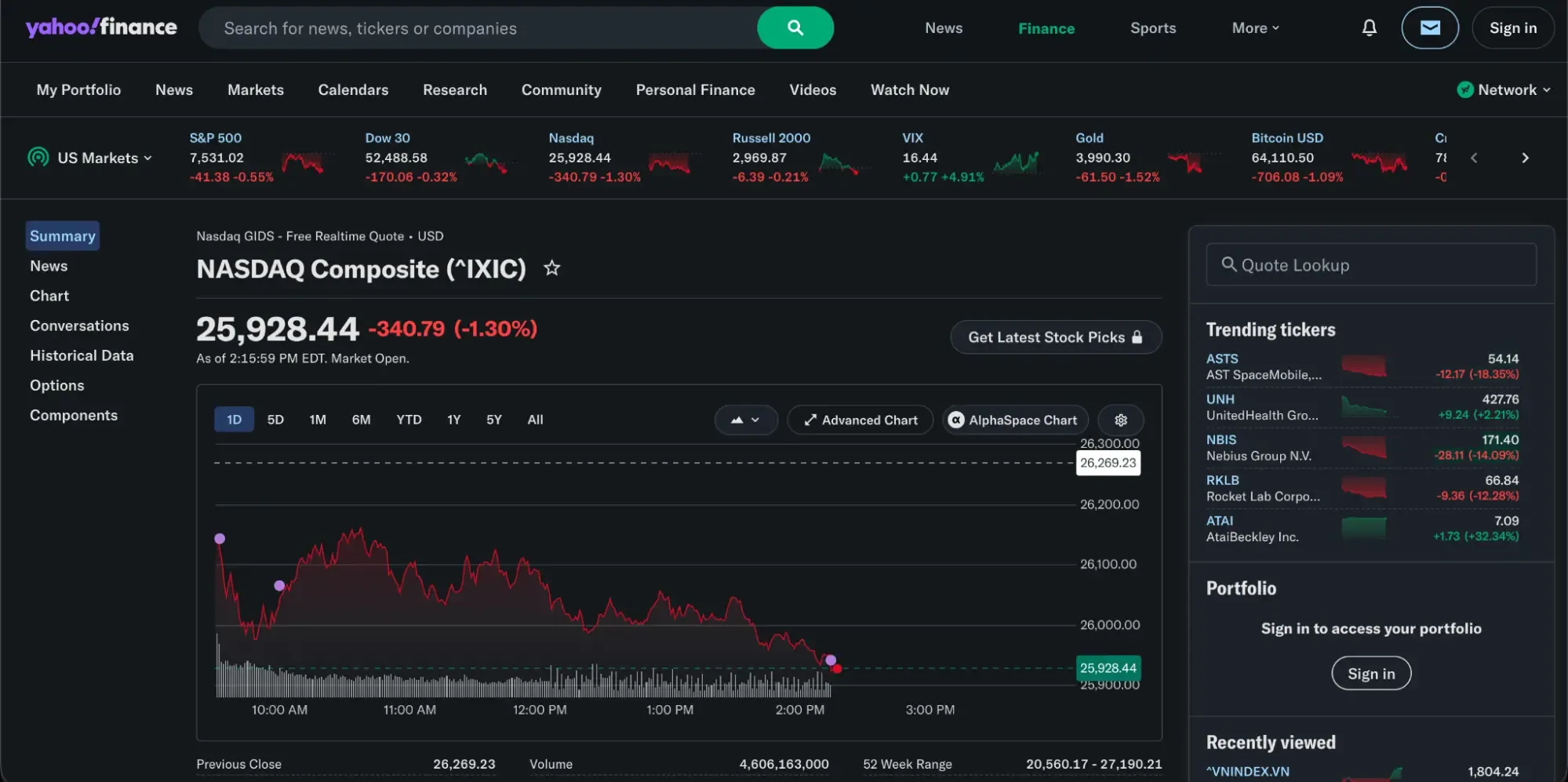
That in-and-out structure within a single day is the definition of what sets a “day” trader apart from someone like a swing trader -- who holds for days to weeks, or long-term investors clutching onto their portfolios for years. Because transactions are measured from buy to sell within a matter of hours, to turn a profit, it demands an incredible amount of attention during market hours for those who’d like to get into this type of trading.
Order Types Every Day Trader Needs to Know
Before opening any account, it helps to understand the order types that actually control how a trade executes. Getting this wrong is a common way beginners lose more to slippage than to bad analysis.
| Order Type | What It Does | When It's Used |
|---|---|---|
| Market Order | Executes immediately at the best available price | Speed matters more than exact price |
| Limit Order | Executes only at a specified price or better | Price control matters more than immediate execution |
| Stop Order | Becomes a market order once a trigger price is hit | Protecting against downside once a level breaks |
| Stop-Limit Order | Becomes a limit order once a trigger price is hit | Protecting downside while still controlling execution price |
| Trailing Stop | A stop order that adjusts automatically as price moves favorably | Locking in gains without manually adjusting the stop |
A market order guarantees execution but not price, which matters in fast-moving conditions where the price can shift between when an order is placed and when it fills.
A limit order guarantees price but not execution, meaning a fast-moving market can leave an order unfilled entirely.
You’ll find professional day traders use a combination of both: limit orders for entries where price matters, and stop or stop-limit orders for exits where discipline counts for more than getting the exact best price.
The Tools Day Traders Actually Use
After getting a brokerage account, the next thing a novice day trader needs is a trading setup. Depending on the amount of fund you have access to, your personal taste, and so on -- the exact setup will be different. But in our experience, there’s a few tools that show up consistently across the vast majority of serious setups:
- A real-time data feed. Delayed quotes are a non-starter for intraday decisions that are measured in seconds. Most brokers include real-time data with a funded account, with some charging extra for Level 2 data that show the full order book rather than just the best bid, best ask, and last traded price that Level 1 data provides.
- Charting software with pattern recognition. Whether built into the broker's platform or a standalone tool like TradingView, the ability to mark support and resistance, apply indicators, and replay historical price action matters more than the specific indicators used.
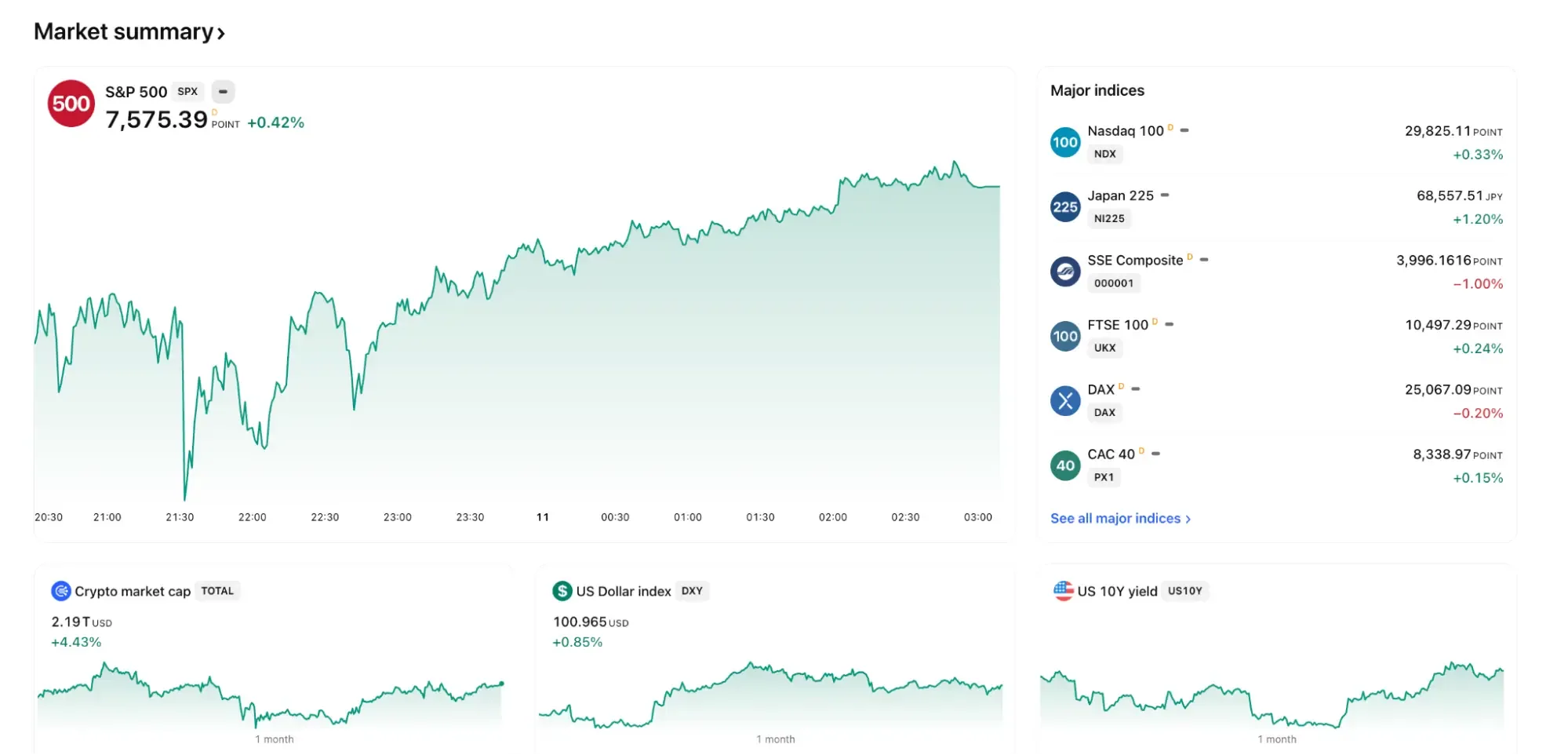
- A fast, reliable order execution path. Slippage between the price you see and the price you get eats into intraday margins faster than most fee schedules do.
- News and headline access. Scheduled announcements (economic data, earnings, rate decisions) and unscheduled headlines both move markets sharply. Traders who build strategies around news events need a fast, reliable feed, since even a few seconds of delay can be the difference between a good trade and a missed one.
- A backtesting environment. Testing a strategy against historical data before risking capital reveals whether the underlying logic holds up, though past performance never guarantees future results.
To be clear, none of these tools is a substitute for a working strategy. Even the best piece of trading software on the market won’t guarantee a win. What they can do, though, is remove friction from executing trades and improve your odds.
Day Trading Strategies at a Glance
Most day traders build around one of a handful of core approaches.
| Strategy | What It Does | Typical Risk | Typical Reward |
|---|---|---|---|
| Scalping | Targets many small profits from brief price changes throughout the day | Medium | Medium (high win rate, small gains per trade) |
| Range/Swing Setups Within the Day | Uses preset support and resistance levels to time entries and exits | Medium | Medium |
| News-Based Trading | Trades the volatility around scheduled announcements or breaking headlines | Medium to High | Medium to High |
| Momentum Trading | Rides short-term trends and reversals for quick gains | High | High |
| Arbitrage | Exploits pricing discrepancies between related instruments or venues | Low | Low to Medium |
Beginners typically do best mastering one of these rather than blending several before any of them are proven.
Start Here: What the 2026 Rule Change Means for New Accounts
Until June 2026, opening a day trading account in the US effectively meant choosing between two paths: keep at least $25,000 in a margin account, or accept a hard limit of three day trades per rolling five-day window. That threshold, tied to FINRA's Pattern Day Trader designation, shaped how nearly every beginner approached account setup for over two decades. Plenty of guides published even in the past few months still cite the old $25,000 figure as current, which is worth double-checking wherever you read it.
FINRA's overhaul of Rule 4210 took effect June 4, 2026, eliminating the $25,000 requirement and the trade-count trigger. In its place is a real-time intraday margin framework, where buying power is calculated based on actual market exposure rather than a fixed dollar floor. Standard margin rules, including the $2,000 minimum equity requirement under Regulation T, still apply. Brokers have until October 2027 to fully implement the new system, so confirm your specific broker's timeline before assuming the old restrictions no longer affect your account.
Practically, this means the account-opening decision that used to dominate this stage (scrape together $25,000, or accept the PDT limit) isn't the forced choice it once was. That doesn't make the rest of the setup process any less important.
Step 1: Decide Your Starting Market and Capital
Different markets carry different practical minimums, and the right answer depends on both your available capital and your risk tolerance.
| Market | Realistic Starting Capital | PDT Rule Applies? | Notes |
|---|---|---|---|
| U.S. Equities (Cash Account) | $500 to $2,000 | No | T+1 settlement limits trade frequency instead. |
| U.S. Equities (Margin Account) | $2,000 minimum (Reg T) | Yes, under the new intraday framework | No longer tied to a $25,000 minimum equity requirement. |
| Forex (Major Pairs) | $500 to $1,000 | No | Micro lots allow precise position sizing on small accounts. |
| Futures | $1,000 to $5,000+ | No | Leverage is higher; volatility demands tighter risk control. |
| Prop Firm Evaluation (e.g. Atlas Funded) | $0 to a few hundred dollars | No, trading firm capital | Account size scales with the evaluation tier, not your personal deposit. |
A note on that first column: these are realistic minimums to start learning with real (if small) stakes, not minimums that guarantee profitability. Position sizing and risk management matter more than the account size itself, particularly in the first year.
Step 2: Choose Your Account Type
The account type decision happens before the broker decision, since it determines which brokers and which day trading rules actually apply to you.
- Cash accounts settle trades under a T+1 cycle, meaning funds from a sale aren't available to reinvest until the next business day. This avoids PDT classification entirely but limits how often you can redeploy the same capital. Beginners trading small amounts often start here specifically to sidestep margin complexity while they build habits.
- Margin accounts allow same-day reinvestment of funds and access to leverage, but require at least $2,000 in equity under Regulation T and are subject to the new intraday margin framework for day trading. Margin also means borrowed money, which magnifies both gains and losses.
- Funded accounts through a prop firm replace personal capital with the firm's capital entirely. You trade under the firm's rules (profit targets, daily loss limits, maximum drawdown) rather than depositing your own funds upfront. This sidesteps the personal capital question altogether, which is covered in more detail further down.

Step 3: Open the Account
Once the market and account type are decided, opening an account with a traditional broker generally follows the same sequence:
- Application and identity verification. Brokers are required to verify identity under KYC (Know Your Customer) regulations, typically requesting a government-issued ID and Social Security number or equivalent tax ID.
- Account type selection. Cash or margin, and whether options trading approval is needed (most brokers use a tiered approval system based on experience and stated objectives).
- Funding. Bank transfer, wire, or check, depending on the broker. Most commission-free brokers have no minimum deposit for a cash account.
- Platform setup. Downloading the desktop platform, configuring watchlists, and testing order types before placing a live trade.
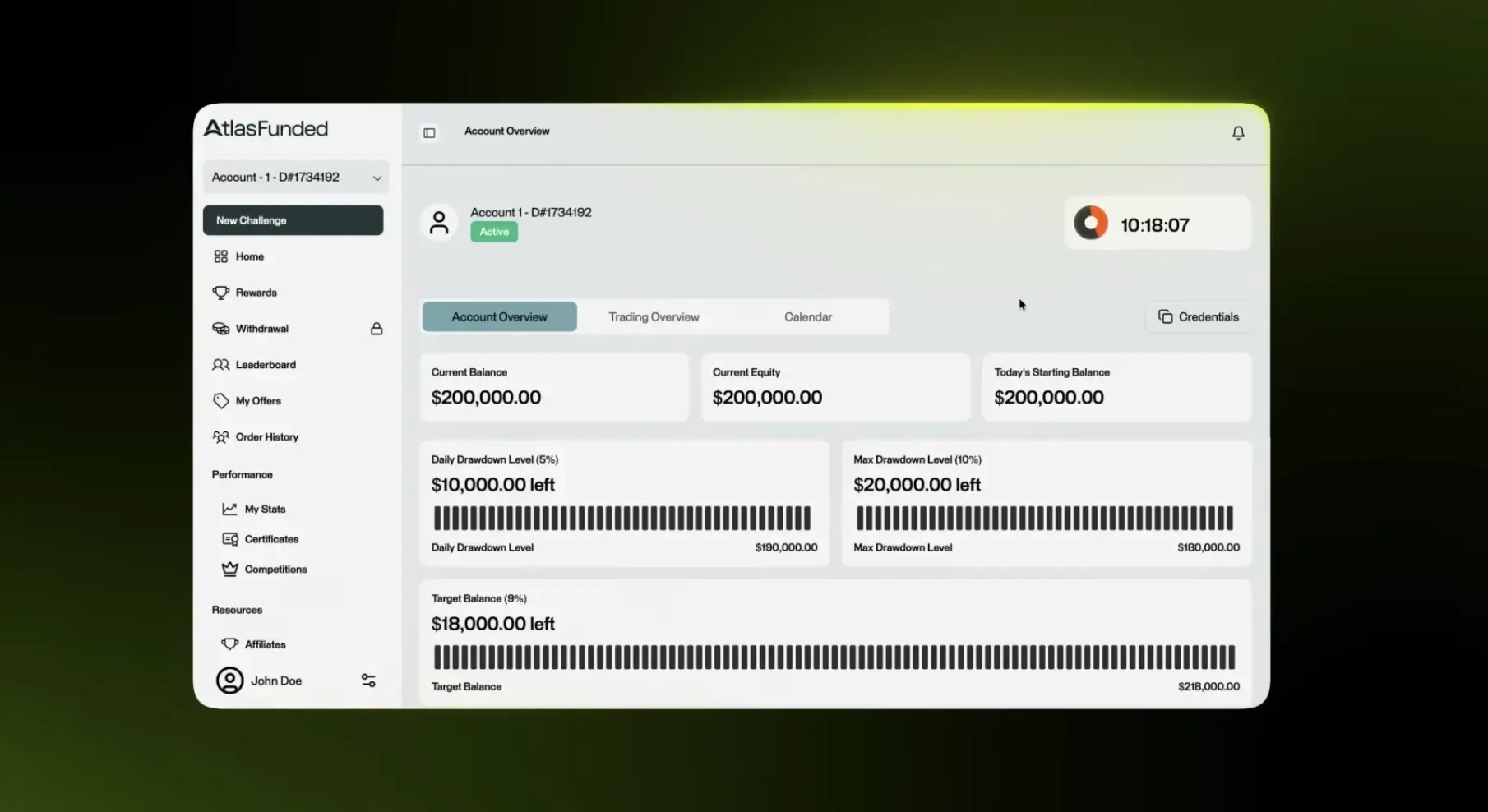
For a prop firm account like Atlas Funded, the sequence will look a bit different. Instead of funding your own account, you either pass an evaluation or opt into instant funding, then trade the firm's capital under a rules-based structure. Check out the How It Works page to get the full details on all the evaluation stages and account options.
Choosing a Broker or Firm: What Actually Matters
Not every broker suits every market or trading style, and the decision matters more than beginners tend to assume upfront.
- Regulatory status: Confirm registration with the SEC and FINRA (or the equivalent regulator if you’re based outside the U.S.) before depositing anything. This is a five-minute check that filters out a huge swathe of bad options.
- Execution quality over headline feels: Zero commissions are standard now, but slippage during volatile opens or fast news events costs more than most fee schedules ever did. A broker with a strong execution track record is worth more than the marginal savings on commission.
- Platform fit for your market: A platform built for options analytics won't serve a futures scalper well, and vice versa. Match the tool to the asset class, not the other way around.
- Paper trading quality: Simulators that use live, unthrottled data are far more useful than ones running on delayed feeds. During your practice phase (we’ll talk more about this later,) this is more important than almost any other single feature that a simulator can give you.
- Support and education, if you're early in the process: Slow support responses or thin documentation cost real time and money once a technical issue interrupts a live session.
Step 4: Practice Before Going Live
This step deserves more space than most beginners give it. You’ll need anywhere from three to six months of consistent practice in a simulator before you’re ready for the real thing -- logging every trade, analyzing every movement, and scrutinizing every facet of your strategy to make sure that it’s sound -- before committing real capital. Skipping this step is the single most common reason new accounts get funded and drained within the first few weeks.
Step 5: Decide Between Personal Capital and Funded Capital
This is the point where most guides stop, treating account opening as the finish line. It's actually a fork.
- Personal capital means the gains are entirely yours, with no profit split, but the account is also capped by whatever you're able and willing to deposit. Scaling requires either external savings or reinvested profits, which takes time.
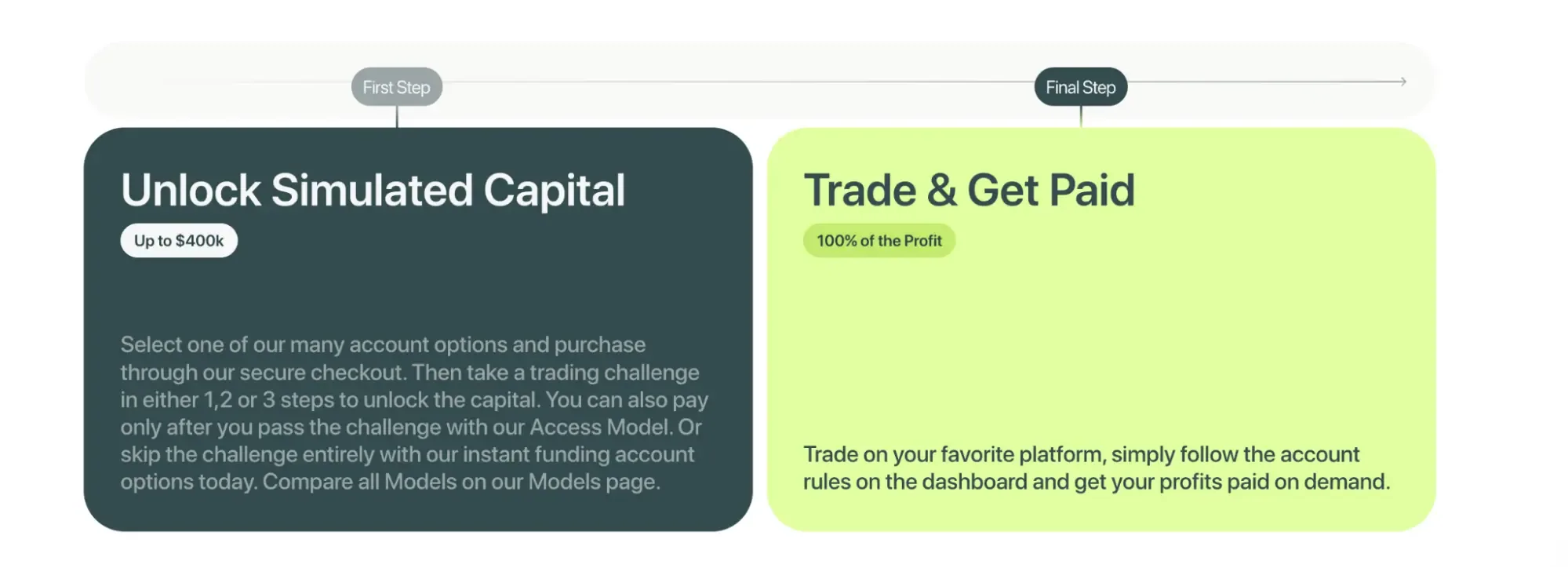
- Funded capital through a prop firm removes the deposit ceiling but introduces a profit split and rules-based structure. Atlas Funded offers several entry points depending on how much friction you want before funding:
| Entry Path | Upfront Cost | How It Works |
|---|---|---|
| Pay-After-You-Pass | $0 | Evaluate for free; pay only once the profit target is met. |
| $1 Access | $1 | Low-cost entry into a standard evaluation. |
| Standard Evaluation | Varies by size | 1-step, 2-step, or 3-step challenge structures. |
| Instant Funding | Higher upfront, no evaluation | Skip the challenge phase entirely. |
Account sizes run from $5K to $400K, with profit splits starting at 80% and scaling up to 100% on upgraded plans. Payouts are available weekly or on-demand, with a guaranteed $1,000 compensation if a payout is delayed past 24 hours.
Neither path is objectively correct or “better”. A trader with big personal savings and no urgency may prefer keeping 100% of a smaller account's gains. But if you believe you have a working strategy but are lacking in capital to turn it into a cash cow, the evaluation-to-funding path is definitely faster than years of compounding a small account.
How Day Trading Profits Actually Get Taxed
Day trading profits are taxed -- and it’s this part that very few guides will talk to you about in the beginning. There’s no shortage of novice day traders who are blindsided by this when they get into the game.
- Default treatment: short-term capital gains: Unless you take the extra step of electing mark-to-market accounting (explained below), day trading profits get taxed the same way any short-term gain does, since these positions are almost never held longer than a year (in day trading, rarely longer than a day). Short-term gains are taxed at ordinary federal income tax rates, anywhere from 10% to 37% depending on total taxable income in 2026. Higher earners ($200,000 single, $250,000 married filing jointly) may owe an extra 3.8% Net Investment Income Tax on top.
- The wash sale rule. Sell a security at a loss, then buy something "substantially identical" within 30 days on either side, and IRC Section 1091 disallows that loss for tax purposes. It doesn't vanish. Instead, it gets tacked onto the cost basis of the replacement position, so the deduction is delayed rather than lost. For anyone moving in and out of the same ticker repeatedly, wash sales stack up fast and turn recordkeeping into a real headache.
- Trader Tax Status (TTS). The IRS defaults everyone to "investor" status, even people trading daily. Qualifying as an actual trader in securities requires activity that's “substantial, regular, continuous” -- and clearly aimed at short-term profit, typically several hundred trades a year, done close to full time. There's no application to file. The IRS just looks at the pattern and decides if you’re a fit or not.
- The Section 475(f) mark-to-market election: Once you qualify for TTS, you can elect mark-to-market accounting, which treats every open position as sold at fair value on December 31, converts everything to ordinary income treatment, and wipes out both the wash sale rule and the usual $3,000 loss cap. There’s one catch: it's generally permanent without the IRS's blessing, and it gives up long-term capital gains treatment on anything that would've qualified. The deadline is the unextended due date of the prior year's return (for 2026, that meant filing by April 15, 2026).
- Futures and broad-based index options: These get their own rules under IRC Section 1256: a flat 60/40 split no matter how briefly you held the position, 60% taxed at the long-term rate and 40% at the short-term rate. Often a real tax advantage over straight equity day trading.
With that said, use the information above for reference only. For consequential and difficult-to-reverse procedures like a mark-to-market election, you’ll want to enlist the help of a licensed tax professional. As a matter of fact, if you have any doubt or question about the process at all, it’s best to give them a call. Knowing precisely what to expect when it comes to the tax treatment can inform you if your strategy is even worth pursuing or not in the first place.
What the Numbers Actually Say
Before committing real capital, it's worth sitting with the peer-reviewed research rather than the version of day trading that circulates on social media. And yes -- we’ll tell you right now: day trading is neither easy nor is it a “get-rich-quick” scheme like you see online.
The most cited academic work on this question comes from Brad Barber, Yi-Tsung Lee, Yu-Jane Liu, and Terrance Odean, who analyzed the complete trading records of the Taiwan Stock Exchange, the most heavily day-traded equity market in the world at the time of the study. Their 2004 paper found that more than 80% of day traders lost money in a typical six-month period before transaction costs were even factored in, and that only about 19% of even the most active day traders earned net profits over any given six-month window.
A follow-up study by the same research group, published in 2020 in the Review of Asset Pricing Studies and covering Taiwan Stock Exchange data from 1992 to 2006, found that day traders lost an average of 23.9 basis points per day net of fees, that consistently profitable day traders made up roughly 5% of all active day traders across the sample period, and that survival rates were 44% after one year, 24% after two years, and just 15% after three years.
Similar patterns show up outside Taiwan. A study tracking traders who began day trading Brazilian equity futures between 2013 and 2015 found that among those who persisted for more than 300 trading days, 97% were losing money, and fewer than 1% earned more than Brazil's minimum wage from their trading activity. Earlier US-focused research by Jordan and Diltz (2003) found that day traders who lost money outnumbered those who made money by roughly two to one.
The key takeaway from these studies isn’t that every day strategy is doomed to failure. Rather, day trading, by nature, is a difficult and risky venture: transaction costs compound quickly against small intraday gains, decision-making under time pressure invites errors that don't show up in backtests, and individual traders compete directly against institutional desks and algorithmic systems operating at a speed no person can match.
None of that means profitable day trading is impossible. In all those research, it’s discovered that there’s also a small, persistent group of traders who does generate real, fee-adjusted profits, and that this group's performance tends to be predictable from one period to the next -- implying that there’s a measure of skill to those who succeed rather than day trading being entirely luck-based. But the base rate is low, and if you’re starting out, it’s worth calibrating your expectations and position size accordingly rather than assuming that you’ll land in that group by default.
Day Trading vs. Swing Trading vs. Long-Term Investing
Getting into day trading also means understanding what you're choosing against. All three -- swing, day trading, and investing -- can be profitable. It’s just that they demand different amounts of time, capital, and tolerance for volatility.
| Feature | Day Trading | Swing Trading | Long-Term Investing |
|---|---|---|---|
| Typical Holding Period | Minutes to hours (closed the same day) | Days to weeks | Months to years or longer |
| Time Commitment | High; requires monitoring during market hours | Moderate; checked daily or a few times a day | Low; periodic review |
| Primary Analysis Style | Technical, order flow, news reaction | Technical with some fundamental context | Fundamental analysis, valuation |
| Tax Treatment | Short-term capital gains (ordinary rates) unless TTS/MTM elected | Short-term capital gains in most cases | Long-term capital gains after a one-year holding period |
| PDT-Style Regulation | Applies to margin accounts trading frequently | Generally exempt if trade count stays low | Not applicable |
| Where Research Shows Most Retail Participants Land | Documented net losses for the large majority | Mixed, depends heavily on strategy and discipline | Passive index strategies broadly outperform actively managed and short-term approaches after fees, per longstanding academic literature |
Common Mistakes When Getting Started
Now that we’ve gone through all the how-tos and understand the risks, if you’re still willing to go ahead and get into the game, there’s a couple of common mistakes that we often see novice traders make -- make sure you’re not one of them:
- Opening a margin account before understanding what margin even means: High leverage magnifies losses just as easily as gains, and a forced liquidation from a margin call can wipe out an account faster than a string of bad trades on a cash account would.
- Skipping identity verification steps and rushing funding: Underfunding an account relative to the market you're trading (for example, opening a $500 futures account) creates outsized risk relative to account size before a single trade is placed.
- Choosing a market based on hype rather than fit: Crypto's 24/7 volatility attracts beginners chasing fast movement, but that same volatility makes it harder to distinguish skill from luck during the early learning phase.
- Treating the funded account decision as permanent: Starting with a personal account doesn't rule out a funded account later, and vice versa. Many traders run both simultaneously once they have a proven strategy.
- Ignoring the base rate: Believing you'll land in the profitable minority by default, without a tested strategy and a practice period behind you, is the single biggest gap between expectation and outcome for new traders.
- Overlooking tax treatment until filing season: Wash sales, the mark-to-market election deadline, and quarterly estimated tax payments all have hard cutoffs. Discovering them after the fact, rather than before the first live trade, is an avoidable (and often expensive, headache-inducing mistake).
Final Verdict
Getting into day trading is a lot more than clicking “sign up” and opening an account. You’ve to know what the activity actually requires and entails on a day to day basis. Then, you also need to make important decisions like choosing a market to trade in, the capital level that match your risk tolerance, signing for the right account type, dealing with taxes on the profits, and deciding whose capital you're trading with once you're ready to go live.
Granted, the rules around getting started have become much friendlier to new traders than ever, but that’s just one obstacle removed from a very long list. If you’re confident you have a proven strategy but don’t have a lot of personal capital to kickstart a career in day trading, Atlas Funded offers a path to trading up to $400K in simulated funding without years of saving toward an account minimum. Get funded and start trading real size today.
Ready to take the next step? Explore AtlasFunded's prop trading programs today and put your trading skills to work with the capital to match.
Explore funding programs
 Senior Writer at Atlas Funded



 Your move
 Only pay the full fee after you pass
 UK
UK ES
ES DE
DE FR
FR IN
IN IT
IT