


The only way to become a profitable day trader is to develop a solid strategy. Without that, you risk losing your entire capital.
This post explores the most successful day trading strategies every beginner or expert should know. Read on to learn what works for other traders and how to formulate a working strategy of your own.
Before we get into specific techniques, you need to understand their foundation.
Day Trading Strategy Basics: What to Know
You can skip this section and move on to the next one if you already know the following vital aspects:
- Trading volume: a measure of how much an asset has been exchanged between buyers and sellers during a specific period. It’s a key indicator of money flow.
- Liquidity: the ease with which you can buy or sell an asset quickly without causing a significant change in its price. High liquidity ensures you can enter/exit at your desired price.
- Volatility: the speed and magnitude of an asset's price fluctuations. High volatility is what makes day trading both profitable and risky.
- Candlestick charts and patterns: technical analysis tools that visually represent price movements.
- Technical analysis: a method used to analyze statistical trends from trading activity and identify entry/exit opportunities.
- Stop-loss order: a risk management tool used to automatically close a position when an asset’s price hits a specific, disadvantageous level.
- Drawdown: the total decline (in percentage or USD) in a trading account's capital over a specific period. It’s especially useful in prop trading.
- News catalyst: an event, announcement, or information that triggers sharp price movements.
- Market trend: the overall direction of an asset's price over a specific timeframe. It could be an uptrend, downtrend, or sideways trend.
- Reversal: a change in the direction of an asset's price trend. The change from an uptrend to a downtrend is a bearish reversal, and the opposite is a bullish reversal.
15 Best Day Trading Strategies
These are the top techniques used by successful day traders around the world.
1. Scalping
Scalping is the most common strategy among day trading beginners. It involves buying assets and selling them on the same day, with the aim of making small but consistent profits.
As a scalper, your aim is to profit from the little price movements that happen within minutes or even seconds. You may “scalp” the same asset multiple times in a day.
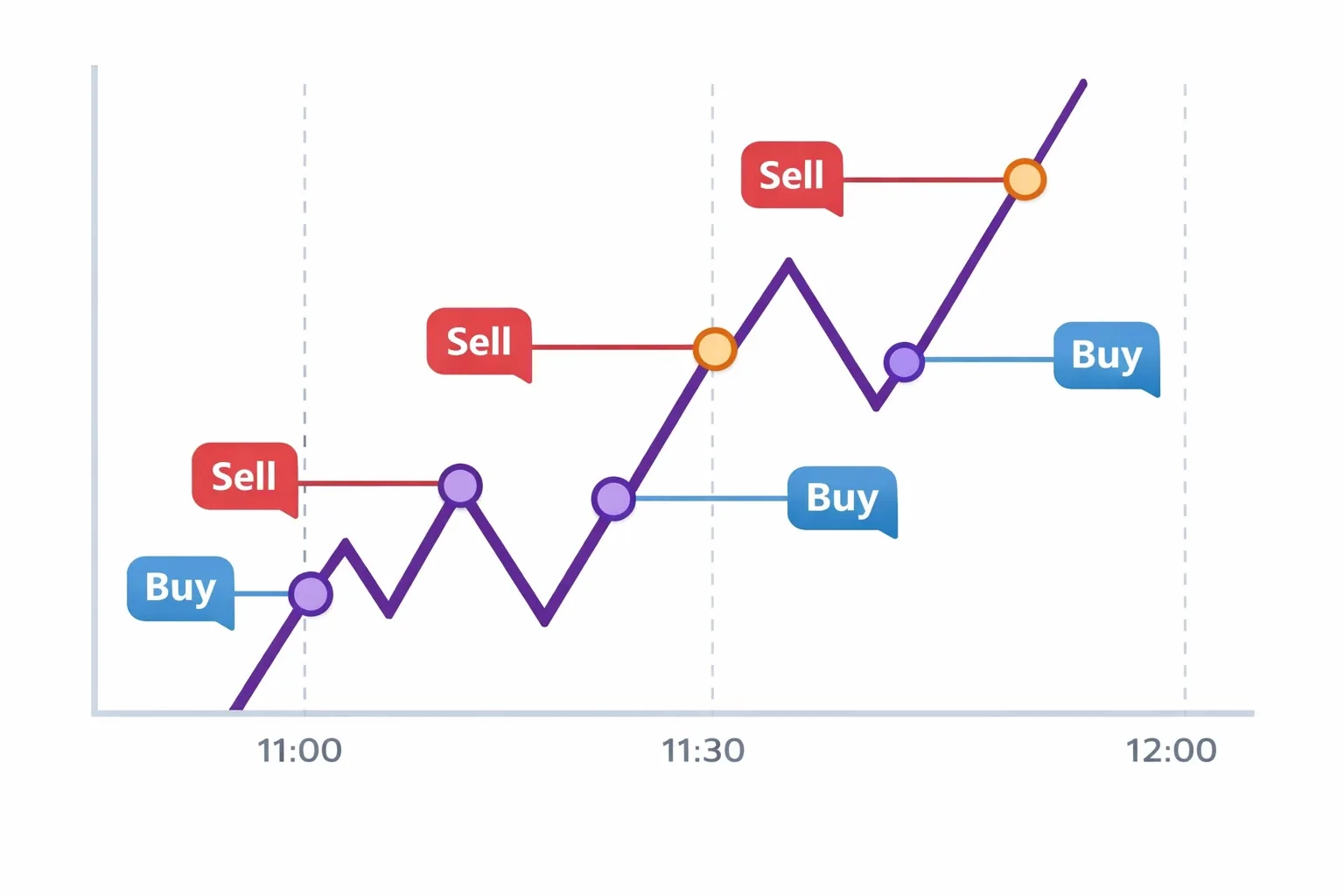
Take profit as soon as you can, no matter how small the earnings. All that matters is that your small wins accumulate into larger account growth.
Scalping is extremely short-term. You want to close your positions before the end of the trading day to avoid overnight funding fees that could eat into your profits.
2. Momentum Trading
In momentum trading, traders make decisions based on the strength of the price trends. Assets experiencing a strong trend will probably continue to increase or decrease in value, depending on the trend direction. However, when the trend becomes weak, a reversal isn’t far off.
Your job is to use momentum indicators, such as Relative Strength Index (RSI), Average Directional Index (ADX), and Moving Average Convergence Divergence (MACD), to identify trend direction and strength.
News releases are the major drivers of momentum in day trading. Expert traders ride trends but maintain the discipline to exit when momentum slows, allowing them to take sizable profits.
3. Trend Trading
This method involves buying or selling in the direction of the market. You go long during a period of sustained upward movement and short when there’s a downtrend. Your goal is to take profit by banking on the continuation of the current price movements.
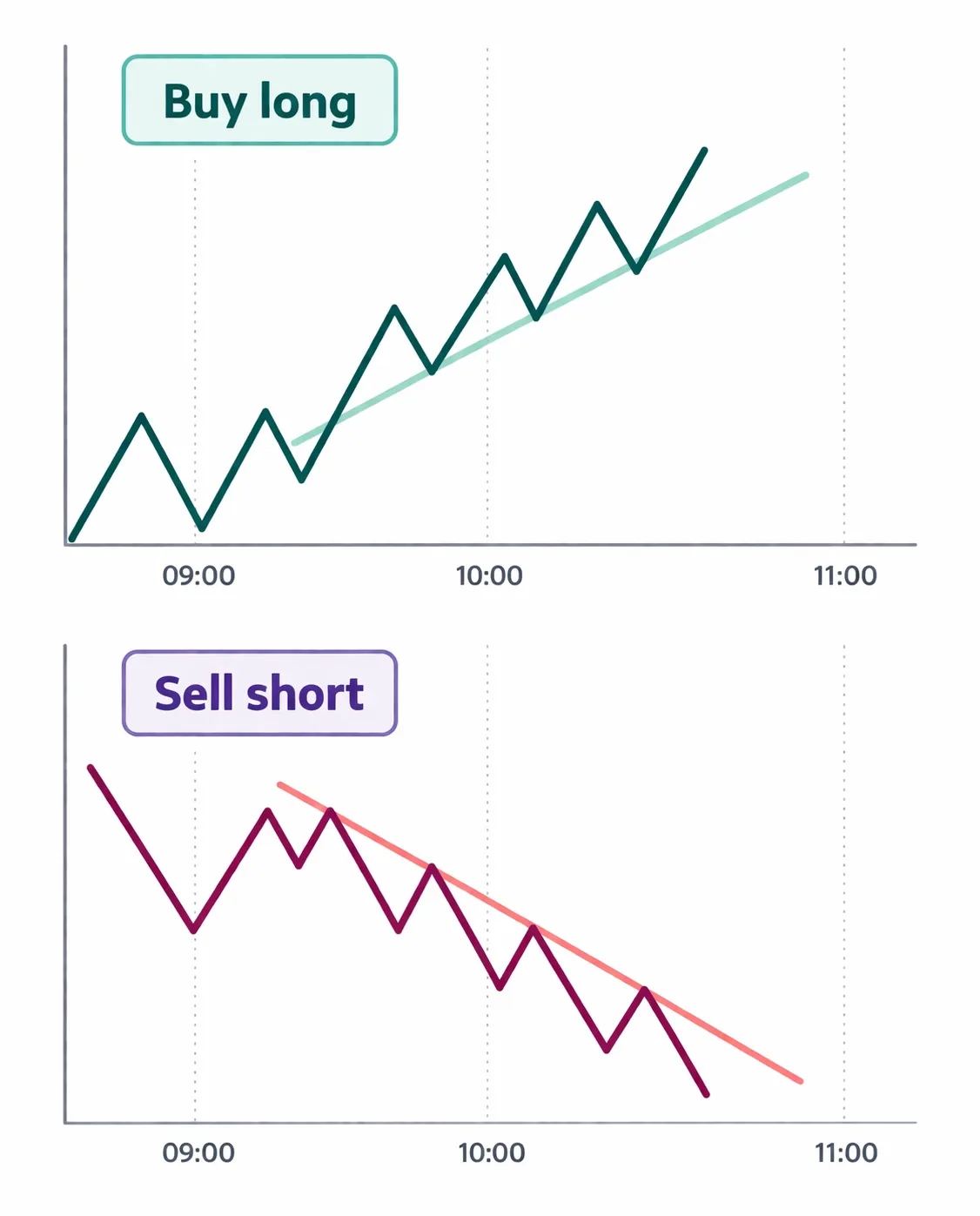
An uptrend is characterized by higher peaks and higher troughs, while a downtrend consists of lower peaks and lower troughs.
4. Mean Reversion Trading
This is a technical strategy that relies on a financial theory known as mean reversion. According to the theory, asset prices and volatility will eventually return to their historical average or mean.
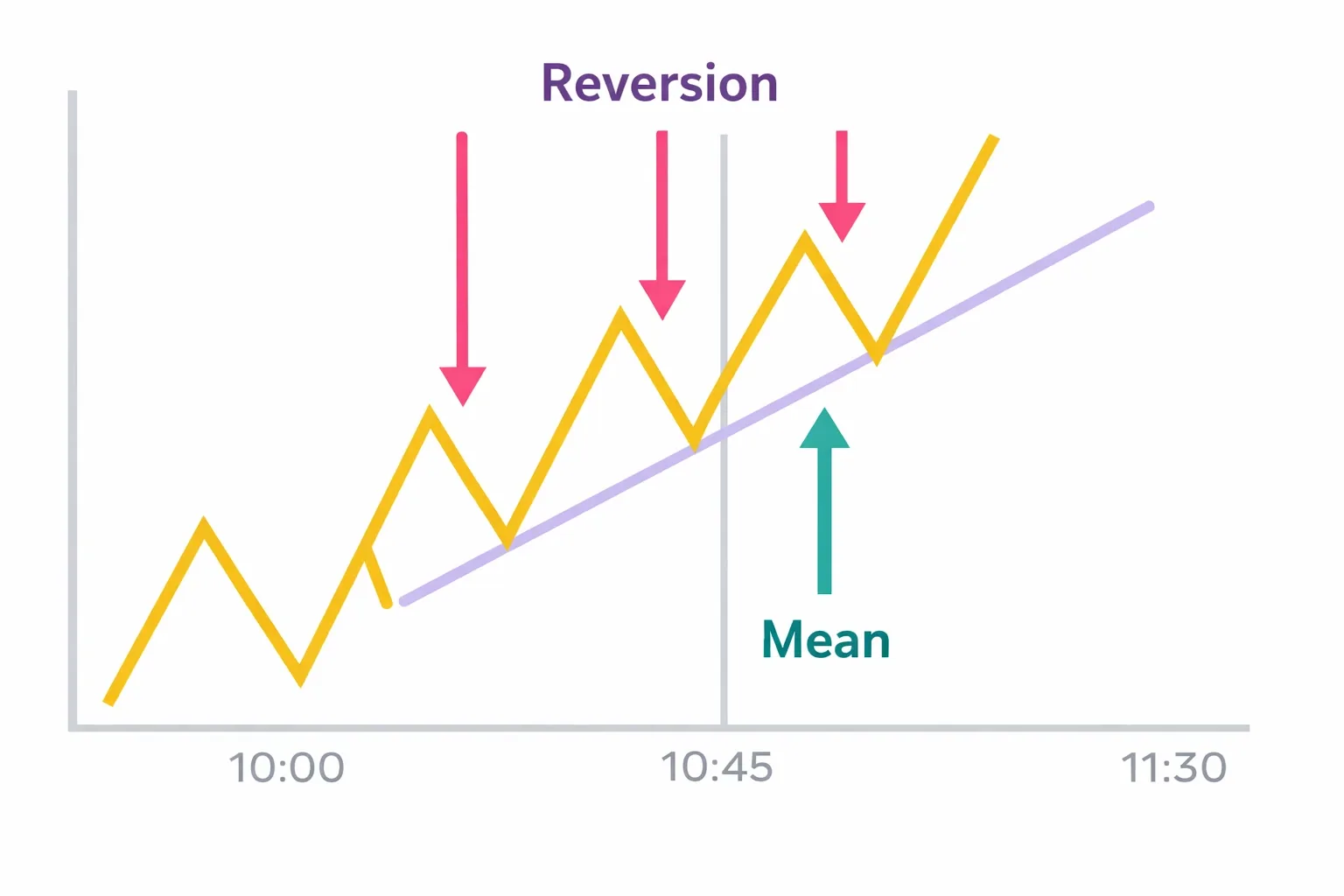
A trader may buy an asset if they find that its price has fallen too far from its mean or sell an asset if they discover that it has risen too far from its mean. The hope is that they will gain profits when the asset returns to its historical average price (reversion).
Mean reversion trading uses technical indicators like moving averages or RSI to identify assets with extreme price movements.
5. Reversal Trading
Also known as contrarian or counter-trend trading, this technique focuses on entering the market at the point when a trend is about to change in the opposite direction. That means the uptrend is turning into a downtrend, and vice versa.
For reversal trading to be successful, you must use technical analysis and your understanding of market behavior to identify oversold or overbought assets.
6. News Trading
Following news events is one of the best ways to choose assets in day trading, especially when it comes to picking the right stocks or cryptocurrencies. In news trading, you monitor multiple sources for notable events, announcements, earning reports, and other relevant information.
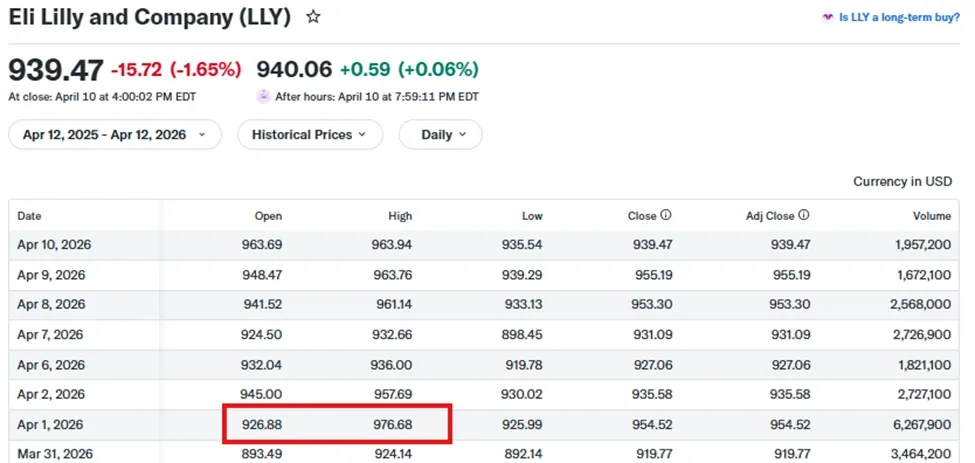
When a significant event occurs, you need to predict how the news will affect asset prices. For example, Eli Lilly and Co. (LLY) stocks rose by nearly 6% in a short period after an announcement that its weight-loss pill, Foundayo, received FDA-approval. From the image below, a smart day trader could have made $49.80 per share as profit using news trading.
7. Price Action Trading
This strategy is based almost solely on price chart patterns from the past. It works on the theoretical principle that prices move in patterns that tend to repeat themselves.
A price action is an asset's price movements over time. It forms a clear pattern when you visualize it on a chart. With price action, you can determine rises, falls, trends, and more.
The most effective way to use price action trading is to incorporate it with other strategies. Also, you don’t have to rely on technical indicators with this type of trading.
8. Breakout Trading
Breakout trading requires you to predefine support and resistance levels for an asset and enter a trade when the price “breaks” any of those levels.
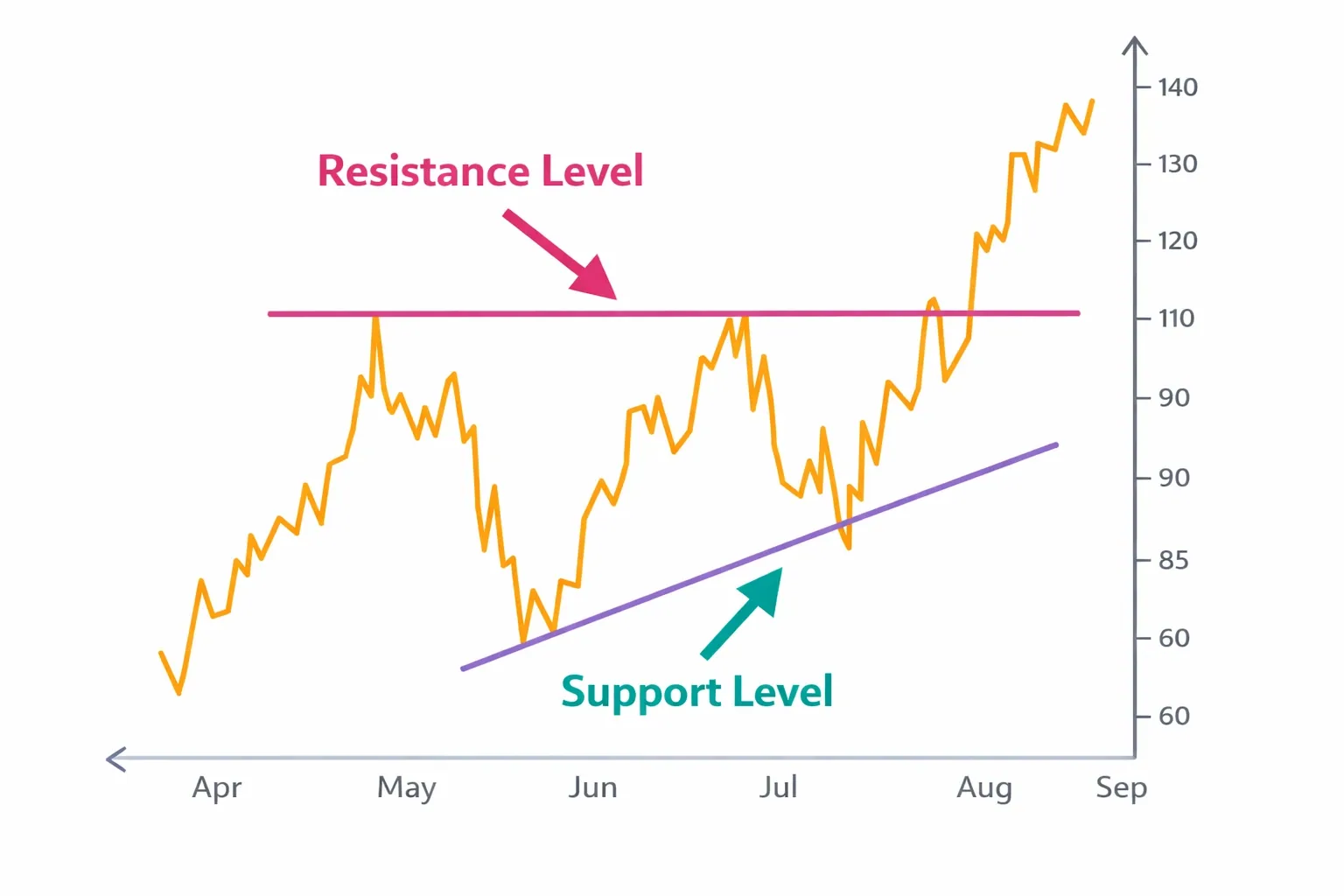
When the price falls below the support level, you can expect a continuous price decline. But when it rises above the resistance level, it will probably continue to increase.
For example, if a stock trades between $50 and $80 for weeks, a breakout trader may buy when it rises above $80 (resistance level) or sell when it drops below $50 (support level), expecting the move to continue.
That’s a simple example, but breakout trading can be a little more complicated. The best practice is to wait until you see additional signs that confirm the breakouts, such as a change in trading volume or bearish (or bullish) candlesticks.
9. Pullback Trading
If you observe a trend on a candlestick chart, you will notice that prices don’t move continuously in a specific direction. They are almost always temporary instances when the price pauses or fluctuates before continuing its trend. Those short-term pauses or fluctuations are called pullbacks.
In pullback trading, you have to use indicators to confirm the strength of the trend. If you’re confident enough, you may open a position in the middle of a pullback and take profit after the trend resumes.
The major risk here is mistaking the start of a long-term reversal for the beginning of a short-term pullback. To the untrained eye, they look similar. However, with proper knowledge of candlestick patterns, it’s possible to tell the difference.
10. Daily Pivot Point Trading
This method involves attempting to profit off the difference between the day's high and low price points. With it, a trader can buy the day’s low and sell at its high.
To implement this strategy, you need to establish support and resistant levels using pivot points and some simple calculations. A daily pivot point is the average of the previous day’s high, low, and closing prices. Mathematically,
Pivot Point = (Highest Price + Lowest Price + Closing Price) / 3
By establishing breakout levels with pivot points, you can target the next reversal and exit before it happens, thereby maximizing your daily profit.
11. Money Flows Trading
This method uses the Money Flow Index (MFI), an indicator that measures the intensity of money flowing into or out of an asset by combining price and trading volume.
MFI can tell you whether an asset is oversold or overbought by comparing the current day’s data to previous days. Mathematically,

Money Flow Ratio is the sum of positive money flow (past 14 periods) divided by the sum of negative money flow. On a daily chart the lookback period is the past 14 days.
An MFI above 80 suggests a potential price decline and one below 20 suggests a potential price increase.
12. Fading
Fading is a risky but highly rewarding stock trading strategy. It involves shorting stocks that have undergone a surge in price based on the assumption that long-term holders are ready to sell and potential buyers are hesitant.
This contrarian investment strategy trades against the current trend while expecting the price to return to its recent average. It requires precise timing of entry and exit points. Most faders wait patiently and exit traders at the sign of a reversal.
13. High-Frequency Trading
High-Frequency Trading (HFT) is the use of algorithms and advanced computer programs to execute a large number of orders quickly. It’s one of the best stock day trading strategies and allows you to execute thousands of trades in seconds.
This algorithmic trading method analyzes markets and identifies trends and opportunities according to preset conditions. The program executes the trades on your behalf and attempts to make a small amount of profit with each trade.
HFT is often used by investment institutions, including major banks. An example is Citadel Securities, a company that made $1.7 billion in one quarter using HFT.
14. Range Trading
In range trading, your goal is to identify assets moving within a range. For that to happen, their prices must follow a clear trend of bouncing between support and resistance levels.
Once you’ve identified a range, you may open a position close to one level and exit when the price is close to the opposite level.
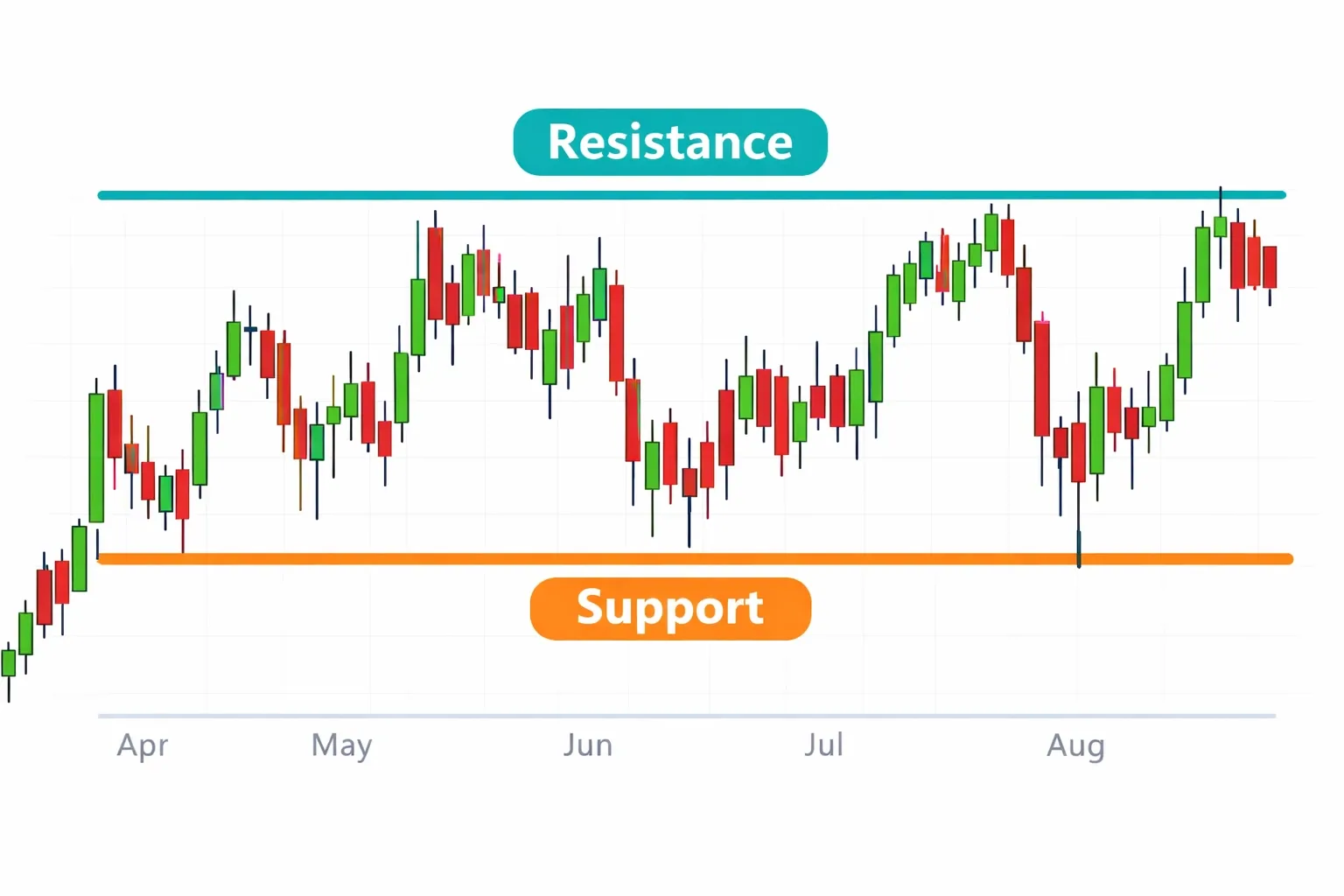
For example, a trader can open a long position when the price is close to the support level (bottom of the range), hold their position while the price rises back up, and exit close to the resistance level (top of the range). The same strategy can work in the opposite direction.
Risk management is important so:
- Set a stop-loss slightly below the support level or above the resistance level, depending on your starting point. This will limit losses if there is no reversal.
- Wait for the price to reverse a little in your predicted direction before buying or short-selling.
- Use indicators like the RSI or stochastic oscillator to identify reversals more accurately.
15. Gap Trading
When markets close for the day, they don’t always open at the same price level on the following trading day. This phenomenon is caused by news, economic data releases, or geopolitical events that occur when the markets are closed overnight or during the weekend.
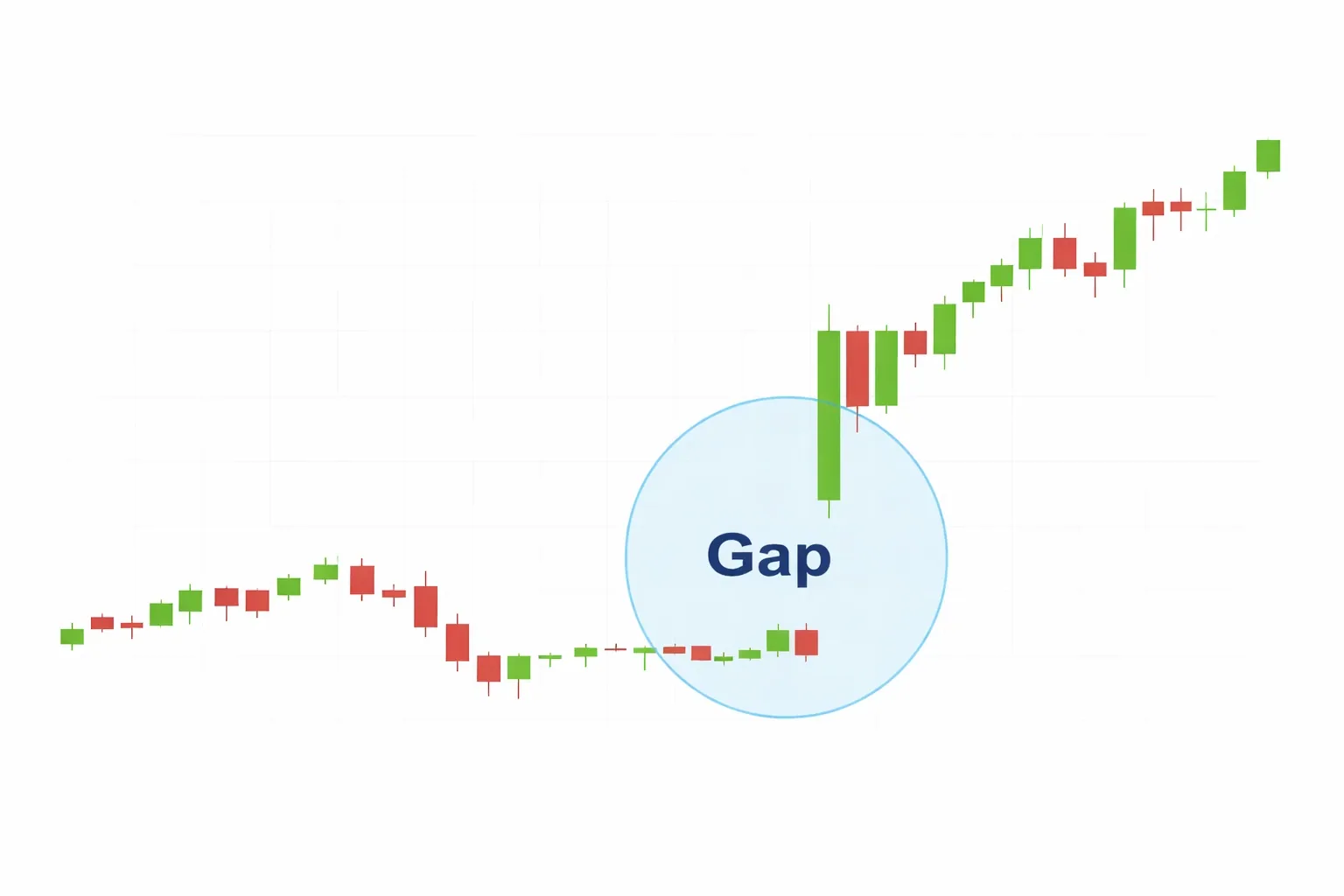
There are four main types of gaps:
- Breakaway gap: signals the start of a new trend and suggests strong momentum.
- Exhaustion gap: signals a final attempt to hit new highs or lows before a price reversal.
- Common gap: occurs randomly and is often "filled" quickly, meaning the price returns to the pre-gap level.
- Runaway gap: signals a surge of interest and confirms the current direction of a trend.
How to Build a Day Trading Strategy That Works
Use this quick guide to put together a strategy for day trading that suits your style and goals.
1. Choose a Trading Product
The global markets offer several asset classes. For day trading, your options include forex, stocks, cryptocurrency, indices, contracts for difference (CFDs), bonds, futures, and options.
Derivatives like CFDs are popular in day trading because they don’t require you to own the asset, making executions smoother and faster.
We recommend that you pick an asset class that you understand. For example, if you regularly follow company or industry performance, stocks may be the ideal option for you.
2. Create a Day Trading Plan
Your day trading plan should include the following information:
- Goals or objectives
- Profit target
- Risk tolerance
- Entry and exit criteria
- Stop-loss levels
- Position sizing
- Daily and overall (capital) loss limits
Your entry and exit criteria will heavily depend on what type of analysis you use. Fundamental analysis relies heavily on news events and market sentiment, but technical analysis uses indicators and chart patterns.
When trading with capital from a prop firm instead of personal funds, you may have to use the company’s risk management conditions on loss limits, position sizing, and profit targets.
3. Select Strategies that Align with Your Plan
If you’re a beginner, choose one strategy that matches your entry and exit criteria, and master it. Experienced traders can use several strategies to execute their trading plans. We’ve already provided you with a list of the best day trading strategies in 2026.
4. Monitor Performance
Record every aspect of your execution, including ideas, mistakes, successes, and failures. That way, you know exactly what changes to make when it’s time to improve a strategy. Monitoring should also tell you when it’s time to discard one strategy and try another.
Conclusion
Day trading is tough, but with the right strategy, you can turn it into a profitable venture. Although we provided 15 different techniques, you should master one strategy before learning a new one.
You’ll probably make mistakes at the start of your career, so try to take risk management seriously. If you can’t afford to use your own money, let Atlas Funded take most of the risk on your behalf. We offer up to $400,000 in capital for day traders.
All you have to do is pass a challenge and make trades using your funded account. You’ll be able to keep as much as 100% of your profits.
Ready to take the next step? Explore AtlasFunded's prop trading programs today and put your trading skills to work with the capital to match.

 Senior Writer at Atlas Funded


 Your move
 Only pay the full fee after you pass
 UK
UK ES
ES DE
DE FR
FR IN
IN IT
IT