



You hit the profit target. You met the minimum trading days. You followed every drawdown rule the firm published.
Then the firm tells you 45% of your profit came from one day, so the payout is on hold until you trade enough additional days to bring that number down.
That's a consistency rule. It won't breach your account. It sits between you and your money until your profit is spread thin enough across trading days to satisfy a formula you probably didn't see until after you'd already paid for the evaluation.
For traders whose edge shows up on breakouts, news releases, or multi-day swing setups, the rule doesn't just delay a payout. It penalises the exact trading that made the account profitable in the first place.
Not every firm runs one. A growing list of prop firms let you pass, hit the target, and withdraw without checking how your profit was distributed across the days it took to get there. Below is where that's actually true, where it's only half true, and where "no consistency rule" is doing more marketing work than the fine print supports.
What Is a Consistency Rule?
A consistency rule limits how much of your total profit can come from a single trading day. Most firms that use one set the cap somewhere between 15% and 50%, with 30% the most common figure in futures and a wider spread across forex firms.
Here's how it plays out in practice: Say you're on a $100,000 funded account from The5ers.
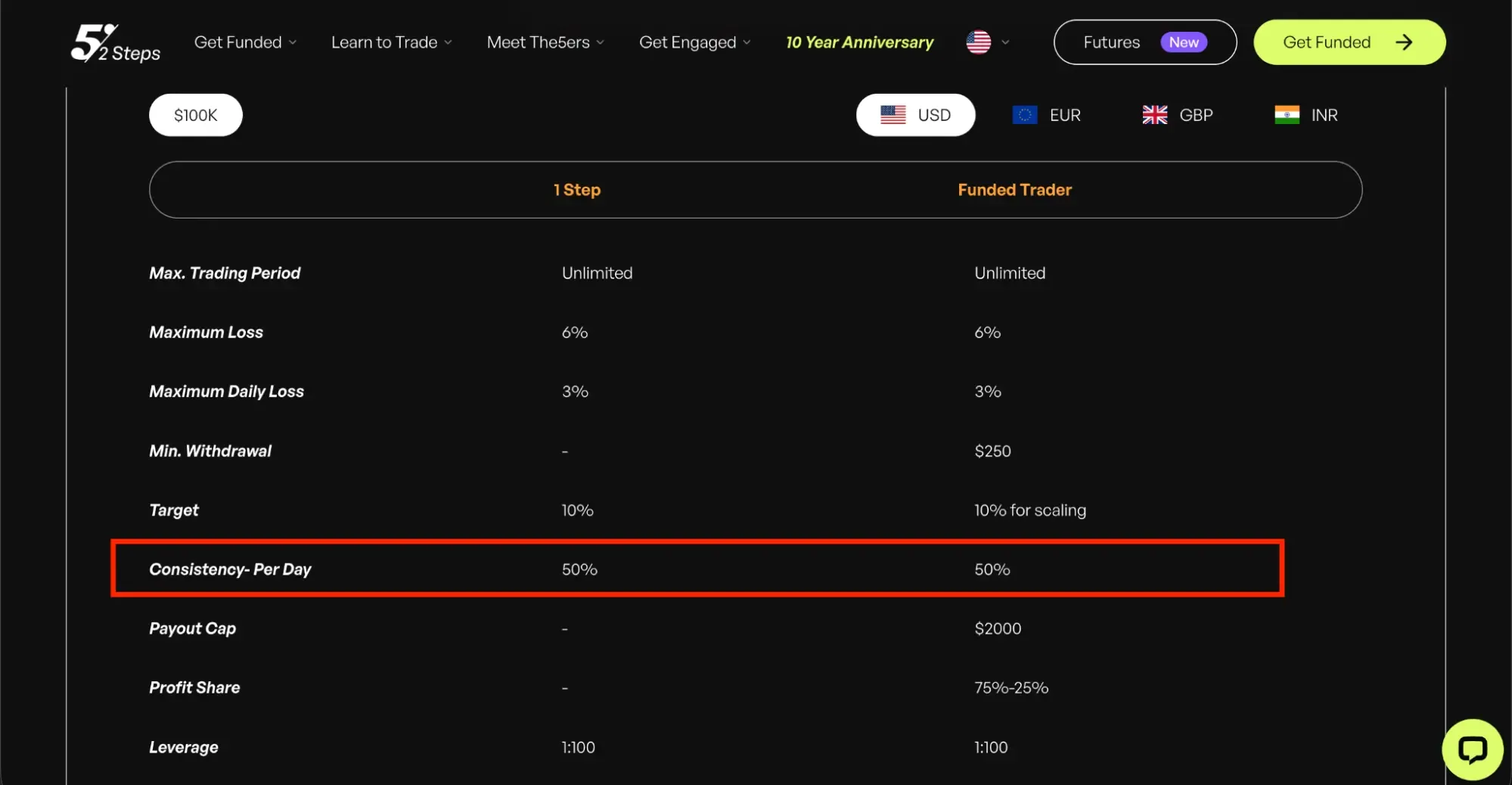
Over a payout period you earn $5,000 in total profit. But $3,000 of that came from one day, a clean breakout on gold during a Non-Farm Payrolls release. If the firm runs a 50% consistency rule, your best day can't exceed $2,500 of that total. You're $500 over, and the payout is held until additional trading days dilute the percentage.
Firms adopt the rule because they'd rather fund traders who produce steady, repeatable returns than traders who land one outsized win and try to cash out before the variance reverts. That's a defensible position from the firm's side. It's a much harder one to defend from the trader's side, because real trading doesn't produce evenly spaced profit curves. Some setups only show up a few times a month. A rule built to filter out lucky one-off trades ends up filtering out skilled traders whose edge is genuinely episodic.
How to Calculate It
The formula is the same at nearly every firm that runs one:
Consistency % = (Best Day Profit ÷ Total Profit) × 100
If your best day made $800 and your total profit across the payout period is $1,650, your best day is 48.5% of the total. Against a 30% cap, you're breached. To bring that $800 day back under 30%, your total profit needs to reach at least $2,667, which means trading more days at smaller size until the ratio clears.
A quick reference for what a given best day requires at different caps:
| Best Day Profit | Total Profit Needed at 15% Cap | At 25% | At 30% | At 50% |
|---|---|---|---|---|
| $500 | $3,333 | $2,000 | $1,667 | $1,000 |
| $1,000 | $6,667 | $4,000 | $3,333 | $2,000 |
| $2,000 | $13,333 | $8,000 | $6,667 | $4,000 |
| $5,000 | $33,333 | $20,000 | $16,667 | $10,000 |
A breach doesn't usually close the account. It holds the payout. The catch is that "keep trading until the ratio clears" is not a neutral instruction. Every additional trade you place to dilute a percentage is a trade you wouldn't otherwise have taken, and it carries the same drawdown risk as any other trade. A rule designed to encourage discipline can end up forcing the opposite of it.
Why It Matters
The traders most affected by a consistency rule are the ones whose strategies naturally produce uneven profit distributions.
News and breakout traders build their edge around a small number of high-conviction setups. A consistency rule forces a choice: skip the setup that would exceed the cap, or keep trading afterward purely to bring the percentage down.
Swing traders run into the same wall from a different angle. Take four trades in a payout period, and if one of them captures a multi-day move worth 60% of the total profit, the rule blocks a payout on a gain that was earned cleanly.
The trading required to "even out" the distribution isn't free. Every trade taken after the target has already been hit is another chance to give back gains, or to breach a drawdown limit you'd otherwise never have approached. The rule doesn't only delay the payout. It changes what trades get taken.
Firms without the rule remove that decision entirely. You trade the setup, hit the target, and the payout processes without anyone checking how the profit was spread across the days it took to get there.
Consistency Rule vs. No Consistency Rule
| With a Consistency Rule | Without One |
|---|---|
| Best day capped at 15–50% of total profit | No cap on how much any single day contributes |
| Payout held until distribution evens out | Payout available once target and minimum days are met |
| Extra trading required after the target, raising breach risk | Trading stops when the plan says stop |
| Penalises breakout and news strategies specifically | All profit-generating patterns treated the same |
| Pressure to "fill" trading days with lower-quality setups | No pressure to trade purely to dilute a ratio |
| Can delay payouts by days or weeks | Payouts follow the firm's normal schedule |
Evaluation vs. Funded: Where the Rule Actually Lives
This is the distinction that determines whether "no consistency rule" means anything to you.
Some firms drop the rule during evaluation to make passing easier, then reintroduce it once you're funded, exactly the stage where it affects real payouts. Others run it the opposite way: a consistency requirement during the evaluation to filter applicants, removed entirely once the account is funded. A smaller number remove it at both stages.
The evaluation rules are almost always the ones published prominently on the marketing page. The funded rules tend to sit in a separate document you typically don't see until after you've paid. When a comparison article, including this one, says a firm has "no consistency rule," the only way to know what that actually buys you is to check which stage it applies to. We've marked that explicitly in the tables below rather than leaving it as a single yes or no.
Rules That Work Like a Consistency Rule Without the Name
A firm can advertise "no consistency rule" and still gate your payout on how your profit was distributed. It just calls the mechanism something else.
Active-day requirements
Blueberry Funded's funded accounts require each trading day to close with at least 0.5% profit for that day to count toward payout eligibility. That isn't a percentage cap on your best day, so technically it isn't a consistency rule. But hold a swing trade open for five days and close it on day five, and it counts as one active day, not five.
If your payout eligibility depends on active-day counts, a concentrated multi-day trade is penalised in almost the same way a consistency rule would penalise it.
Winning-day streaks
Some payout policies require a set number of profitable days in a row before a withdrawal unlocks, separate from any profit-distribution math. The effect on a trader whose edge produces occasional large days and several flat ones is similar to a consistency rule: you're rewarded for frequency over magnitude.
Per-payout caps
A cap on how much can be withdrawn in a single payout request, regardless of how much profit sits in the account, pushes the same trader toward more, smaller withdrawal cycles rather than fewer, larger ones. It doesn't touch your best day directly, but it shapes your trading calendar the same way a consistency rule would.
Buffer and minimum-day requirements
A buffer above your starting balance, or a minimum number of trading days before the first payout, doesn't cap a single day's contribution. It does, however, force a spread of activity across the calendar that a trader who prefers to concentrate risk into fewer, higher-conviction sessions will find just as restrictive.
None of this means these firms are being deceptive. Read literally, "no consistency rule" is often accurate. It just isn't the complete answer to the question a trader is actually asking, which is closer to "will my payout be held up because I made most of my profit on one day." Check the full funded rules document, not just the consistency clause, before deciding a firm fits your trading style.
Best Prop Firms With No Consistency Rule in 2026
Forex and CFD firms
The5ers

Runs no consistency rule at any stage across its evaluation and funded programs. Profit split starts around 50% and scales toward 100% with account growth, and scaling potential reaches into the millions. If a rule-free structure across both the evaluation and the funded stage matters more to you than any other single factor, The5ers is one of the few firms that can say that without a stage caveat attached.
FTMO
The 2-Step evaluation carries no consistency rule at either stage. FTMO's 1-Step program is different, it applies a 50% best-day rule during both the evaluation and once funded, so the program you choose changes the answer. FTMO is one of the longest-running names in the space, with scaling up to $2M and a well-documented rulebook, though it's worth checking current eligibility for your country before applying, since acceptance criteria have shifted over time.

Alpine Funded
No consistency rule on either Base Camp (instant funding) or Peak (2-step evaluation).
Peak's profit targets are 8% in Phase 1 and 5% in Phase 2, with a 4% daily drawdown, 8% max drawdown, and a 5-day minimum across both phases. Profit split reaches up to 90%, leverage runs to 1:100, and scaling extends to $2M. The trading platform is cTrader only.
Trustpilot feedback on Alpine is quite mixed: strong support at one end, a notable cluster of complaints about rule interpretation and payout disputes at the other. That split is worth reading in full before committing, and it's the kind of thing worth testing with a smaller account first.

Blueberry Funded
No consistency rule across all seven of its challenge types (Prime 2-Step, Classic 2-Step, 1-Step, Rapid, Stocks, Synthetics, and two Instant models).
Profit targets range from 7–10% depending on the model, daily drawdown sits at 4–5%, and profit split goes up to 90%. Fees start from $25. The catch is the active-day requirement covered above: funded accounts need each trading day to close with at least 0.5% profit to count toward payout eligibility, which functions like a soft consistency check even though it isn't labelled one.
BrightFunded
No consistency rule on evaluation or funded accounts, paired with an uncapped scaling plan. The evaluation is a single 2-Step challenge (8% Phase 1, 6% Phase 2, 4% daily drawdown, 8% max drawdown, no time limit). Profit split starts at 80% and climbs through the Trade2Earn program, which awards tokens for every trade placed, including losing ones, redeemable for higher splits and account upgrades.

AquaFunded
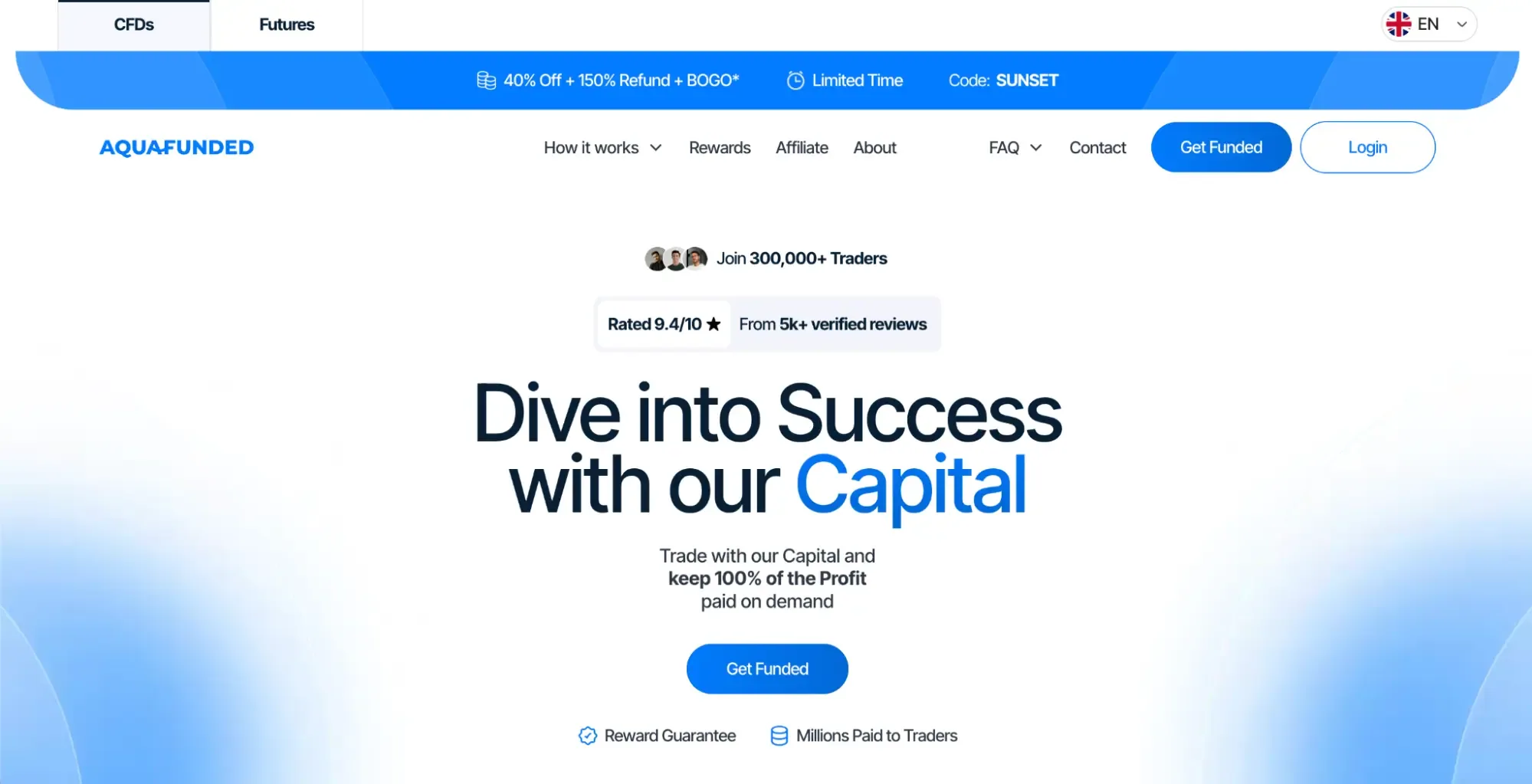
No consistency rule, paired with a 100% profit split by default across all funded models, at entry prices starting from $42. The 2-Phase evaluation runs a 10% Phase 1 target and 5% Phase 2, with 5% daily loss and 10% max drawdown throughout.
Some independent review platforms have flagged inconsistent enforcement on post-funding rules, so the 100% split is worth verifying against recent Trustpilot activity rather than taking at face value.
Velotrade
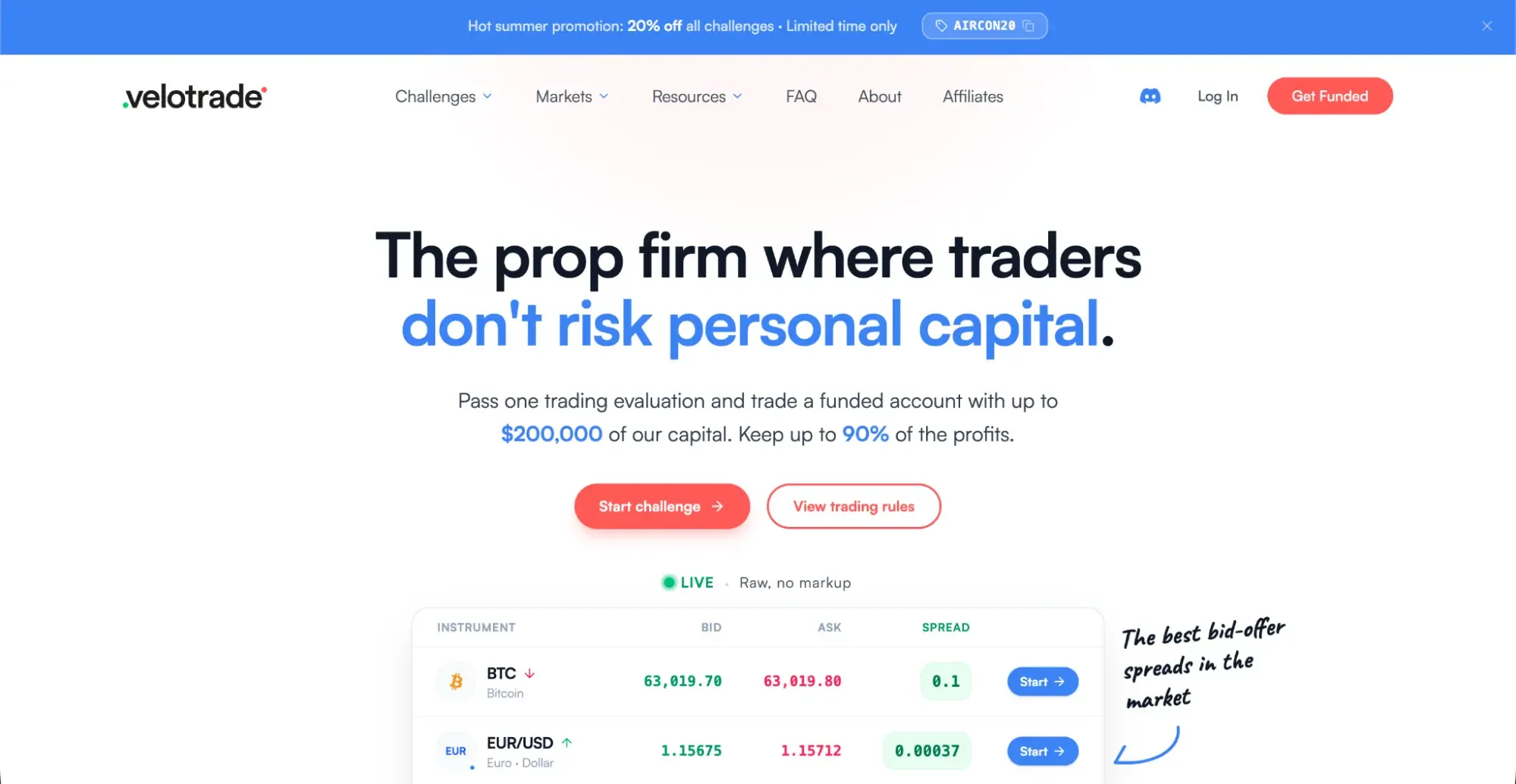
Crypto only, with no consistency rule and no trailing drawdown, using a fixed, balance-based drawdown model instead. The 2-Step challenge runs 8% and 5% profit targets with a 5% daily loss limit and 10% max drawdown. Meanwhile, the 1-Step requires 10% profit with a 4% daily loss and 7% max drawdown.
Because crypto trades continuously, news trading and weekend holding are both permitted without the exceptions other firms build in for markets that close.
Futures firms
Retail futures prop trading is dominated by consistency rules more than the forex side, so the firms that remove it are worth naming specifically rather than folding into a single list.
Tradeify
No consistency rule once funded. During the Select evaluation, a 40% cap applies (no single day can represent more than 40% of total profit) – that requirement disappears entirely on the funded account.
Tradeify's separate instant-funding path, Lightning Funded, works differently: accounts purchased after September 12, 2025 use a progressive consistency schedule that starts at 20% for the first payout, rises to 25% for the second, and settles at 30% for later payouts. If Lightning Funded is the product under consideration, that schedule, not the Select evaluation's 40%, is the relevant number.

Take Profit Trader
No consistency rule and no payout caps on funded accounts, with daily payout eligibility from day one once the account's buffer requirement clears.
Combined with fast withdrawal processing, it's one of the more flexible payout structures on the futures side, though the PRO and PRO+ paths carry different mechanics and should be checked against TPT's current withdrawal rules before assuming a specific timeline applies to your account type.

Firms That Still Enforce One
Naming the firms that keep a consistency rule is as useful as naming the ones that don't, if only because it shows how wide the range actually is.
| Firm | Where It Applies | Reported Figure |
|---|---|---|
| Atlas Funded (Access) | Evaluation and funded | 40%, among the most permissive caps of any firm reviewed here |
| Apex Trader Funding | Evaluation and funded | Loosened from 30% to 50% in early 2026; still technically in force |
| FundingPips (2-Step Pro / Standard) | Funded | Around 35% on standard funded payouts |
| FundingPips Zero | Funded, every payout | 15%, the tightest cap among firms reviewed here |
| Bulenox | Funded | Reported around 40% |
| Alpha Futures (Standard Plans) | Varies by plan | Waived on some funded plans, retained on others |
| Top One Futures | Funded | Reported in the 15–25% range depending on account |
Atlas Funded's Access model is worth a specific mention here. At 40%, its cap is tighter than Apex's 50% but looser than FundingPips' 15% and 35% tiers, and roughly in line with Bulenox. It isn't absent, so it doesn't belong in the recommended list above, but for traders who found this article searching for some room rather than zero rule, it's worth knowing about.
FundingPips is a useful case study in why the stage caveat matters. It's sometimes described as having "removed" its consistency rule, and that's accurate for exactly one of its five products, One Step Flex, which carries neither a consistency requirement nor a minimum trading-day count.
The Zero account runs a 15% rule checked at every payout, and the standard 2-Step and On Demand products run something closer to 35%. Treat any single-line claim about FundingPips' consistency rule as incomplete until you know which of the five products it's describing.
Which Firm Fits You?
| If You... | Best Pick | Why |
|---|---|---|
| Want zero consistency rule at every stage, forex | The5ers or FTMO 2-Step | No rule on evaluation or funded. |
| Want a 2-Step FTMO program without the rule | FTMO 2-Step | Avoid FTMO's 1-Step, which carries a 50% rule at both stages. |
| Want instant funding with no evaluation and no consistency rule | Alpine Funded (Base Camp) | Trading starts the day you pay, with no payout gate. |
| Want the widest range of challenge formats | Blueberry Funded | Seven formats, none with a hard consistency cap, but check the 0.5% active-day rule. |
| Want uncapped scaling | BrightFunded | No ceiling on account growth; rewards every trade through Trade2Earn. |
| Trade crypto exclusively | Velotrade | No consistency rule, no trailing drawdown, fixed balance-based model. |
| Want a 100% split with no payout gates | AquaFunded | Full split from day one; verify recent payout reviews first. |
| Trade futures and want the rule gone once funded | Tradeify or Take Profit Trader | Both remove it at the funded stage; Tradeify still applies 40% during evaluation. |
| Land big wins on news or breakout days | The5ers or BrightFunded | No rule penalising a concentrated best day. |
| Take few trades per payout cycle | Velotrade or The5ers | Low minimum days plus no consistency rule means no filler trades required. |
| Want some room, not zero, at low upfront cost | Atlas Funded (Access) | 40% cap, wider than most firms in the "still enforce one" table above, from a $5 entry. |
FAQs
A limit on how much of your total profit can come from a single trading day, typically 15–50% depending on the firm. It doesn't breach your account, but it holds your payout until additional trading days bring the percentage down.
To filter out traders who hit a profit target through one outsized trade rather than a repeatable process. The tradeoff is that the same filter catches skilled traders whose results are naturally uneven – news traders, breakout traders, and swing traders in particular.
It varies by firm, and sometimes by product within the same firm. Tradeify applies 40% during evaluation and removes it on funded accounts. FTMO's 1-Step applies 50% at both stages, while its 2-Step applies none. Always check the funded rules document specifically, since that's usually a separate publication from the evaluation terms.
At most firms, no. The benchmark carries forward until a new high is set, which means a strong day early in your funded account can keep affecting your consistency math for months afterward. Confirm this directly with any firm before assuming it resets.
Not directly. It holds the payout rather than closing the account. The indirect risk is real, though: the extra trading required to dilute a concentrated day increases exposure to whatever drawdown limit the account carries, and every trade taken purely to fix a ratio is a trade that wasn't part of the original plan.
Apex loosened its rule from 30% to 50% in early 2026, a meaningful change but not a full removal. FundingPips removed the requirement entirely on its One Step Flex product while keeping it on its other four. Rule changes happen often enough in this market that any specific claim is worth checking against the firm's current published rules rather than a comparison article, including this one.
Divide your best single day's profit by your total profit across the payout period, then compare that percentage to the firm's stated cap. A best day of $2,000 against $6,000 in total profit is 33%, which clears a 40% cap but fails a 30% one. The table in the calculation section above gives a quick reference for common cap levels.
Conclusion
Consistency rules exist to filter out traders who pass on one lucky day. For anyone whose edge shows up as a few large days rather than twenty identical ones, this rule turns skilled trading into a waiting game – the money's earned, but the payout depends on how evenly it was spread across the calendar.
The firms above close that gap, in full or in part depending on the stage and the product. Which one fits depends on what you trade, how concentrated your best days tend to be, and whether the firm's funded-stage rules match what its marketing page implies. If your best days regularly carry the bulk of your profit, look for a firm that pays out on that result instead of holding it up for review.
Ready to take the next step? Explore AtlasFunded's prop trading programs today and put your trading skills to work with the capital to match.
Explore funding programs
 Senior Writer at Atlas Funded




 Your move
 Only pay the full fee after you pass
 UK
UK ES
ES DE
DE FR
FR IN
IN IT
IT