


You spot a clean setup on the daily chart. Everything lines up. You enter the trade, set your stop, and plan to hold for a week. Then your prop firm forces you to close before the weekend.
Most prop firms are built for day traders. Forced Friday closures, news trading restrictions, and equity-based drawdowns that punish open trade pullbacks. None of that works if your strategy depends on holding positions for days or weeks, aka swing trading.
Don’t worry, though cause swing trading prop firms are there to provide you the solution for this problem. But more importantly, picking the right swing trading prop firm matters.
That’s why we compared eight firms that actually support swing traders, and broke down their holding policies, drawdown rules, and evaluation structures so you can find the one that fits how you trade.
Quick Comparison Table: 8 Best Prop Firms for Swing Traders
| Feature | Atlas Funded | PipFarm | FTMO (Swing) | The 5%ers | Goat Funded Trader | City Traders Imperium | Lux Trading Firm | MarketMates |
|---|---|---|---|---|---|---|---|---|
| Best For | Overall swing trading | Gamified progression | Established track record | Long-term scaling | Budget-friendly entry | VIP perks and education | Real capital and career building | Broker-backed swing challenges |
| Overnight Holding | Yes | Yes | Yes (Swing account) | Yes | Yes | Yes | Yes | Yes |
| Weekend Holding | Yes (no new positions Sat/Sun) | Yes | Yes (Swing account) | Yes | Yes | Yes | Yes | Yes |
| News Trading | Yes (funded: 5-min profit deduction) | Yes, no restrictions | Yes (Swing account) | Yes | Yes (2-min profit clawback) | Yes | Yes | Yes |
| Drawdown Type | Balance-based, static | Static or trailing (choice) | Equity-based | Equity-based (midnight reset) | Static | Balance-based | Static (balance-based) | Balance-based, no trailing |
| Max Drawdown | 8% | 6% static / 12% trailing | 10% | 5–10% (varies by program) | 6% (1-Step) / 10% (2-Step) | 5% | 6% ($1M account) | 6% |
| Leverage | Up to 1:100 | Up to 1:30 | 1:30 | 1:30 | 1:50 (Forex) | Varies by program | Varies | Up to 1:1000 (Forex) |
| Evaluation Time Limit | None | None | None | None | None | None | None | None |
| Min Trading Days | 0–5 | 3 | 4 per phase | Varies | 3 | 3 profitable days | None | 5 |
| Profit Split | 80–100% | 70–95% | 80–90% | 50–100% | 80–100% | 80–100% | 80% | 70–90% |
| Account Sizes | Up to $200K | Up to $200K | $10K–$200K | $5K–$250K+ | Up to $400K | Various (from $5K+) | $100K–$1M | From $10K |
| Scaling Potential | Up to $2M | Up to $1.5M | Up to $2M | Up to $4M | Up to $800K | VIP tiers | Up to $10M | Up to $3M buying power |
| Platforms | MT5, TradeLocker, Match Trader | cTrader | MT4, MT5, cTrader, DXtrade | MT5, cTrader | MT5, cTrader, DXtrade, Match Trader | MT5, Match-Trader | Any (via copy to MatchTrader) | MT5, MatchTrader |
| Fee Refund | Yes, at payout milestones | Verify on site | Yes, with first payout | Yes (varies) | Yes, on passing | Yes (after 1st payout) | Yes (100% on passing) | No activation fee |
What Is Swing Trading (and Why Does Your Prop Firm Choice Matter)?
Swing trading means holding positions for days or weeks to capture medium-term price moves. Instead of opening and closing trades within the same session like a day trader, you are waiting for a setup to develop across multiple days, sometimes riding a trend for two or three weeks before taking profit.
In practice, that means fewer trades, wider stop losses, larger profit targets, and regular exposure to overnight sessions and weekends. You might enter a trade on Tuesday and not close it until the following Thursday. You might hold through a Friday close and into Monday's open because the setup has not played out yet.
This is where most prop firms become a problem. The rules at a typical firm are written for someone who goes flat every evening.
Swing traders run into forced weekend closures that kill valid setups, equity-based drawdowns that count unrealized pullbacks against you even when the trade is still on track, evaluation deadlines that pressure you into taking entries before they are ready, and news trading restrictions that block you from holding through the very events that drive multi-day moves.
So when you are researching swing trading prop firms, five things matter more than anything else.
- Overnight and weekend holding without forced closures
- Balance-based drawdown that only counts closed losses, not floating pullbacks
- No time limit on the evaluation, so you can wait for quality setups
- Freedom to hold through news events
- And enough leverage to size your positions properly, even if swing traders generally use less than day traders do
8 Best Swing Trading Prop Firms
The eight firms below check most or all of the boxes mentioned above. Where they differ is in their evaluation structures, profit splits, platforms, and costs.
1. Atlas Funded (Best Overall for Swing Traders)
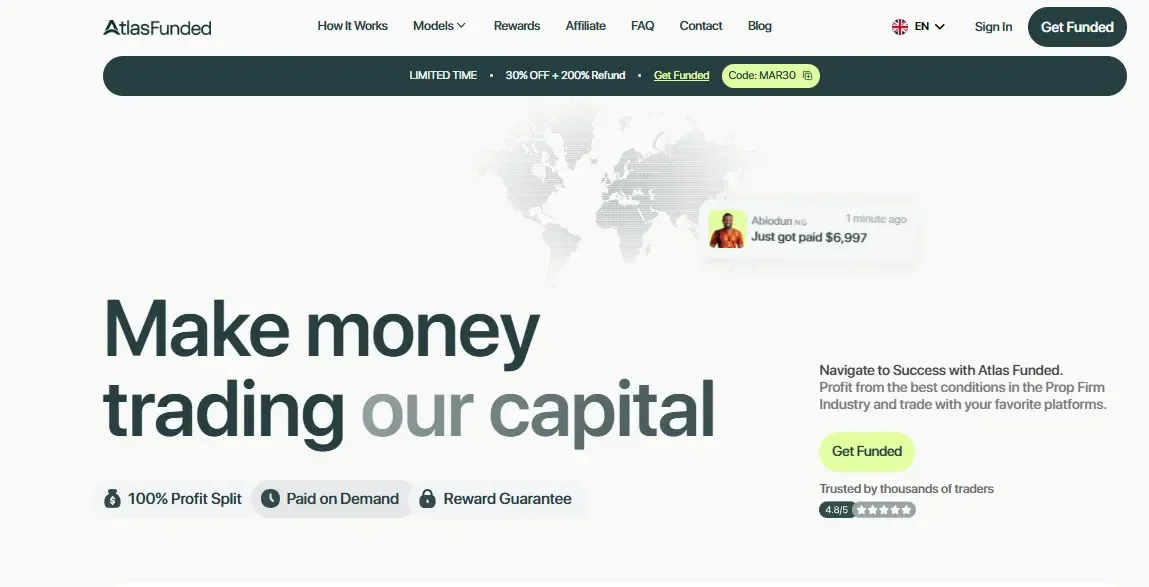
Atlas Funded is built around flexibility, which is exactly what makes it the best prop firm for swing traders. You can hold positions overnight and over weekends across both the evaluation and funded stages. The only restriction is that new trades cannot be opened on weekends when markets are closed. If your trade is already running, it stays open.
The biggest draw here is the drawdown structure. Atlas uses a static, balance-based drawdown of 8% on a standard account. That means if you start with a $100K account, your breach point is $92,000, and it stays there, even if your account grows to $110,000. The floor does not trail your profits upward.
For swing traders, this is the key advantage. If your open trade pulls back temporarily before reversing in your favor, that floating loss will not breach your account the way an equity-based trailing drawdown would. You actually gain more breathing room as your balance grows.
There is no time limit on the evaluation, and the minimum trading days range from 0 to 5, depending on the challenge you choose. News trading is allowed during the evaluation. On funded accounts, profits made within 5 minutes of a high-impact news event may be deducted rather than triggering a ban or breach.
Atlas also offers a Pay After You Pass model called Atlas Access, where you can start for as little as $1 to $5 and only pay the full activation fee after you successfully complete the evaluation. This removes the upfront financial risk that keeps many traders from even starting.
Account sizes go up to $200K with scaling potential to $2M. The default profit split is 80%, with add-ons available to push it to 90% or even 100%. Payouts are fast, often processed within 24 hours (14-day schedule). Platforms include MT5, TradeLocker, and Match Trader.
2. PipFarm (Best for Gamified Progression)

PipFarm takes a different approach by rewarding consistency over time. There are no restrictions on overnight holding, weekend holding, or news trading. You can hold through anything without worrying about profit clawbacks or forced closures.
The evaluation or prop firm challenge comes in two formats. The 1-Stage challenge requires a 12% profit target with a 3% daily drawdown and your choice of either 6% static or 12% trailing drawdown. The 2-Stage splits into two 6% targets with a 9% static drawdown. Neither has a time limit, and both require just 3 minimum trading days.
What makes PipFarm unique is its XP progression system. Every milestone you hit, whether it is passing a challenge, receiving a payout, or scaling your account, earns experience points. As your rank increases, you unlock permanent rewards like higher profit splits, increased drawdown limits, lower commissions, and lifetime discounts. The profit split starts at 70% and can climb to 95% through this system.
Account sizes range from $5K to $200K, with scaling potential up to $1.5M. The platform is cTrader only, so if you depend on MT5, you will need to adjust. Payouts are processed every 14 days with no hidden fees or add-on charges for holding over weekends.
3. FTMO (Best Established Firm with a Dedicated Swing Account)
FTMO has been around since 2015 and is one of the most recognized names in swing trading prop firms. What sets it apart for swing traders is a dedicated Swing account type that removes all restrictions on overnight holding, weekend holding, and news trading.
The trade-off is leverage. Swing accounts are capped at 1:30 across the board, compared to 1:100 on Standard accounts. For most swing traders, this is not a dealbreaker since the strategy naturally uses smaller position sizes relative to account equity.
One important detail: the Swing account is only available through the 2-Step evaluation. The first phase requires a 10% profit target, and the second requires 5%, with a 5% daily loss limit and 10% max drawdown across both. Minimum trading days are 4 per phase, with no time limit. If you go through the 1-Step evaluation, the Swing account is not an option.
Account sizes range from $10K to $200K, with fees starting at around €155. The fee is refunded with your first profit split. The default profit split is 80%, scaling to 90% through a plan that also increases your account balance by 25% every four months.
Scaling can take you up to $2M. Payouts are available on-demand after 14 calendar days and are processed within 1 to 2 business days.
4. The 5%ers (Best for Long-Term Scaling and Education)

The 5%ers has been operating since 2016 and is one of the few prop firms where funded traders manage real capital, not simulated accounts. Overnight and weekend holding is allowed across all programs, and news trading is permitted.
The firm offers three programs. Bootcamp starts as low as $39 with a 6% profit target and 5% max drawdown. High Stakes is a 2-phase evaluation with 8% and 5% targets. Hyper Growth gives instant access to live capital with scaling through performance stages. None have evaluation deadlines.
The scaling potential is the standout. Consistent performers can grow accounts up to $4M with a profit split that starts around 50 to 80% and scales to 100%. Funded traders also get free one-on-one performance coaching, which is rare in this space.
Leverage is conservative at 1:30, and US traders are restricted from the platform. The daily loss rule is based on midnight equity, which can catch swing traders holding volatile positions overnight if they are not managing size carefully. EAs are allowed as long as you avoid exploitative strategies like latency arbitrage.
5. Goat Funded Trader (Best Budget-Friendly Option for Swing Traders)

Goat Funded Trader has some of the lowest entry fees in the industry while still supporting swing trading, which makes it one of the cheapest prop firms as well. Overnight and weekend holding is fully allowed, including crypto on weekends.
News trading is permitted with one caveat. Profits earned within 2 minutes of a high-impact news event are removed. It will not breach your account, but macro-driven swing traders should be aware of the clawback.
The 1-Step evaluation requires a 10% profit target with 4% daily loss and 6% static drawdown. The 2-Step gives more room with 5% daily loss and 10% max drawdown. Both require 3 minimum trading days with no time limit, and the fee is refunded when you pass.
Account sizes reach $400K. Profit split starts at 80%, scaling to 95% or 100% via add-on. The instrument selection is massive, with 1,300+ forex pairs, 14,000+ stocks, and 1,500+ crypto pairs.
If stocks are your primary swingtrading market, our dedicated comparison of the best prop firms for stocks covers which firms offer the deepest equity access and the most stock-friendly rules alongside Atlas Funded.
6. City Traders Imperium (Best for VIP Scaling and Education)
City Traders Imperium has been around since 2018, which gives it more operational history than most firms on this list. For swing traders, the important parts are straightforward: overnight holding, weekend holding, and news trading are all allowed with no restrictions. There are no forced closures at the end of the week, so your multi-day setups stay intact.
CTI uses a balance-based drawdown, which is what swing traders want. Your floor is calculated on closed balance, not floating equity, so temporary pullbacks on open trades do not count against you. The 1-Step challenge has an 8% profit target with a 5% max drawdown and requires 3 minimum profitable days. There is no time limit on the evaluation.
The profit split starts at 80% and scales to 100% through their VIP program. Bronze tier gets you weekly payouts and 90% split. Silver unlocks on-demand payouts and 100% split. Gold traders can even receive a monthly salary on top of their profit share. That progression system is unique on this list and gives swing traders a long-term incentive to stay with the firm.
CTI also includes free access to their full academy with every account purchase, which covers everything from risk management to strategy development. Platforms are MT5 and Match-Trader. The firm is based in Dubai and challenges start from as low as $27.
7. Lux Trading Firm (Best for Real Capital and Career Building)

Lux Trading Firm is the only firm on this list that funds traders with real capital from day one of the funded stage. Every other firm here uses simulated accounts. For swing traders who want their track record to mean something beyond the prop firm world, this matters. Lux provides an audited performance record that is accepted by banks and hedge funds, so your results can open doors to institutional roles down the line.
The firm offers a 1-stage evaluation with account sizes of $100K, $400K, and $1M. The $1M account has a $150K profit target (15%) and a $60K max loss (6%), with the fee fully refunded when you pass. There are no minimum trading days, no restrictions on trading strategies, and no time limit on the evaluation. Overnight holding, weekend holding, and news trading are all permitted.
The scaling potential is the highest on this list by far. Funded traders progress through stages that take accounts up to $10M. The profit split is 80% across all funded stages. Lux also offers a monthly salary to committed long-term traders, which is rare in this space.
The catch is the evaluation fees, which are higher than average. The $100K account costs £199 and the $1M costs £999. But for swing traders building a professional career, not just passing a challenge, Lux offers something no other firm here can match. You can use any trading platform by copying trades to their MatchTrader setup, so you are not locked into a specific tool.
8. MarketMates (Best Broker-Backed Swing Challenge)

MarketMates is both a broker and a prop firm, which is a different model from every other firm on this list. Because they are broker-backed and regulated by the Financial Services Commission of Mauritius, funded account trades are placed on the real market through their A-book model. This means there is no conflict of interest between the firm wanting you to lose and you wanting to win.
The firm offers balance-based challenges with no trailing drawdown. The $10K account costs $99 and has a 10% profit target, 3% max daily loss (calculated on balance, not equity), and 6% max overall loss. There are no time limits and minimum trading days are 5. News trading is allowed, algos are allowed, and there is no inactivity rule.
For swing traders specifically, the balance-based structure is the key draw. Your open trades can pull back without triggering a drawdown breach, which is exactly the breathing room you need when holding positions for days at a time. Payouts are processed daily, which is the fastest schedule of any firm on this list. The firm covers 230+ markets across forex, metals, indices, commodities, crypto, and stocks.
Leverage goes up to 1000:1 on forex, commodities, and indices, which is by far the highest on this list. Most swing traders will not need that much, but it gives you full flexibility on position sizing. Platforms include MT5 and MatchTrader, both with zero spread markups.
The main limitation is availability. MarketMates is not open to residents of Australia or the United States. The firm was also founded in 2024, so it has a shorter track record compared to established names like FTMO or The 5%ers. But for swing traders who want a regulated, broker-backed firm with balance-based rules and daily payouts, it checks the right boxes.
Quick Table: Evaluation Rules Comparison
| Rule | Atlas Funded (1-Step) | PipFarm (1-Stage) | FTMO (2-Step Swing) | The 5%ers (High Stakes) | Goat Funded (1-Step) | City Traders Imperium (1-Step) | Lux Trading Firm (1-Stage) | MarketMates |
|---|---|---|---|---|---|---|---|---|
| Evaluation Steps | 1 | 1 | 2 | 2 | 1 | 1 | 1 | 1 |
| Profit Target | 11% | 12% | 10% + 5% | 8% + 5% | 10% | 8% | 15% ($1M account) | 10% |
| Daily Loss Limit | 5% | 3% | 5% | 5% | 4% | None specified | None specified | 3% (balance-based) |
| Max Drawdown | 8% (static) | 6% static or 12% trailing | 10% | 10% | 6% (static) | 5% (balance-based) | 6% ($1M account) | 6% (no trailing) |
| Drawdown Type | Balance-based, static | Static or trailing (choice) | Equity-based | Equity-based (midnight reset) | Static | Balance-based | Static (balance-based) | Balance-based, no trailing |
| Min Trading Days | 0–5 (varies by challenge) | 3 | 4 per phase | Varies by program | 3 | 3 profitable days | None | 5 |
| Time Limit | None | None | None | None | None | None | None | None |
| Leverage | Up to 1:100 | Up to 1:30 | 1:30 (Swing) | 1:30 | 1:50 (Forex) | Varies | Varies | Up to 1:1000 (Forex) |
| Profit Split | 80% (up to 100% via add-on) | 70% (up to 95% via XP) | 80% (up to 90%) | 50–80% (up to 100%) | 80% (up to 100% via add-on) | 80% (up to 100% via VIP) | 80% | 70–90% |
| Fee Refund | Yes, at payout milestones | Verify on site | Yes, with first profit split | Yes (varies by program) | Yes, on passing | Yes (after 1st payout) | Yes (100% on passing) | No activation fee |
| Platforms | MT5, TradeLocker, Match Trader | cTrader | MT4, MT5, cTrader, DXtrade | MT5, cTrader | MT5, cTrader, DXtrade, Match Trader | MT5, Match-Trader | Any (via MatchTrader) | MT5, MatchTrader |
How to Pick the Right Swing Trading Prop Firm
Here’s how you can evaluate swing trading prop firms on your own:
- Start with your strategy. If you regularly hold through news trading events, make sure the firm allows it without clawing back profits. If you enter and exit away from major releases, a firm with minor news restrictions will not affect you.
- Drawdown type should be the next filter. Balance-based static drawdown is safer for swing traders because it ignores floating losses on open positions. Equity-based drawdown counts every unrealized dip, which can breach your account during a healthy pullback that would have reversed in your favor.
- Do not overpay for leverage you will not use. Swing traders rarely need 1:100. If 1:30 covers your position sizing, then the leverage caps at FTMO Swing or The 5%ers are not a disadvantage.
- Think about the evaluation structure, too. A 1-step challenge gets you funded faster. A 2-step split of the profit target across two phases, giving you a lower bar to clear in each one. Finally, check that your preferred platform is supported, especially if you rely on specific charting tools or EAs.
Quick Table: Which Firm Fits Your Swing Trading Style?
| If you are... | Best Pick | Why |
|---|---|---|
| Looking for the safest drawdown rules | Atlas Funded | Balance-based static drawdown won't breach on open trade pullbacks |
| Want gamified rewards and progression | PipFarm | XP system unlocks a higher profit split, more drawdown, and lower costs over time |
| Want a proven firm with a 10+ year track record | FTMO | Swing account purpose-built for multi-day holds, operational since 2015 |
| Focused on long-term career scaling | The 5%ers | Scale to $4M, 100% profit split potential, free coaching, real capital |
| On a tight budget with broad market access | Goat Funded Trader | Lowest entry fees, 1,300+ forex pairs, 14,000+ stocks, swap-free available |
| Want VIP perks and built-in education | City Traders Imperium | VIP tiers scale to 100% split and monthly salary, free academy included |
| Want to trade real capital with an audited record | Lux Trading Firm | Real money funded accounts, audited track record accepted by institutions, scaling to $10M |
| Want a regulated, broker-backed firm | MarketMates | FSC-regulated, balance-based with 6% max loss, daily payouts, A-book execution, up to 1:1000 leverage |
| Need to hold through news events freely | Atlas Funded or PipFarm | No profit clawbacks around news (Atlas has minor 5-min deduction on funded; PipFarm has zero restrictions) |
| Prefer to trade on cTrader specifically | PipFarm | cTrader-exclusive, with kill switch and clean UI |
| Want to use any platform you choose | Lux Trading Firm | Trade on any platform and copy trades to their MatchTrader setup |
FAQs
A prop firm that provides funded capital to traders who hold positions for days or weeks. The firm's rules allow overnight and weekend holding, giving swing traders freedom to capture larger price moves without forced closures.
Yes. The key is choosing a firm with no time limit on the evaluation, a balance-based drawdown, and no restrictions on holding. Swing traders take fewer trades, so unlimited evaluation time is critical.
Balance-based is generally better. It only counts closed trade losses, so a temporary dip in an open position won't breach your account. Equity-based counts floating losses in real time, which can penalize swing traders who ride pullbacks before a trade moves in their favor.
Wrapping Up…
All eight firms on this list support swing trading, but each one serves a different type of trader. AtlasFunded stands out with its static balance-based drawdown, full overnight and weekend holding, and a Pay After You Pass model that removes upfront risk.
PipFarm rewards long-term consistency through its XP progression system. FTMO brings a decade of operational credibility with a dedicated Swing account built specifically for multi-day holds. The 5%ers lets you trade real capital with scaling potential up to $4M. Goat Funded Trader keeps entry costs low while giving you access to thousands of instruments.
City Traders Imperium combines balance-based drawdown with a VIP scaling path that takes your split to 100% and adds a monthly salary. Lux Trading Firm is the only option here that funds with real capital and offers an audited track record accepted by institutions, with scaling to $10M. MarketMates brings a regulated, broker-backed model with balance-based challenges and daily payouts built specifically for swing traders.
The best prop firm for swing traders is the one whose rules do not fight your strategy. Match the drawdown type, holding policies, and evaluation structure to how you actually trade, and you will be in a much stronger position to pass and stay funded.
Get started with AtlasFunded today.
Ready to take the next step? Explore AtlasFunded's prop trading programs today and put your trading skills to work with the capital to match.
Explore funding programs
 Senior Writer at Atlas Funded





 Your move
 Only pay the full fee after you pass
 UK
UK ES
ES DE
DE FR
FR IN
IN IT
IT