


When social media bombards you with how day traders are investing and profiting thousands, if not millions of dollars a day, the idea of starting with $100 sounds ridiculous. The good news is that it’s not: $100 is enough to open an account almost anywhere.
Sure, it's not yet enough capital to make day trading your main income, but what that $100 can get you is a real, if small, education that can make future trades smoother. From familiarity with order execution, position sizing under financial pressure, and a firsthand look at your own emotional reactions when actual money (even a small amount of it) is on the line, $100 can get you a long way, as far as day trading goes.
In this guide, we’ll cover what's realistically possible with $100 across different markets, the position-sizing math that determines whether a trade is even worth taking at that size, and an alternative most beginners never consider: putting that same $100 toward proving a strategy through a funded account instead of risking it directly.
Can You Actually Day Trade With $100?
Absolutely. Plenty of brokers will let you open an account and place a trade with a balance of just $100. Whether it's a productive way to spend $100, however, will depend entirely on the market you’re aiming for.
| Market | Realistic With $100? | Why |
|---|---|---|
| Forex (Micro/Nano Lots) | Yes | Position sizes scale down to 1,000 units (micro) or smaller, keeping risk per pip manageable. |
| Crypto | Yes, with caveats | Fractional purchases are standard, but fees eat a larger share of a small position. |
| U.S. Equities (Cash Account) | Difficult | Fractional shares help, but tight risk management leaves almost no room for a meaningful position after a realistic stop distance. |
| U.S. Equities (Margin/PDT-Style Trading) | No | Margin accounts still require a $2,000 minimum under Regulation T regardless of the 2026 PDT rule change. |
| Futures (Including Micro Futures) | Marginal | Micro futures contracts lower the barrier, but margin requirements and contract volatility make $100 a very thin cushion. |
| Prop Firm Evaluation | Yes, often for less than $100 | Entry costs for evaluations frequently run under $30, with $0 and $1 access models available. |
In all honesty, the $100 is rarely the real constraint. Instead, the math of position sizing and risk management is what ultimately decides whether a trade is worth taking at all, once fees, spread, and a sensible stop-loss are accounted for.
The Math That Determines What's Tradeable
Standard risk management caps a single trade's risk at 1% to 2% of total account equity. On a $100 account, that's $1 to $2 per trade. Starting with that constraint, we can immediately determine what’s actually tradeable:
- In forex, a micro lot moves roughly $0.10 per pip, so a $1 to $2 risk budget supports a 10 to 20 pip stop. That's workable for a tightly managed setup, though it leaves little room for noise on a more volatile pair. Some brokers offer nano or cent accounts sized even smaller than a micro lot, which stretches the stop distance further at the cost of smaller potential gains.
- In U.S. equities, the same $1 to $2 risk budget runs into a harder wall. Say a stock trades around $50 and a realistic stop-loss, one that won't get triggered by ordinary intraday noise, sits $0.50 to $1.00 away from entry. That limits the position to one or two shares, assuming the broker even supports a stop that tight on a position that small. Bid-ask spread matters more, not less, at this scale: a $0.02 spread is negligible on a $5,000 position and can represent 1% to 2% of an entire $100 stake before the trade has even moved.
- In crypto, fractional purchases mean position size isn't the binding constraint the way it is with whole shares. Trading fees are. A round-trip fee structure that looks trivial on a $5,000 position can consume a major share of a $100 one, particularly for a strategy built around frequent, small trades.
There’s one pattern repeated across all three: transaction costs and spread don't shrink proportionally with account size, so they take a proportionally larger bite out of a small account than a large one. A $100 account isn't a scaled-down version of a $10,000 account. It behaves differently.
Why Percentage Thinking Beats Dollar-Target Thinking
On small accounts, we often see one mistake that shows up disconcertingly often: setting a fixed dollar target, like "I need to make $20 today," rather than a percentage-based one. This can backfire quite badly, and you’ll see it when you do the math.
On a $100 account, $20 is a 20% single-day target, a return that would be considered exceptional even for a professional fund over an entire year. Chasing it forces oversized positions, wider stops than the account can absorb, or both.
The alternative is thinking in consistent, modest percentages and letting position size scale with the account rather than staying fixed. Risking a steady 1% to 2% of current equity, win or lose, means the dollar amount at risk grows as the account grows and shrinks as it shrinks, which is a drastically different (and more survivable) approach than betting a fixed dollar amount regardless of how the account is performing.
It's worth being honest about what modest, compounded percentage gains actually look like, and where the honesty needs to kick in. A 2% gain compounded daily is a useful illustration of how compounding works mathematically: a $100 account reinvesting a steady 2% daily gain would, in theory, grow substantially over a year. In practice, almost no trader sustains a 2% net daily return over any meaningful stretch of time. That's the mechanism at work, not a target anyone should expect to hit. Peer-reviewed research on day trading outcomes put the share of consistently profitable day traders in the single digits to low double digits over the long run, which is the number worth anchoring expectations to and not a hypothetical compounding curve.
There's a second, less obvious problem with growing a small account through pure compounding: the setups that justify a given position size get harder to find as the account grows. A trade that makes sense at $100 risking $1 might require a materially larger, rarer price move to justify the same percentage risk once the account has grown to $1,000 or $10,000, because the position size (and therefore the dollar amount needed to move it) has grown too. This is one honest reason some traders eventually look toward funded capital rather than trying to compound a small personal account indefinitely: it substitutes a step change in size (passing an evaluation) for the much harder task of compounding a tiny account many multiples over through trading alone.
Market by Market: What $100 Actually Gets You
Forex
Forex is the most workable market for a $100 account, largely because lot sizing scales down further than almost any other asset class.
- A standard lot is 100,000 units of the base currency
- A mini lot is 10,000
- A micro lot is 1,000
Some brokers offer cent or nano accounts below even that. Micro account forex brokers commonly require deposits as low as $10, with pip values scaled accordingly.
Eightcap and Exness both come up often for small accounts.
Eightcap requires a $100 minimum deposit and supports micro-lot trading down to 0.01 lot increments across MT4, MT5, TradingView, and TradeLocker.

Exness goes lower still, with deposits accepted from $10 and micro lots available alongside leverage that scales to fit a small account. That leverage is worth treating carefully rather than as a feature to max out.
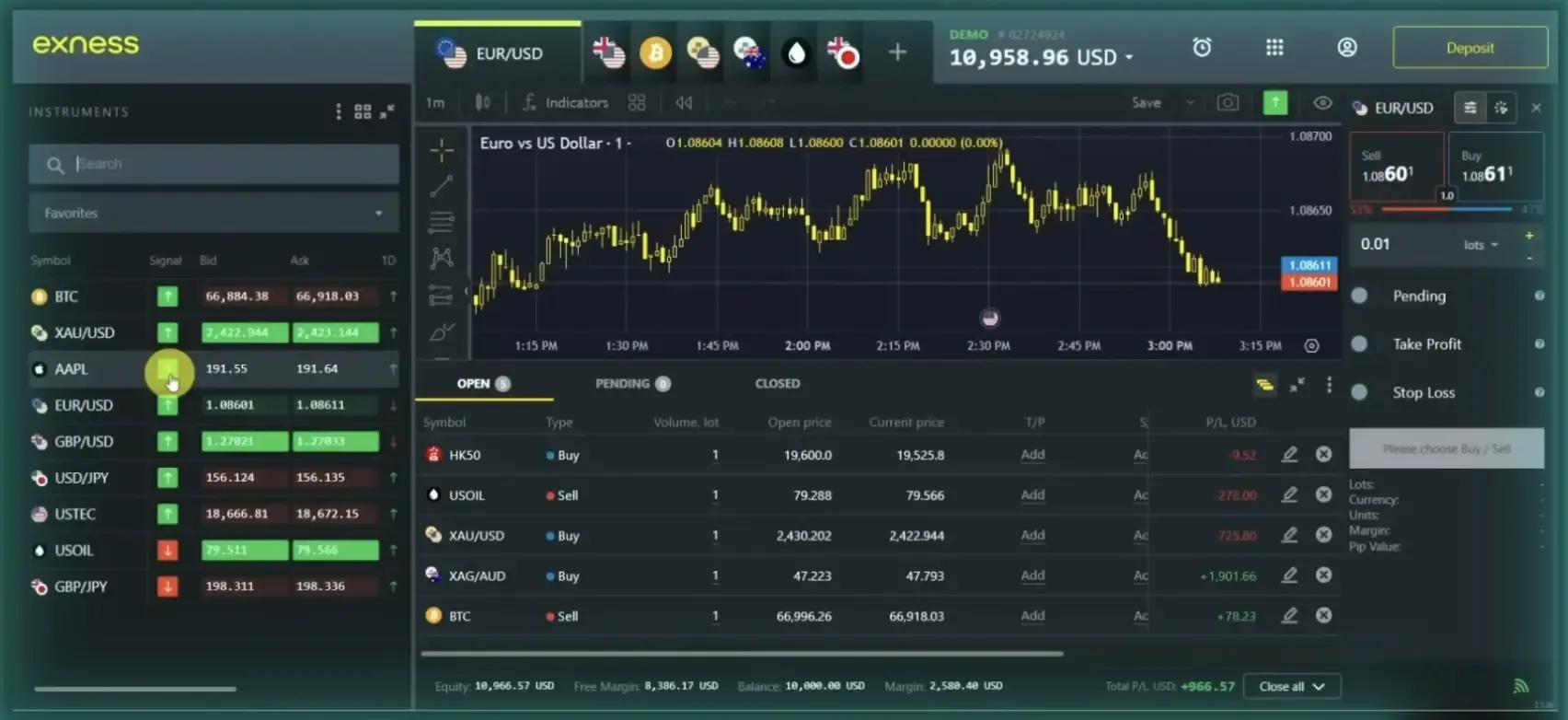
Major currency pairs are the better choice for a small account. These majors carry tighter spreads and deeper liquidity than exotic pairs:
- EUR/USD (Euro / US Dollar)
- GBP/USD (British Pound / US Dollar)
- USD/JPY (US Dollar / Japanese Yen)
- AUD/USD (Australian Dollar / US Dollar)
- USD/CAD (US Dollar / Canadian Dollar)
- NZD/USD (New Zealand Dollar / US Dollar)
They’ll keep the fixed cost of entering and exiting a trade lower relative to a $100 stake. And sure, exotic pairs can look tempting for their volatility, but wider spreads on those pairs eat into a small account's risk budget before a trade has even moved in either direction.
Another thing worth flagging is leverage. High leverage lets a $100 account control a much larger notional position, which sounds like an advantage until a losing trade is amplified by the same ratio. Leverage doesn't change the underlying math of risk management; it changes how quickly an undisciplined position size can violate it.
Crypto
Crypto markets run 24/7, which removes the time-of-day constraints equities and forex sessions impose, and most exchanges support fractional purchases down to very small dollar amounts. The tradeoff is fee structure: round-trip trading costs on some platforms are high enough that a strategy built around frequent small trades can lose to fees even when the underlying calls are directionally correct. Volatility also cuts both ways at this account size, since a large favorable move can considerably grow a small account, but the same volatility working against an oversized position can erase it just as fast.
U.S. Equities
Fractional shares have made it technically possible to buy a few dollars' worth of an expensive stock, which helps with diversification but doesn't solve the core position-sizing problem for day trading specifically. The stop-loss distance needed to avoid getting shaken out by normal price noise, combined with a $1 to $2 risk budget, leaves very little room for a position that's both risk-managed and worthwhile. Margin accounts, which most active equity day traders eventually use for buying power and same-day reinvestment, still require a $2,000 minimum under Regulation T regardless of the June 2026 removal of the old $25,000 Pattern Day Trader threshold. That means $100 in equities effectively means a cash account, with T+1 settlement limiting how often the same capital can be redeployed.
Futures, Including Micro Futures
Micro futures contracts (a tenth the size of standard futures contracts on the same underlying index or commodity) have lowered the capital barrier to futures trading substantially. Even so, margin requirements and the inherent volatility of futures markets mean a $100 account has very little cushion. This is generally the least forgiving starting point of the four for a beginner-sized account.
Choosing a Broker for a Small Account
A handful of things matter more than usual when the account itself is small:
- Confirm regulation first: A broker offering unusually generous terms for tiny deposits is worth double-checking against its regulatory registration (FCA, ASIC, CySEC, or the equivalent in your jurisdiction) before depositing anything.
- Check the actual minimum lot or fractional increment: Not every broker that advertises a low minimum deposit actually supports position sizes small enough to make that deposit useful.
- Look for transparent, low round-turn costs: At this account size, a few basis points of spread or commission matter far more than they would on a larger account.
- Confirm negative balance protection where available: Some regulated brokers guarantee an account can't go below zero even after a highly leveraged loss, which matters more, not less, on a small account trading with leverage.
Weighing the Trade-Offs of a Small Account
A $100 account isn’t a complete limitation, though, as strange as that sounds. It comes with a few advantages.
The pros:
- Losses are capped at a small, absolute dollar amount, which limits the real-world financial damage from early mistakes.
- A small account doesn't move markets, so execution isn't complicated by your own order size the way it can be for institutional traders.
- Forex and futures markets offer micro and nano contract sizes specifically built to accommodate capital this limited, which isn't true of every asset class.
The cons:
- Meaningful profit takes considerable time to accumulate at this scale, which can create pressure to take on more risk than the account can safely absorb.
- The temptation to use maximum available leverage to make small positions feel significant is a common and costly mistake.
- Fixed costs (spread, commission, minimum fees) take a proportionally larger bite out of a small account, as covered in the math above.
- Regulatory account minimums, particularly the $2,000 margin threshold for equities, limit which markets are genuinely accessible at this size.
Alternatives Worth Considering Alongside (or Instead of) Day Trading
Day trading isn't the only way to put $100 to work, and it may not even be the best fit for every beginner's temperament or time availability. Instead, you can give the following a shot:
- Swing trading holds positions for days to weeks rather than hours, which removes the need for constant intraday monitoring and can be considerably less stressful for a beginner still building discipline. Since fewer trades means fees and spread matter less in aggregate, swing trading is more forgiving of a $100 account even though the same position-sizing math still applies to each individual trade.
- Fractional shares and ETFs let a small account build diversification rather than concentrating $100 into a single position. This shifts the approach away from day trading entirely and toward a longer holding period, but it's a legitimate way to put a small amount of capital to work with a much lower error rate for beginners.
- Dollar-cost averaging into an ETF or index fund on a regular schedule removes the timing question altogether. It won't teach the same execution and risk-management skills that day trading does, but it's a lower-risk way to grow $100 over time if day trading's time demands and statistical odds don’t sound like it’s the right fit for you.
- Options income strategies (covered calls, cash-secured puts) exist, but they typically require more capital than $100 to be worthwhile, since they're built around owning or securing full share lots rather than fractional positions. This should be a future direction once your account and your skills have both grown and shouldn’t be jumped into immediately.
- A prop firm evaluation is the option most directly comparable to day trading with personal capital, since it still involves day trading -- just with someone else's capital backing the account after a qualifying evaluation.
None of these alternatives are mutually exclusive with day trading itself. Plenty of traders run a small, actively day-traded personal account for skill-building while separately dollar-cost averaging a portion of savings into a long-term ETF position.
$100 in a Personal Account vs. $100 Toward a Funded Evaluation
This is the comparison most beginner guides skip entirely, and it's worth sitting with before depositing anything.
Putting $100 directly into a personal trading account means that $100 is the entire risk budget, the entire account, and the entire ceiling on position sizing math covered above. Losing it means starting over from zero.
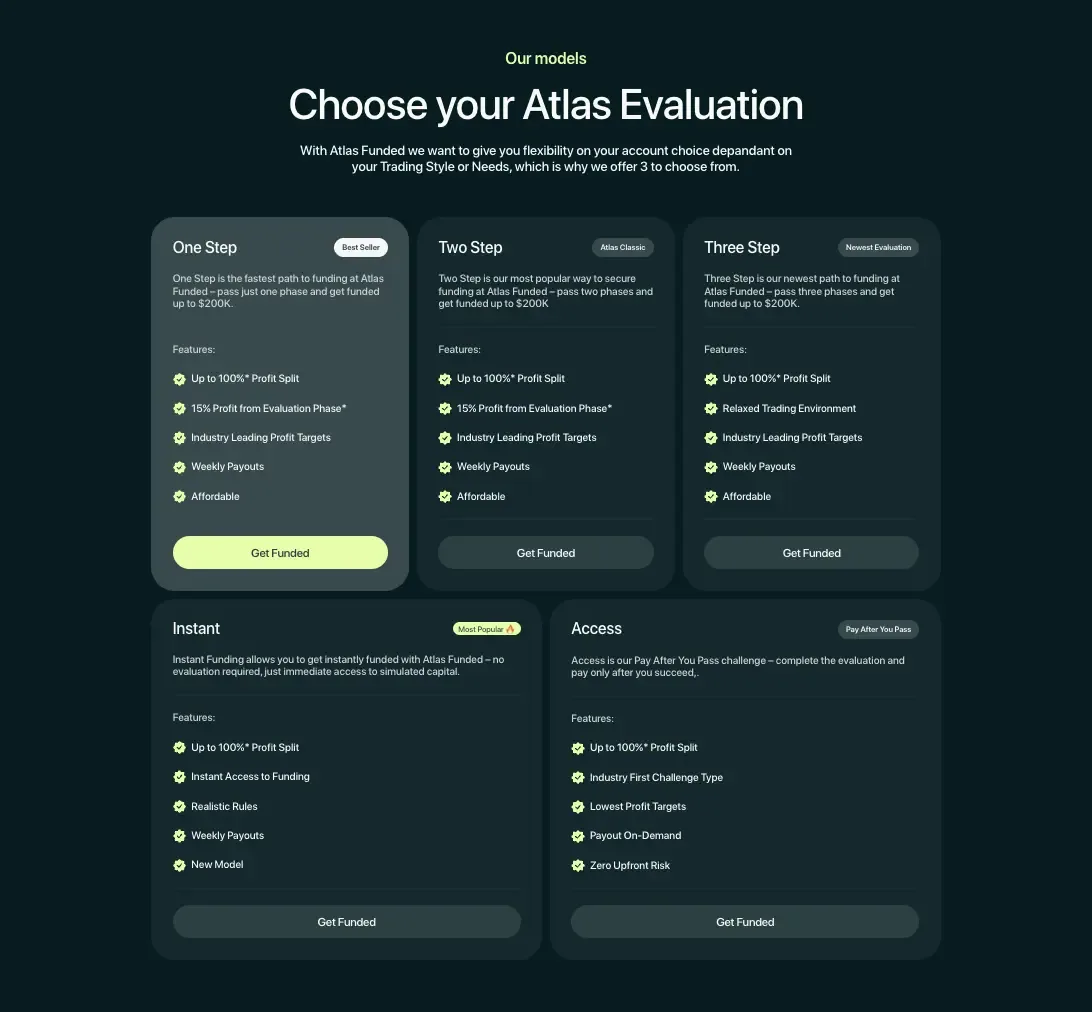
Putting that same amount toward a prop firm evaluation works differently. Atlas Funded's entry paths include a $1 access option and a pay-after-you-pass model that requires no upfront cost at all, evaluating instead against the firm's capital rather than a $100 personal deposit. Passing the evaluation means trading a funded account, sized well beyond what $100 of personal capital could ever support, under a rules-based structure with defined daily loss limits and drawdown rules rather than an open-ended personal risk budget.
| $100 Personal Account | Atlas Funded Evaluation | |
|---|---|---|
| Upfront Cost | $100 | $0 to $1, depending on entry path |
| Capital at Risk if Unsuccessful | The full $100 | The evaluation fee only (or none under the pay-after-you-pass model) |
| Capital Available if Successful | Still $100, plus or minus trading results | Up to $400K in simulated funding, depending on the selected account size |
| Risk Structure | Self-imposed, easy to abandon under pressure | Enforced daily loss limits and maximum drawdown |
| Profit Split | 100% (it's your own money) | 80% by default, upgradeable to 100% |
For context on where that entry cost sits relative to the rest of the industry, evaluation pricing across prop firms varies substantially by account size and challenge type. Standard evaluation costs at established firms commonly range from around $25 on the low end up to several thousand dollars for the largest account tiers, depending on the firm and the size of account being evaluated. Atlas Funded's $0 and $1 access models sit at the low end of that range specifically to remove the upfront cost as a barrier, which matters more for a trader deciding between risking $100 directly or testing a strategy through an evaluation first.
Neither path is objectively superior for every beginner. Someone who wants full ownership of a small account and total flexibility over risk rules may prefer the personal route, accepting that $100 is all there is to work with. Someone who has already built a tested strategy through paper trading, and simply lacks personal capital, often finds the evaluation-to-funding path a more efficient use of a small amount of money. The two aren't mutually exclusive either. Plenty of traders run a small personal account for full creative control while pursuing a funded account for actual scale.
Common Mistakes at This Account Size
- Treating $100 as an income stream rather than a learning budget: The percentage gains required to turn $100 into anything resembling a decent income are extreme relative to realistic per-trade returns, and chasing that math tends to produce oversized, undisciplined position sizes.
- Over-leveraging because the leverage is available: High leverage exists on many small-account forex offerings specifically because the position sizes are otherwise too small to matter. Using the maximum available leverage by default, rather than what a tested risk plan calls for, is one of the fastest ways to blow up a small account.
- Ignoring how much fees and spread actually cost at this scale: A cost structure that's negligible on a larger account can consume a disproportionate share of a $100 one, particularly for strategies involving frequent trades.
- Chasing a single large win to make up for the account's size: A $100 account can't compound its way to significance through position sizing alone. Trying to force that math with oversized bets tends to end the account faster than patience would.
- Skipping the practice phase because the stakes feel low: Low dollar amounts can create a false sense that mistakes don't matter. The habits built (or not built) at this stage carry forward to whatever account size comes next.
Final Verdict: It’s Best to Treat $100 as Tuition
A $100 account can teach real lessons: how order execution actually feels, what disciplined position sizing looks like under real (if modest) financial pressure, and how your own psychology reacts when real money is on the line. What it can't do is generate worthwhile income, and treating it as though it can is the fastest way to lose it.
For traders who've used a small account, or a paper trading period, to prove a strategy works, Atlas Funded offers a path to trading larger size without needing thousands of dollars of personal capital to get there. Entry costs as low as $0 to $1 change what's actually being weighed: $100 at genuine risk with a hard ceiling, versus a small evaluation fee with a funded account on the other side of it.
Ready to take the next step? Explore AtlasFunded's prop trading programs today and put your trading skills to work with the capital to match.
Explore funding programs
 Senior Writer at Atlas Funded




 Your move
 Only pay the full fee after you pass
 UK
UK ES
ES DE
DE FR
FR IN
IN IT
IT