


A routine takes some of the guesswork out of your day and keeps your decisions on plan. It helps you prepare for market movements, spot trading opportunities, and manage risk without making impulsive decisions. This article walks through it phase by phase.
Why Day Traders Need a Set Routine
Day trading requires quick decisions, usually while prices move and market conditions change. Without a routine, it’s easy to react to every price move, take trades that don’t fit your strategy, or overlook important economic announcements.
Having a consistent routine gives you a clear process to follow. You know what conditions must be present before you enter a trade and when to stop for the day. This reduces how many decisions you have to make in the moment and helps limit emotional trading.
It also makes it easier to evaluate your performance. A routine allows you to separate repeatable results from random ones. When you follow the same preparation and review process, you can identify whether your strategy is working or whether mistakes in execution are affecting your results.
Pre-Market Routine
Your preparation should begin before the market opens. Use this time to review your previous performance, understand current market conditions, and identify the instruments or setups worth watching.
Get Into a Focused Mindset
Start by making sure you’re in the right place mentally to trade. Avoid opening your platform immediately after waking up or jumping into the market while distracted.
A few minutes of deep breathing or visualization can help you settle down and focus. If you are tired, stressed, or dealing with something that could affect your judgment, consider reducing your trading activity or sitting out the session.
Review Yesterday's Trades and Your Journal
Open your trading journal and review the previous session's positions. Review your entries, exits, position sizes, and results. Which rule did you break? Which setup paid? Write out what you'll repeat and one thing you'll fix.
Identifying these patterns gives you something specific to work on during the next session. This takes five minutes and keeps the same mistakes from showing up.
Check the Economic Calendar and News
Check the economic calendar for announcements or breaking news that could affect the markets you trade. For US markets, check Consumer Price Index (CPI) reports, employment figures, Federal Reserve announcements, and speeches by central bank officials. Stock traders should also check the earnings calendar for companies reporting before the open or after the previous day’s close, since these stocks often gap and see heavy volume.
Knowing when important events are scheduled helps you avoid being caught off guard by sudden volatility.
Analyze Overnight Moves and Key Price Levels
Check how major indices and the instruments you typically trade performed during the previous session and overnight. For US stock traders, the S&P 500 and Nasdaq-100 futures can provide an early indication of market sentiment before the cash session opens.
Next, mark important levels on your charts. These typically include:
- Previous-day high and low
- Previous close
- Overnight or pre-market high and low
- Support and resistance
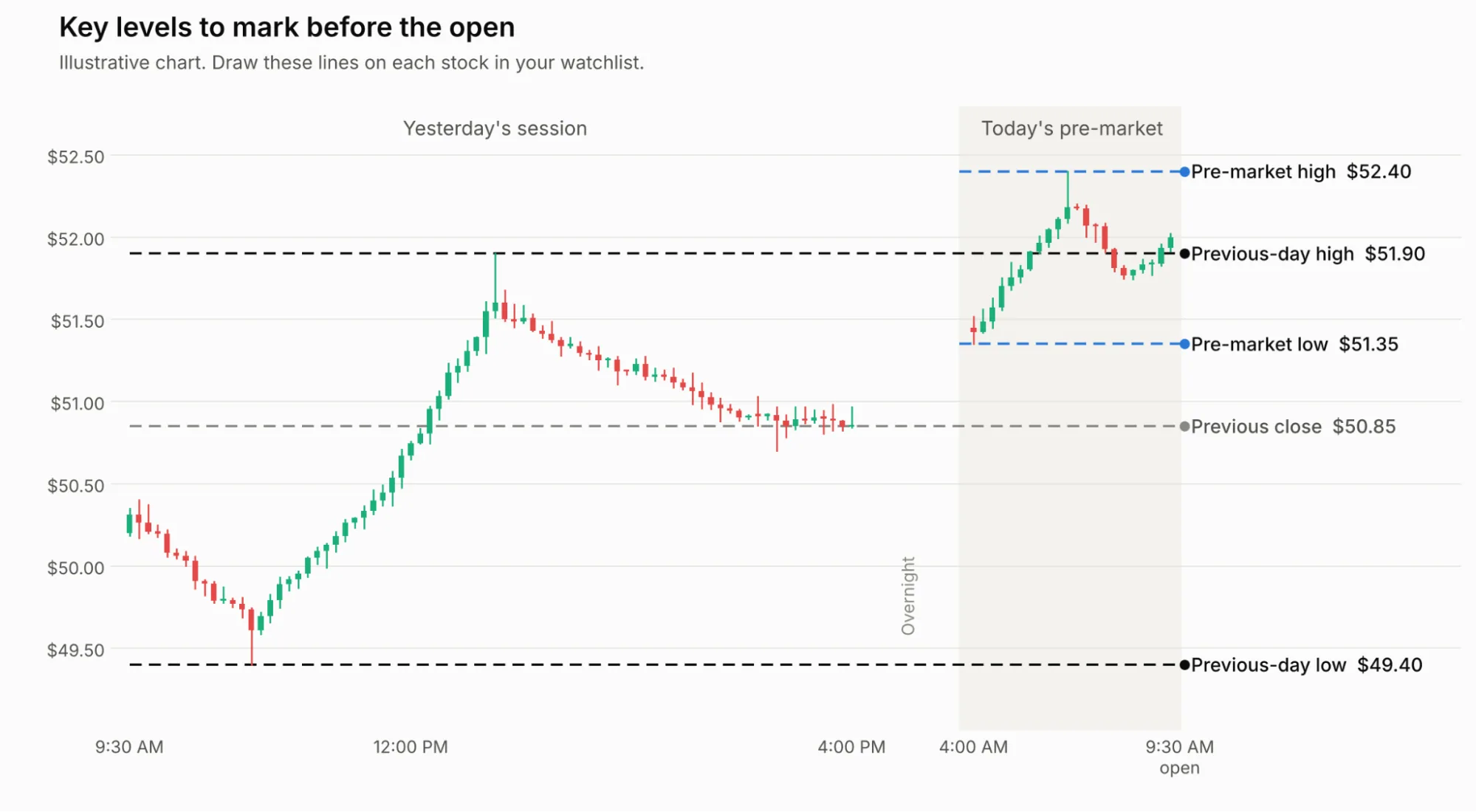
These levels give you reference points for planning trades.
Build Your Watchlist and Set Alerts
Scan and select instruments that fit your trading strategy instead of watching dozens of charts without a clear reason. For stocks, look for factors such as unusual trading volume, price gaps, volatility, and relevant news. For forex and futures, focus on instruments that have suitable liquidity. You can learn more about how to pick stocks for day trading when building a stock watchlist.
Set price alerts around important levels so you don’t always have to monitor every chart continuously. A focused watchlist also makes it easier to concentrate on quality setups without jumping between markets.
Review Your Trading Plan, Daily Goal, and Risk Limits
Before trading begins, review your trading strategy and the conditions required for making entries. Set a clear daily loss limit and decide how much you’re willing to risk on each position. If your daily limit is $150, you should stop opening new positions once your losses reach that amount.
Many traders risk around 1% of their account per trade. To size a position, divide your dollar risk by the distance between your entry and stop. For example, risking $100 with a $0.50 stop allows 200 shares.
You can also define a daily profit target, but try not to use it as a reason to keep trading after the market stops offering suitable setups.
If you trade a funded account, check its daily loss and maximum drawdown limits before the open, and set your own daily limit below them so one bad session can’t end the account.
Check Your Platform and Clear Old Orders
Make sure your trading platform is working properly and displaying live market data. Check your internet connection, chart settings, order-entry tools, and account balance.
Review any pending orders from the previous session and cancel the ones that aren’t relevant anymore.
Sample Pre-Market and Trading Schedule
Here’s an example of a trading schedule for someone trading US stocks during regular market hours. Your schedule may be different depending on the market you trade and your preferred trading hours.
| Time (ET) | Activity |
|---|---|
| 7:30-7:45 AM | Settle in and review yesterday’s journal |
| 7:45-8:30 AM | Check the economic calendar, earnings, and news. Watch the 8:30 AM data releases. |
| 8:30-9:00 AM | Analyze overnight moves and mark key levels |
| 9:00-9:30 AM | Build your watchlist, set alerts, and confirm risk limits and platform settings |
| 9:30-11:00 AM | Monitor the opening session and trade qualifying setups |
| 11:00 AM-1:00 PM | Manage open positions and reassess market conditions |
| 1:00-3:30 PM | Look for suitable afternoon setups or reduce trading activity |
| 3:30-4:00 PM | Close remaining day trades before the bell |
| 4:00 PM onward | Complete your trade journal and prepare for the next session |
During the Trading Session
Once the market opens, your priority is to execute the plan you prepared.
Trading the Open
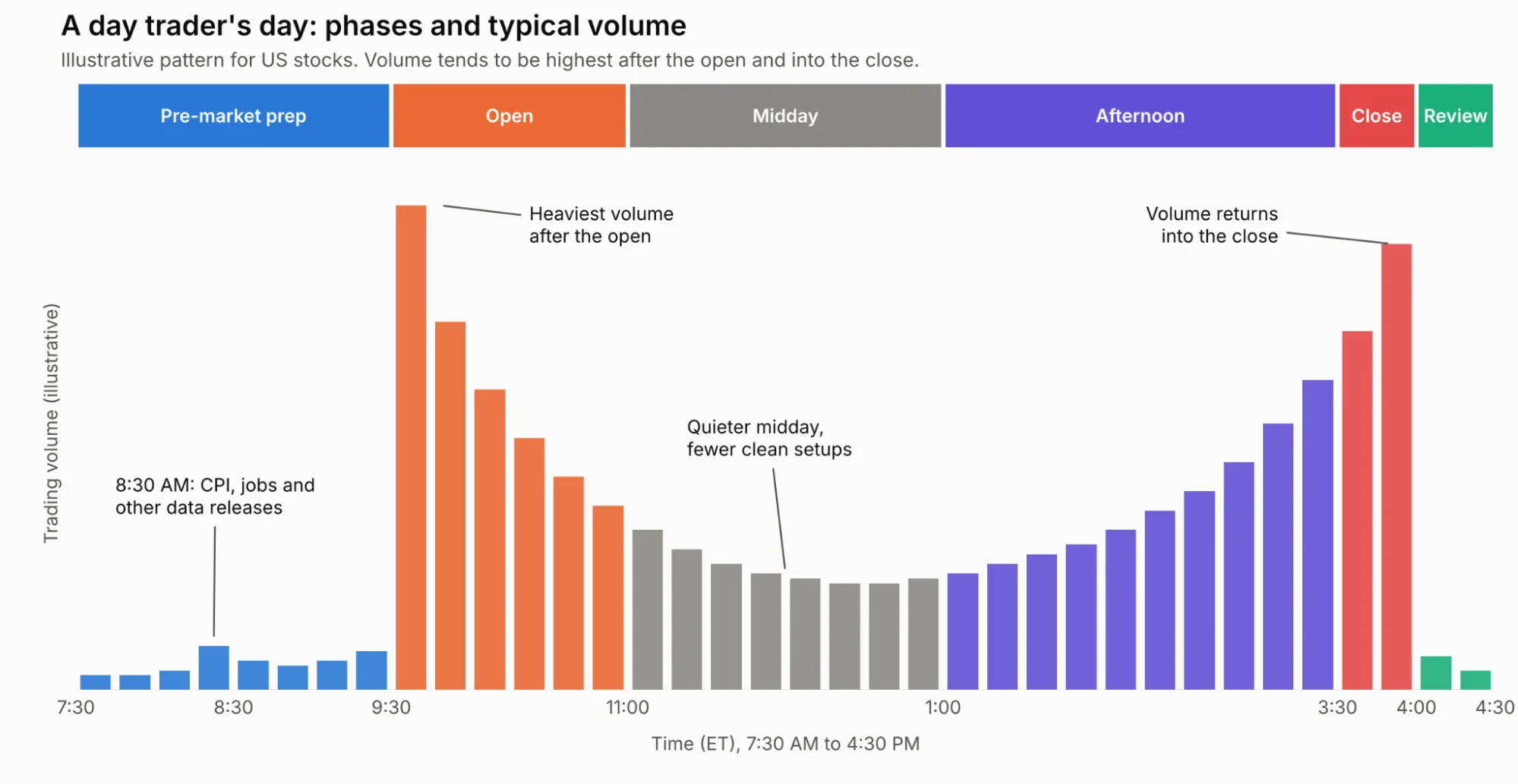
The opening session often brings increased trading volume as market participants react to overnight developments, new orders, and possible economic releases. This can create opportunities, but prices can also move sharply in either direction.
Wait for a setup that meets your entry conditions and give prices time to establish direction if your strategy requires confirmation. Watch out for catalysts like news, a break of a pre-market level, or a clear surge in volume.
If you carried a position overnight, which is more common in futures or swing trades, manage it first. Keep it in line with your original stop-loss and risk rules instead of holding it in the hope that prices will reverse.
Run Your Pre-Entry Checklist
Before placing an order, confirm that the trade meets your strategy's requirements. Having a checklist can help you avoid impulsive entries.
- Entry: Does the setup meet your entry conditions?
- Stop-loss: Where will you exit if the trade moves against you?
- Profit target: Where do you plan to take profits?
- Risk-to-reward ratio: Is the potential reward worth the risk?
- Position size: Does the trade fit within your risk limit?
Midday Monitoring and Adjustments
Trading activity can change around midday, with some markets experiencing lower volume and slower price movements. Review your open positions and check whether market conditions still support your setups.
If you don’t have any open positions, you can review your watchlist and wait for another setup. There’s no need to trade just because you have time available. You can also take a break, review your charts, update alerts, or step away from your screen.
Manage the Close
The last 30 minutes often bring a jump in volume as funds and institutions adjust positions. Decide in advance whether you’ll trade this period or sit it out. Either way, close all day trades before 4:00 PM ET so you don’t carry overnight gap risk into the next session.
Know When to Stop Trading for the Day
Your trading plan should include specific conditions for ending the session. These might include:
- Reaching your maximum daily loss.
- Hitting your maximum number of trades.
- Losing focus or becoming emotionally affected by previous trades.
- Finding that none of your preferred setups is developing.
For example, if your daily loss limit is $150 and you have already lost that amount, stop opening new positions. Cancel pending entry orders and manage any remaining exposure.
Avoid revenge trading after a losing session. Increasing your position size or taking lower-quality setups to recover losses can make the situation worse. You’re better off protecting your remaining capital than forcing another trade.
Post-Market Review
Your routine shouldn’t end right after you close your final position. Reviewing the session helps you understand your performance and identify areas for improvement.
Record each trade in your journal. Include the instrument, entry and exit prices, position size, stop-loss, profit target, and final result. Also record why you entered and whether the trade followed your strategy.
Review the session for specific execution mistakes. Did you recognize good setups? Were your entries and exits well-timed? Did you take unnecessary risks or miss opportunities because you hesitated? Don’t evaluate your performance using profit or loss alone.
Finally, prepare for the next trading day. Mark important price levels on your charts and update your watchlist for the next session.
Habits That Break a Routine
Certain trading habits can make even a well-planned routine ineffective:
- Overtrading: Taking too many positions, especially when there are few valid setups.
- FOMO: Chasing a price move because you don’t want to miss out on an opportunity.
- Revenge trading: Increasing position sizes or taking impulsive trades to recover losses.
- Ignoring risk limits: Continuing to trade after reaching your daily loss limit.
- Skipping preparation: Rushing into the market without checking news, reviewing previous trades, or planning entries.
How to Build and Test Your Own Routine
You do not need to copy another trader's schedule exactly. Your own routine should fit the market you trade, your strategy, available trading hours, and personal commitments.
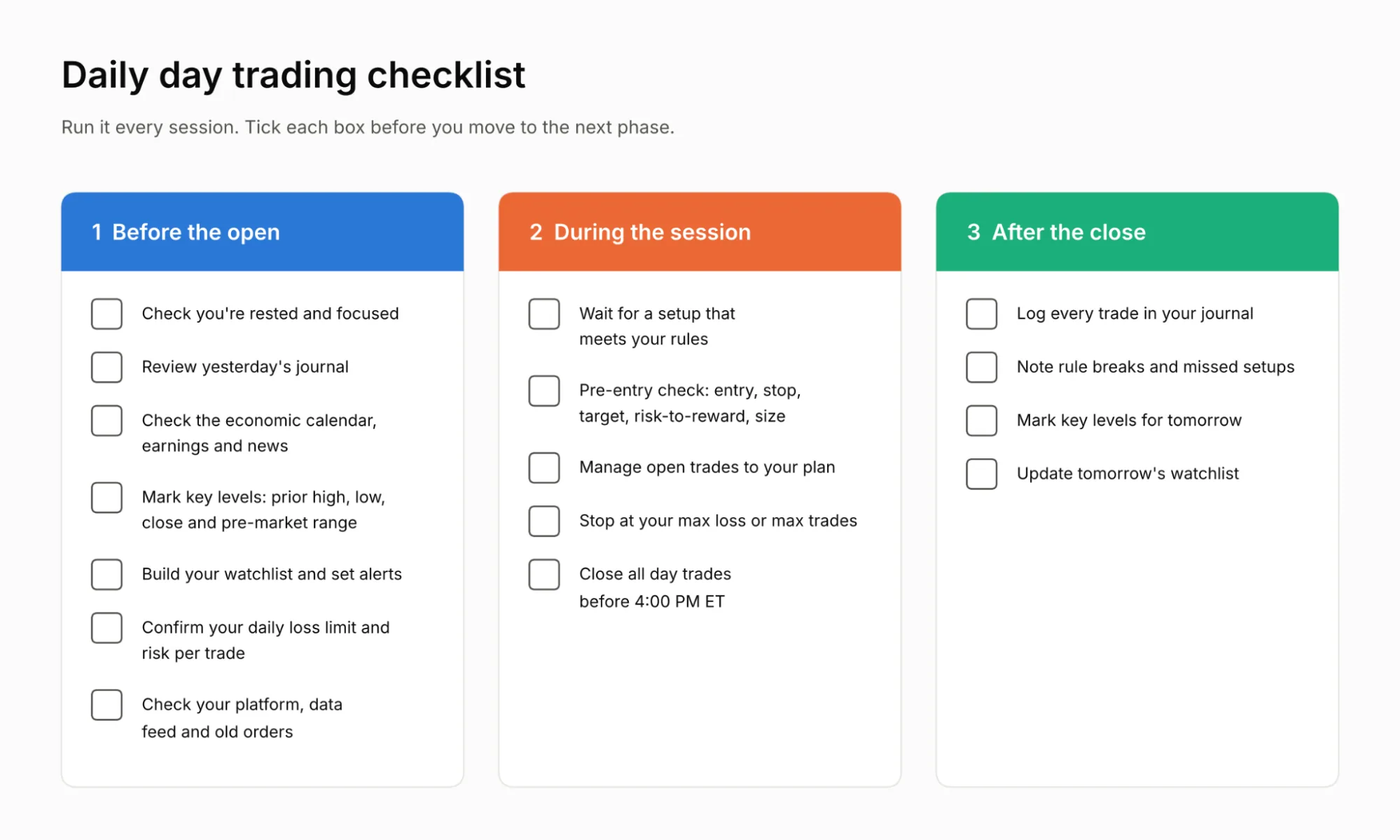
Start by writing down the tasks you need to complete before, during, and after each session. Turn them into a checklist that you can follow without spending too much time deciding what to do next.
Test the routine for 30 trading days and record how consistently you follow it. Note whether you have enough preparation time, whether your trading hours suit your strategy, and which rules you struggle to follow.
After 30 days, cut the steps you skip, add time where you felt rushed, and adjust the schedule to fit your market.
FAQs
What should a day trading routine include?
A day trading routine should include pre-market preparation, market analysis, a watchlist, risk management rules, entry and exit checks, trade monitoring, and a post-market review. It should also include clear conditions for when to stop trading.
How long should a pre-market routine take?
A pre-market routine can take anywhere from 30 minutes to two hours, depending on your strategy and the markets you trade.
Does a routine differ for futures vs. stocks?
The basic structure is similar, but the timing and preparation can be quite different. Stock traders typically focus on company news, earnings, and the regular market open. Futures traders pay more attention to overnight price action, contract specifications, tick values, and scheduled economic releases. Both should use a watchlist, entry rules, and clear risk limits.
Ready to take the next step? Explore AtlasFunded's prop trading programs today and put your trading skills to work with the capital to match.
Explore funding programs
 Senior Writer at Atlas Funded



 Your move
 Only pay the full fee after you pass

 UK
 ES
 DE
 FR
 IN
 IT