



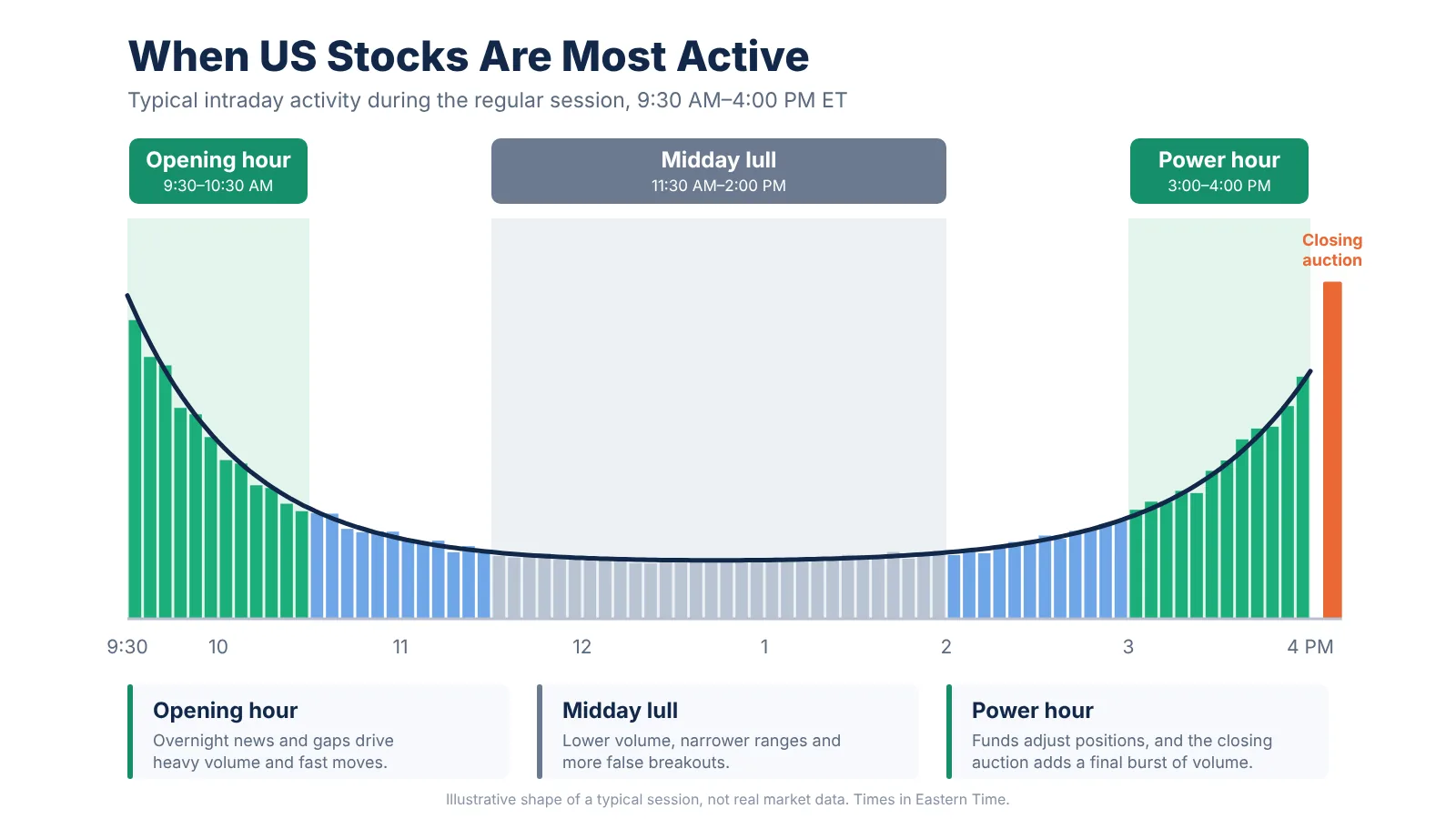
The best time to day trade US stocks is generally the first hour after the market opens (9:30-10:30 AM ET) and the final hour before it closes (3:00-4:00 PM ET), which traders call the “power hour.” These periods often attract higher trading volume and volatility, creating opportunities for breakouts, reversals, and momentum trades. Between them, the market usually slows during the midday session.
The ideal trading window depends on your strategy, experience, and the market you trade.
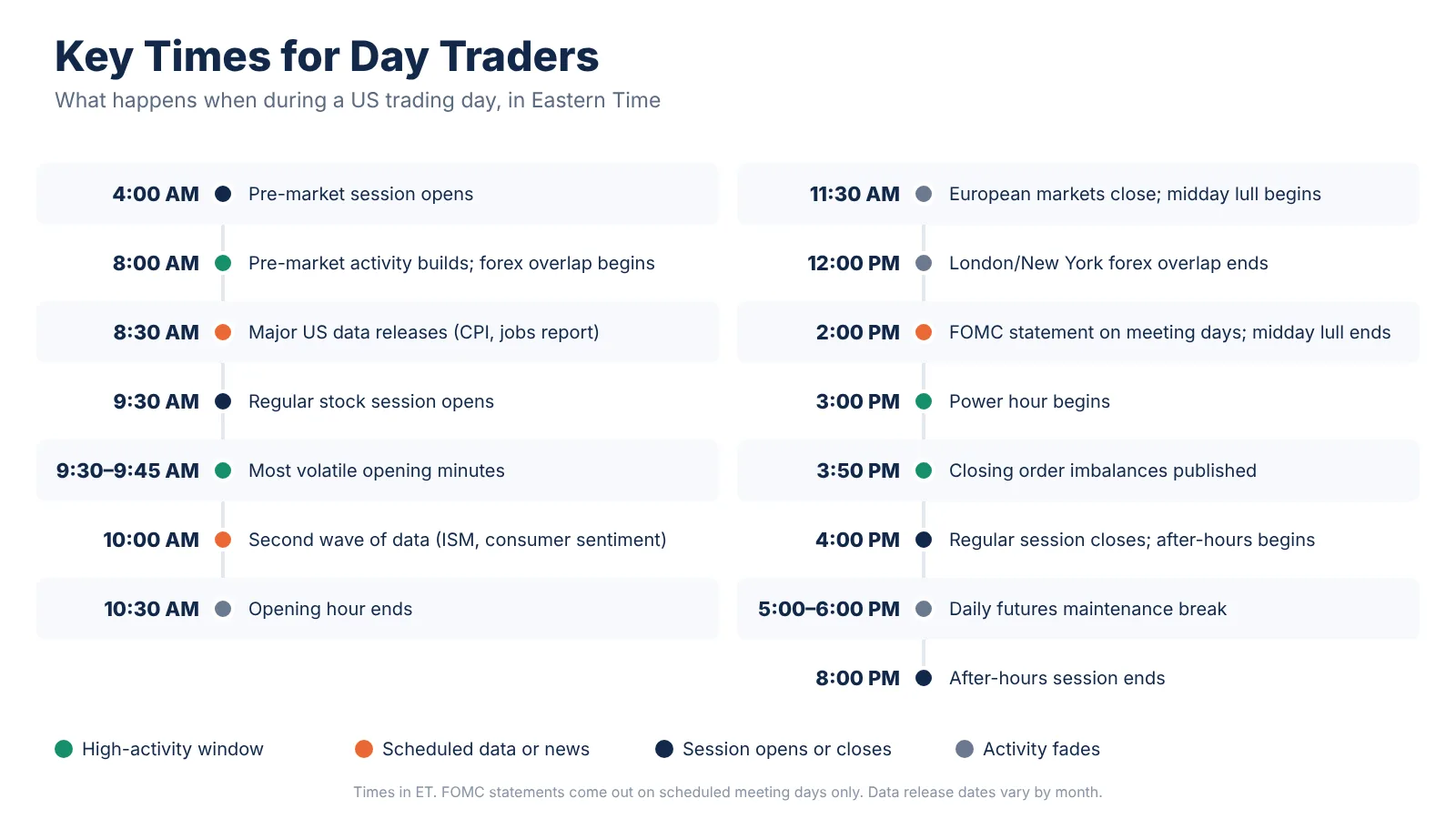
| Time (ET) | What Happens |
|---|---|
| 4:00 AM | Pre-market session opens |
| 8:00 AM | Pre-market activity builds; London/New York forex overlap begins |
| 8:30 AM | Major US data releases (CPI, jobs report) |
| 9:30 AM | Regular stock session opens |
| 9:30-9:45 AM | Most volatile opening minutes |
| 10:00 AM | Second wave of data (ISM, consumer sentiment) |
| 10:30 AM | Opening hour ends |
| 11:30 AM | European markets close; midday lull begins |
| 12:00 PM | London/New York forex overlap ends |
| 2:00 PM | FOMC statement on meeting days; midday lull ends |
| 3:00 PM | Power hour begins |
| 3:50 PM | Closing order imbalances published |
| 4:00 PM | Regular session closes; after-hours begins |
| 5:00-6:00 PM | Daily futures maintenance break |
| 8:00 PM | After-hours session ends |
US Stock Market Hours (ET)
The US stock market has three main trading periods.
| Trading Session | Hours (ET) |
|---|---|
| Pre-market | 4:00-9:30 AM |
| Regular session | 9:30 AM-4:00 PM |
| After-hours | 4:00-8:00 PM |
Most day traders focus on the regular session because it generally offers higher liquidity and tighter bid-ask spreads. More buyers and sellers are active, making it easier to enter and exit positions without significantly affecting the execution price.
Pre-market and after-hours trading can be more challenging. Lower participation often leads to wider spreads, limited order availability, and sharper price movements. Session times can vary by broker, and some brokers now offer overnight trading in select US stocks, although liquidity in those sessions is usually thin.
Why Time of Day Affects Day Trading Results
Volume, volatility, liquidity, and the timing of news all shift during the session, and each one changes how prices move.
- Trading volume: Higher volume generally indicates plenty of buyers and sellers, and can help confirm the strength of a price movement. It also means you can enter and exit quickly.
- Volatility: Higher volatility provides opportunities for larger price movements, which creates the profit potential day traders need but also increases the risk of sudden losses.
- Liquidity: Deep liquidity and tight spreads keep your costs low. When volume drops, spreads widen, and a trade can lose money on entry before price moves at all.
- Institutional activity: Banks, hedge funds, and asset managers execute large orders throughout the day. In US stocks, opening and closing auctions concentrate significant order activity, which can contribute to increased volume and price movements around these periods.
- News releases: Economic reports and earnings announcements can trigger sudden increases in volume and volatility.
Best Times of Day to Day Trade
Here are the key trading windows and what to expect in each one.
Market Open (9:30-10:30 AM ET)
The first hour of the regular session is one of the busiest periods for day traders. It packs in overnight news, price gaps, and some of the heaviest volume of the day. Trading activity increases as overnight orders are executed and market participants react to new information.
Price moves fast, giving day trading strategies like momentum, gap, and breakout trading opportunities. The first 15 minutes can be quite volatile, so it’s important to be cautious. Prices may move in both directions as opening orders are processed and buyers and sellers establish positions.
Keep an eye on 10:00 AM ET as well. Reports such as the ISM Manufacturing Index and University of Michigan consumer sentiment are released at that time and can extend or reverse the opening move. Many traders also mark the opening range (the high and low of the first 15 to 30 minutes) and the volume-weighted average price (VWAP) as reference levels for the rest of the morning.
Power Hour (3:00-4:00 PM ET)
Power hour is the final hour of the regular trading session. It tends to attract increased trading volume as investors adjust positions before the market closes.
Some traders close positions to avoid overnight exposure, while institutional investors may rebalance portfolios or execute orders ahead of the closing auction. Others enter new positions based on the day's price action. These activities can contribute to increased volume and create conditions for trend continuation, late-day breakouts, and reversals.
From 3:50 PM ET, the NYSE and Nasdaq publish closing order imbalances, which show whether more shares are waiting to be bought or sold at the close. Large imbalances can drive sharp moves in the final minutes, and the closing auction itself now accounts for a large share of daily volume in many stocks.
Pre-Market (8:00-9:30 AM ET)
Pre-market trading starts as early as 4:00 AM ET, but activity usually builds from around 8:00 AM, as earnings reports and economic data come out. This period can be useful for preparing a watchlist. Traders can monitor markets experiencing unusual activity, review overnight news, and identify potential catalysts for the opening session.
Pre-market trading generally has lower liquidity than the regular session. Wider spreads and fewer available buyers and sellers can make execution difficult. For most day traders, this period is much better for preparing than actively trading.
The Midday Lull (11:30 AM–2:00 PM ET)
Trading activity often slows during the middle of the day. After the opening rush, many traders have already taken positions, while others wait for new catalysts. European markets also close around 11:30 AM ET, which removes another group of participants.
This can produce:
- Lower trading volume compared with the opening and closing periods.
- Narrower price ranges and slower directional movements.
- False breakouts, because there is too little volume to sustain the move.
- Sideways movement that makes momentum strategies less effective.
Midday is not a bad time for every strategy. Range traders can still find opportunities since price tends to repeatedly bounce between support and resistance.
Beginners may also find the slower pace easier to observe and study. Still, lower activity does not automatically mean lower risk. Sudden price movements can still occur, and entering trades without clear setups can lead to overtrading.
Best Time to Day Trade for Beginners
For beginners in day trading, it's usually best to focus on one trading window once the opening volatility has started to settle, instead of watching the market all day.
The opening hour offers plenty of activity, but the first 15 minutes can be difficult to navigate because of rapid price changes. Waiting until around 9:45 AM ET gives traders time to observe the initial movement before looking for potential setups.
The goal is to understand how your strategy performs under specific market conditions before expanding into other trading windows.
Best Times for Futures and Forex
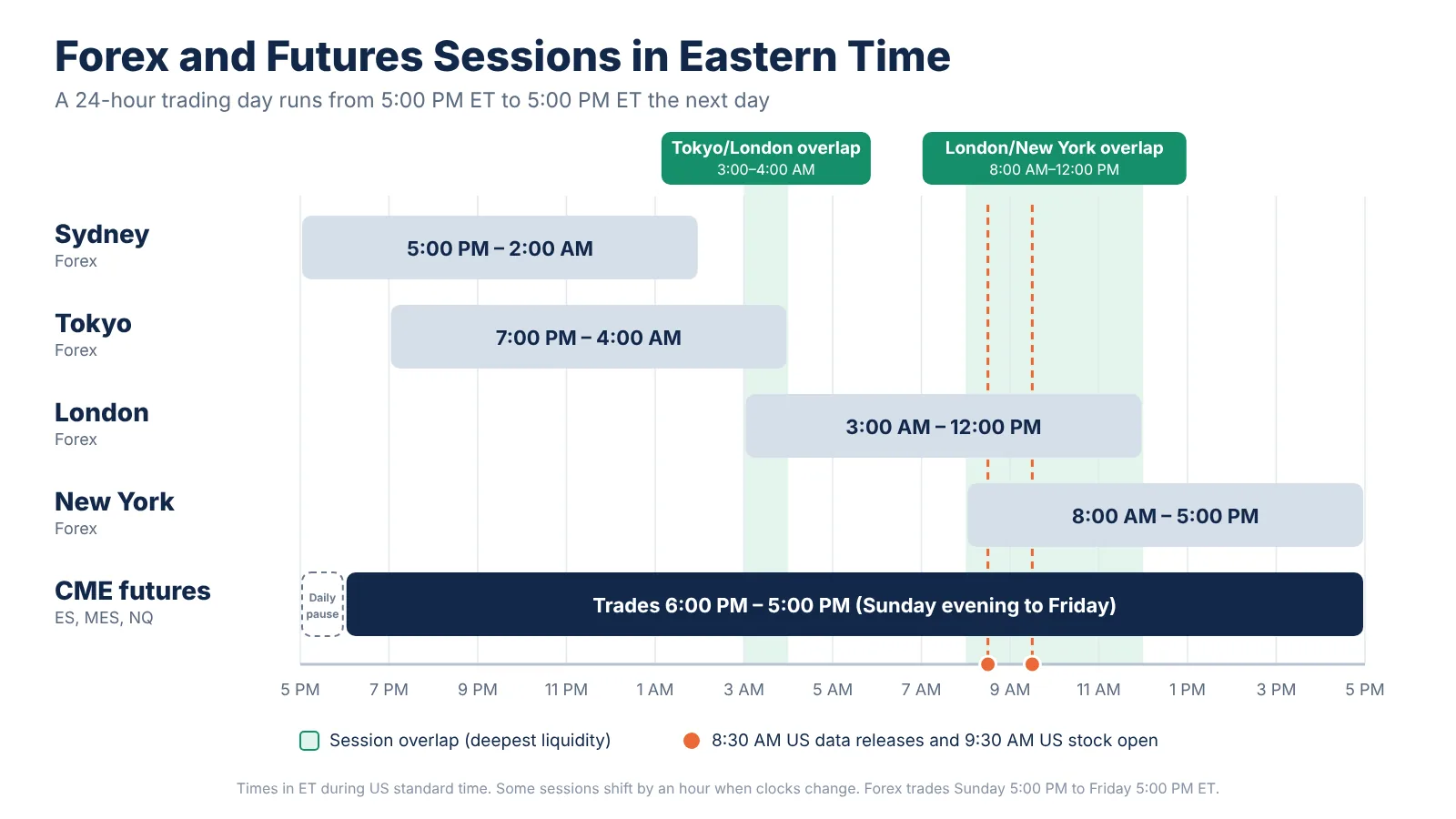
Futures and forex are traded on different schedules from the stock market, creating opportunities outside regular US trading hours.
Futures
Popular contracts such as the E-mini S&P 500 (ES), Micro E-mini S&P 500 (MES), and E-mini Nasdaq-100 (NQ) trade nearly 24 hours a day from Sunday 6:00 PM ET to Friday 5:00 PM ET, with a one-hour daily maintenance break from 5:00 to 6:00 PM ET each day.
Trading activity varies between sessions. US regular trading hours generally attract greater participation in equity index futures.
Traders also watch 8:30 AM ET, when important economic reports such as the Consumer Price Index (CPI) and the monthly employment report are frequently released. Overnight sessions offer additional opportunities as Asian and European markets become active. However, volume and liquidity may be lower than during the US session.
Forex
Forex trading takes place 24 hours a day, five days a week, across global trading sessions, with activity concentrated around major financial centers such as London, New York, and Tokyo.
Two important periods are:
- London/New York overlap: Usually around 8:00 AM to 12:00 PM ET, shifting by an hour for a few weeks in March and October/November when US and UK clocks change on different dates. Carries the deepest liquidity and the biggest moves in pairs like EUR/USD and GBP/USD.
- Tokyo/London overlap: It runs 3:00 to 4:00 AM ET in winter and 3:00 to 5:00 AM ET in summer. It moves yen crosses like EUR/JPY, but volume stays well below the New York overlap.
Best Days of the Week to Day Trade
Each day of the week has its own character.
Mondays can bring increased activity as markets react to news and developments from the weekend. In US stocks, this may produce opening price gaps, while futures and forex can also respond to new information when trading resumes.
Tuesday through Thursday often provide a more established trading environment after Monday's initial adjustments. However, activity still depends on economic announcements, earnings, and other market developments.
On Fridays, some traders close positions ahead of the weekend, which can influence market activity. Monthly options expire on the third Friday of each month, and the quarterly expirations in March, June, September, and December (often called "triple witching") can bring especially heavy volume. SPX, SPY, and QQQ now also have options expiring every weekday, so expiration-driven moves are no longer limited to Fridays.
Seasonal Patterns
Activity also shifts across the year. Common seasonal patterns include:
- Summer lull: Trading activity can decline during parts of the summer, particularly from late June through August, as some institutional traders and market participants take vacations.
- Holiday weeks: Trading slows down around major US holidays, especially Thanksgiving and Christmas, as fewer traders are active. US stock markets typically close early, at 1:00 PM ET, on the day after Thanksgiving and on Christmas Eve, so plan for a shorter session.
- Earnings season: Quarterly earnings announcements can increase volatility in individual stocks, particularly when reported results differ significantly from expectations. These announcements can produce price gaps, sharp reversals, and short-term trading opportunities.
- Year-end tax-loss selling: Some investors sell losing positions toward the end of the year to realize capital losses for tax purposes. This can influence activity in certain stocks.
Trading Around Economic Releases
Major economic announcements can create some of the largest intraday price movements in stocks, futures, and forex. For example, if inflation readings are higher than expected, that could raise concerns that the Federal Reserve will keep interest rates elevated. Similarly, a weaker jobs report may increase expectations of rate cuts. These changing expectations can drive rapid buying or selling across financial markets.
- Consumer Price Index (CPI): The CPI measures changes in consumer prices and provides an indication of inflation.
- The monthly US Employment Situation report: Commonly called Nonfarm Payrolls (NFP), it covers job creation, unemployment, and wage growth. Both reports are generally released at 8:30 AM ET.
- Federal Open Market Committee (FOMC) announcements: The FOMC announces the Federal Reserve's interest rate decisions, with policy statements generally released at 2:00 PM ET. On decision days, the statement is followed by a press conference.
Traders generally approach these announcements in one of two ways. The first is to trade the release itself, looking for opportunities created by the immediate price reaction. The second is to wait for the initial reaction to settle. Traders can then assess the direction of the move and look for setups around established support, resistance, or trend levels.
Spreads often widen and slippage increases in the seconds around a release, so orders can fill well away from the expected price. If you trade a funded account, check your firm's rules, as some restrict trading around high-impact news.
Adjusting for Your Time Zone and Schedule
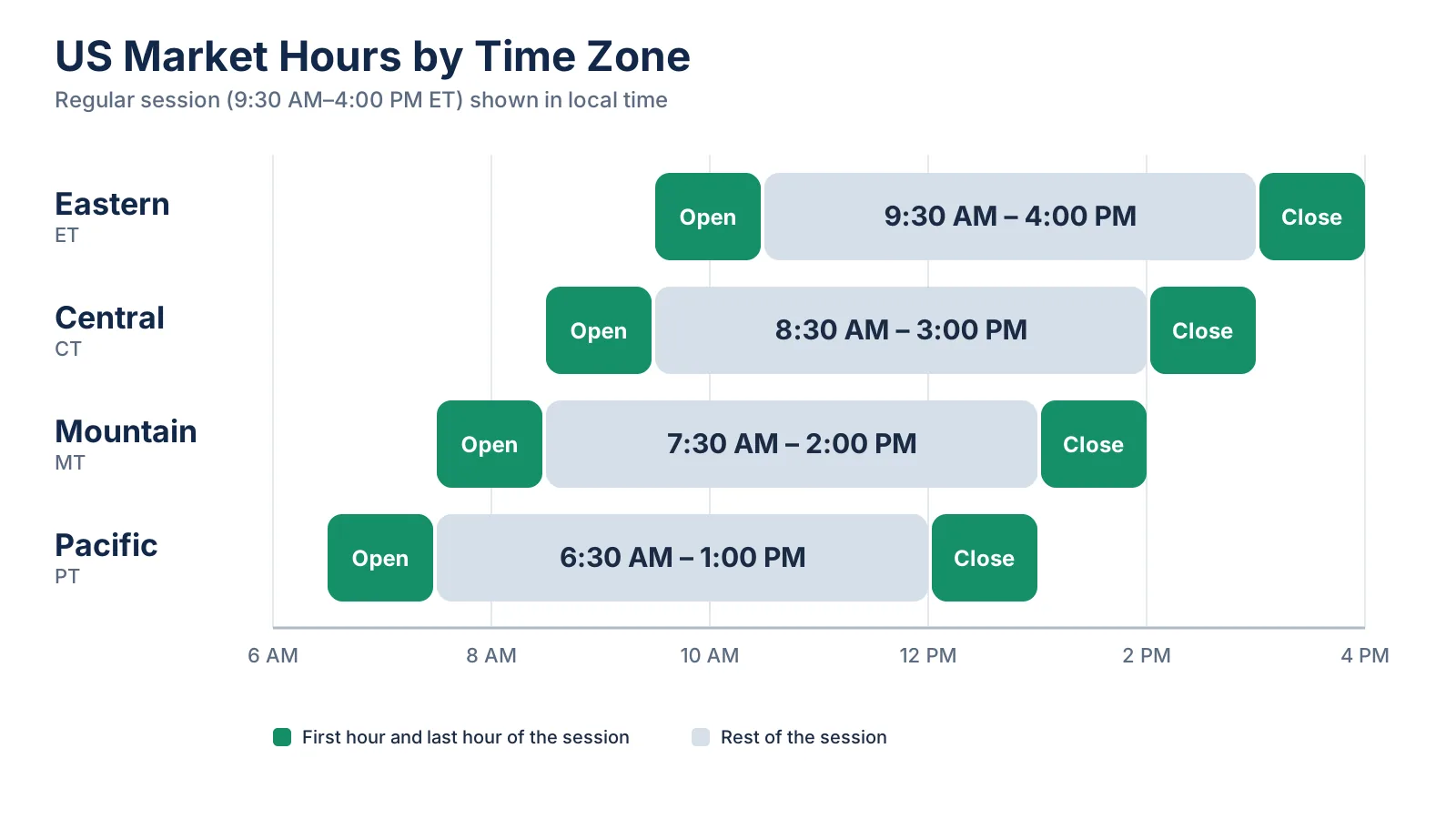
US stock market hours fall at different local times depending on your location.
| Time Zone | Market Open | Market Close |
|---|---|---|
| Eastern (ET) | 9:30 AM | 4:00 PM |
| Central (CT) | 8:30 AM | 3:00 PM |
| Mountain (MT) | 7:30 AM | 2:00 PM |
| Pacific (PT) | 6:30 AM | 1:00 PM |
Most of Arizona does not observe daylight saving time, so from March to November the market opens at 6:30 AM there, the same as Pacific Time.
If you trade part-time, you don’t need to monitor the market all day. Focus on one high-volume window, either the opening hour or the final hour.
Traders outside the United States can convert ET into local time (the 9:30 AM ET open is 2:30 PM in London for most of the year) or focus on markets with longer hours, such as the futures and forex sessions covered above.
How to Find Your Own Best Trading Window
Your best trading window depends on your strategy and how well you perform under different market conditions.
Higher volume can make it easier to enter and exit positions because more buyers and sellers are active. For breakout strategies, increased participation can help sustain a move beyond established support or resistance. Quieter periods may produce narrower price ranges, which can make it harder to find strong directional moves.
Use a trading journal to record trade times, strategies, entry and exit prices, and results. Group trades by time of day and compare your win rate, average profit or loss, risk-to-reward ratio, and trading costs. Review a meaningful sample, such as 30 or more trades per window, before choosing your preferred window.
FAQs
What time is the stock market most active?
The most active trading periods depend on the market. For US stocks and equity index futures, activity often increases around the 9:30 AM ET open and the final hour of the stock market session. In forex, the London/New York overlap is generally one of the busiest periods.
Can you day trade pre-market or after hours?
Yes. Many financial markets offer trading opportunities beyond standard stock market hours. Forex and futures trade through overnight sessions, while cryptocurrencies trade 24/7. US stocks also have premarket and after-hours sessions, although liquidity may be lower and spreads wider.
Is midday a bad time to day trade?
Not necessarily. Trading activity often slows around midday, leading to lower volume, narrower price ranges, and less pronounced price movements. This can make momentum and breakout setups harder to trade, although range-bound conditions may still offer opportunities.
Ready to take the next step? Explore AtlasFunded's prop trading programs today and put your trading skills to work with the capital to match.
Explore funding programs
 Senior Writer at Atlas Funded



 Your move
 Only pay the full fee after you pass

 UK
 ES
 DE
 FR
 IN
 IT