


Most proprietary trading firms impose a daily drawdown limit to control risk. While these rules protect the firm's capital, they can also force traders out of otherwise profitable strategies after a single volatile trading session.
That's why many experienced traders now look for a no daily drawdown prop firm. Instead of worrying about hitting a daily loss threshold, you can focus on managing your overall risk.
In this guide, we'll explain how these kinds of prop firms work and compare top providers in the industry.
Best No Daily Drawdown Prop Firms: Full Comparison
The table below compares AtlasFunded against six popular prop firms that don’t have a daily loss limit.
| Rank | Firm | Max. Overall Drawdown | Profit Split | Account Sizes | Max Leverage | Upfront Fee | Assets |
|---|---|---|---|---|---|---|---|
| 1 | AtlasFunded | 10% | 80-100% | $5K-$400K | 1:100 | $5 | CFDs + Futures |
| 2 | FTMO | 10% | 80-90% | $10K-$200K | 1:100 | $104 | CFDs only |
| 3 | FunderPro | 10% | 80-90% | $5K-$200K | 1:100 | $69 | CFDs only |
| 4 | Instant Funding | 6% | 80-90% | $5K-$200K | 1:30 | $55 | CFDs only |
| 5 | FundedNext | 10% | 60-95% | $6K-$200K | 1:100 | $32.99 | CFDs + Futures |
| 6 | Hola Prime | 10% | 80-95% | $5K-$200K | 1:100 | $23.40 | CFDs + Futures |
| 7 | FundingPips | 10% | 60-100% | $2.5K-$200K | 1:100 | $19 | CFDs only |
AtlasFunded is the best option on the above list because of the following reasons:
Highest Overall Drawdown Limits
AtlasFunded uses a 10% balance-based overall drawdown across its standard evaluation programs. "Balance-based" means floating losses don't count against you as long as positions recover before they close. On a $100,000 account, you have a $10,000 total risk buffer that moves with your realized balance, not your unrealized equity.
Up to 100% Profit Split
AtlasFunded offers high payouts for traders, with profit splits starting at 80% on standard evaluation accounts and scaling to 100% through the firm's milestone structure and available add-ons.
Lowest Entry Models
AtlasFunded offers one of the most affordable entries in the prop firm market. Its Pay After You Pass ($5 Access) model costs $5 upfront, while the standard 2-step challenge costs just $28. For context, FTMO's cheapest challenge is $104 and FunderPro's starts at $69.
Most Flexible Trading Conditions
Traders can choose between MT5, TradeLocker, and MatchTrader. News trading, weekend holding, and EAs are all permitted across the firm's programs, and there's no activation fee on funded accounts, which means the price you see on the challenge is the price you pay.
Reward Guarantee
Traders who comply with the rules and achieve the profit target are guaranteed payment. There’s also a $1000 compensation if payment processing is delayed.
Built for Both CFD and Futures Traders
AtlasFunded supports both CFD and futures trading, which is a rare, highly valuable combination. CFD traders get access to forex, indices, and gold. Futures traders can access commodity and index contracts with defined risk profiles.
How Daily Drawdowns Work

Daily drawdown is your total loss in a single trading day, and a limit caps how high that loss can go before you lose your evaluation or funded account. Let’s look at an example.
On a $100,000 account with a 5% daily drawdown, your total permitted intraday loss is $5,000. If your equity falls $5,001 below the session-open reference point at any moment during the day, the account is breached. Most firms calculate this from the opening balance at the start of each trading session.
How it differs from maximum drawdown:
The maximum drawdown is the cumulative, account-lifetime loss limit. It tracks how much you've lost from your starting balance. The daily drawdown is a separate, shorter-term rule that resets daily. A trader can be perfectly within their maximum drawdown limits and still breach a daily limit on a single bad session.
The practical disadvantages:
Daily drawdown limits create friction that consistently damages otherwise profitable traders:
- Forced exits: Traders close winning positions early to protect their daily headroom, often exiting trades before price targets are hit.
- Session avoidance: High-impact news releases become high-risk events to avoid entirely.
- False disqualification: A trader can be profitable across a challenge and still fail because one session briefly hit their daily drawdown limit before recovering.
- Psychological pressure: The daily timer runs on every session. Traders who are down 3% at noon face a completely different psychological environment than those managing only against a rolling lifetime cap.
What Is a No Daily Drawdown Limit?
A no daily drawdown limit means the prop firm doesn’t impose any cap on how much you can lose within a single trading session. With this, the trader's account is governed by only the maximum overall drawdown.
As an example, consider AtlasFunded's 10% balance-based model. A $100,000 account can sustain up to $10,000 in total realized losses before a breach occurs. This structure changes the relationship between a prop trader and their risk. When there's no daily drawdown rule, the overall drawdown becomes the major risk framework.
Benefits of No Daily Drawdowns
Here’s why you’re better off without these limits:
- You manage only one risk rule, not two
- You can trade around news events
- Holding overnight stops being a problem
- You’re less likely to make panic decisions
- Higher evaluation pass rates
- Strategies that need intraday drawdown (such as mean-reversion entries, breakout retests, and trend setups) work better
How to Succeed With No Daily Drawdown Limits

Removing the daily drawdown rule doesn’t negate the need for discipline. It moves that discipline from the firm to the trader's own system. Without an automatic session cap, the controls that prevent loss accumulation have to come from you. Here’re ways to make this perk work for you.
Set Your Own Daily Risk Ceiling
Even without a firm-imposed limit, experienced traders cap their own daily risk at 1-2% of account equity. On a $100,000 account with a 10% overall drawdown, a self-imposed 2% daily ceiling means you can handle five losing days in a row before touching your lifetime limit. The goal is to keep enough of your drawdown budget intact so one bad week doesn't end the account.
Size Every Trade Around a Fixed Risk Percentage
Position sizing is the single biggest factor in whether a trading strategy survives long enough to work. How much capital you put behind each trade accounts for far more of your results than your entry signals or technical analysis.
At 0.5% risk per trade on a $100,000 account, you can take 20 losing trades in a row before reaching your overall drawdown limit. At 2% per trade, that drops to five. Fixed-fractional position sizing keeps your risk proportional to your account balance as it grows or shrinks, which is why most professional traders use it as their default method.
Match Your Risk to the Setup
A daily drawdown rule forces you to spread risk evenly across every session, whether the setup is strong or weak. Without that rule, you can do the opposite by committing more of your budget to high-conviction trades and pull back during rough or low-liquidity conditions. Most experienced traders keep their total exposure across all open positions between 4% and 8% of account equity, adjusting the ceiling based on how strong the current opportunities are.
Track Your Drawdown in Real Time
Without a daily reset to anchor you daily or provide a clear reference point, it's easy to lose track of your overall drawdown, especially across several open trades. Check your equity against your starting balance before every session and at intervals throughout the day. You can monitor all your trading data on AtlasFunded's dashboard.
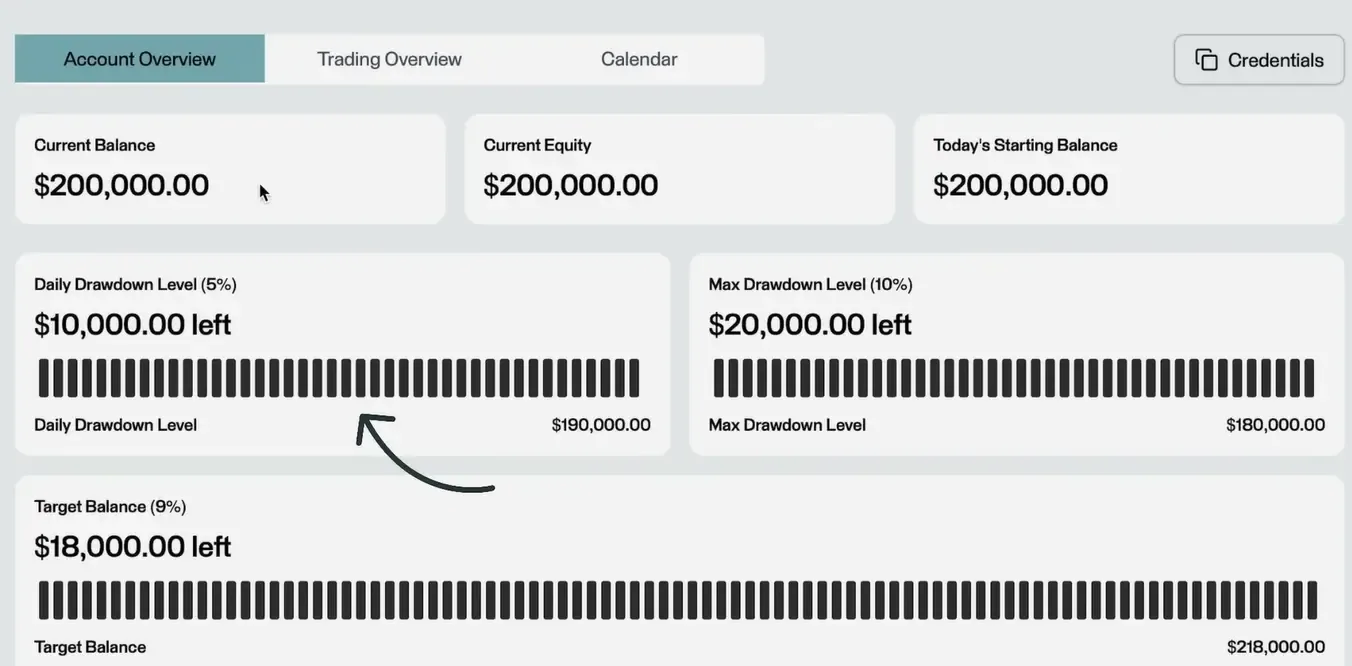
Alt text: Screenshot of AtlasFunded trader dashboard showing balance, drawdown percentage, balance, and more
These tips have been put to the test. AtlasFunded's own trader success stories document this in practice. One trader, Arjun, scaled an algorithmic strategy to a $200,000 funded account by using the firm's no-consistency-rule structure to size positions around setup quality instead of a fixed daily quota.
Another trader, Chloe, a part-time UK trader, used the platform's news-trading flexibility to swing-trade Apple stock around earnings, completing her evaluation in five weeks and scaling to a $50,000 funded account.
Both cases follow the same underlying pattern: disciplined position sizing combined with the freedom to let a setup develop, not a higher tolerance for risk.
Leverage AtlasFunded's No Daily Drawdown Model
AtlasFunded stands out as the best CFD and futures prop firm with no daily drawdown by backing its rules with infrastructure that helps traders use them well. The firm’s Discord community is active daily with risk management discussion and strategy sharing to help keep you disciplined.
There’s also a real-time dashboard that tracks the max overall drawdown and scaling progress at all times. You can join the regular webinars covering volatility management and challenge psychology.
To get started:
- Visit Atlasfunded.com and compare the evaluation models and account sizes
- Set a personal daily risk ceiling of 1-2%
- Join the Discord
- Use the dashboard's live equity display to track your drawdown throughout the evaluation
You can get started on AtlasFunded and enjoy zero daily drawdown accounts for as little as $5 by using the Pay After You Pass model.
Ready to take the next step? Explore AtlasFunded's prop trading programs today and put your trading skills to work with the capital to match.

 Senior Writer at Atlas Funded




 Your move
 Only pay the full fee after you pass
 UK
UK ES
ES DE
DE FR
FR IN
IN IT
IT