.png)






.svg.webp)
.svg)

Prop Firms With No Minimum Trading Days: 14 Platforms Checked
.webp)

.svg)
Make money trading our capital



Hitting your profit target on day two and then being told to keep trading for another eight days is a strange way to be assessed. You've already shown the firm what it asked to see, but the rules just want you to keep clicking.
That's the problem "no minimum trading days" is supposed to solve, and plenty of firms advertise it. Atlas Funded went through the published rules for 14 of them to see how many actually deliver it. Several do. Several others use the phrase in their marketing while a day count sits in their help centre, sometimes on the evaluation, more often on the funded account before your first payout.
How We Checked This
Every figure in this guide came from the firm's own rules page, help centre or pricing page. Where a rule differs by model (which it usually does), we’ll name the exact model.
What we looked at, in order:
- Whether a minimum trading day rule exists on the evaluation
- Whether one exists on the funded account before the first payout, which is where most of them hide
- Whether there's a time limit on the challenge
- Profit target, drawdown type and daily loss rule
- Cost at $100k, profit split and payout timing
Since prop firm terms change often, make sure to give their terms and conditions a last once-over before you pay for anything.
What "No Minimum Trading Days" Means
A minimum trading days rule says you have to be active on a set number of separate days before you can pass, regardless of when you hit the profit target. Four days is common. Five is more common. Some firms want ten.
Remove it and passing becomes purely a question of performance. Hit the target, stay inside the drawdown, done. Whether that took one session or fifty makes no difference.
Two details catch people out.
- What counts as a day: At most firms a trading day is one on which you open a position. Holding a trade you opened on Monday through to Thursday gives you one trading day, not four. FTMO spells this out explicitly in its trading objectives, and the same logic applies almost everywhere.
- Whether the day has to be profitable: A growing number of firms count only days that clear a profit floor, usually 0.5% or 1% of starting balance. Top One Trader calls this the "3 Profitable Days Rule." Our own funded accounts use the same idea. A day where you traded and finished flat may not count at all, which makes the requirement much harder than the number suggests.
No Minimum Days vs No Time Limit vs Instant Funding
These three get used interchangeably in marketing and they mean different things. A firm can offer one and not the others.
The combination worth looking for is no minimum days and no time limit on the same account. Apex, for example, has no day requirement but gives you 30 calendar days to pass, so the clock is still running. Our Free Access model has neither.
The Comparison Table
Prices are for a $100k account before promotions.
- "Min days: evaluation" is the requirement to pass.
- "Min days: first payout" is the requirement to withdraw once funded, which is a separate rule at almost every firm.
Firms With No Minimum Trading Days on the Evaluation
1. Atlas Funded
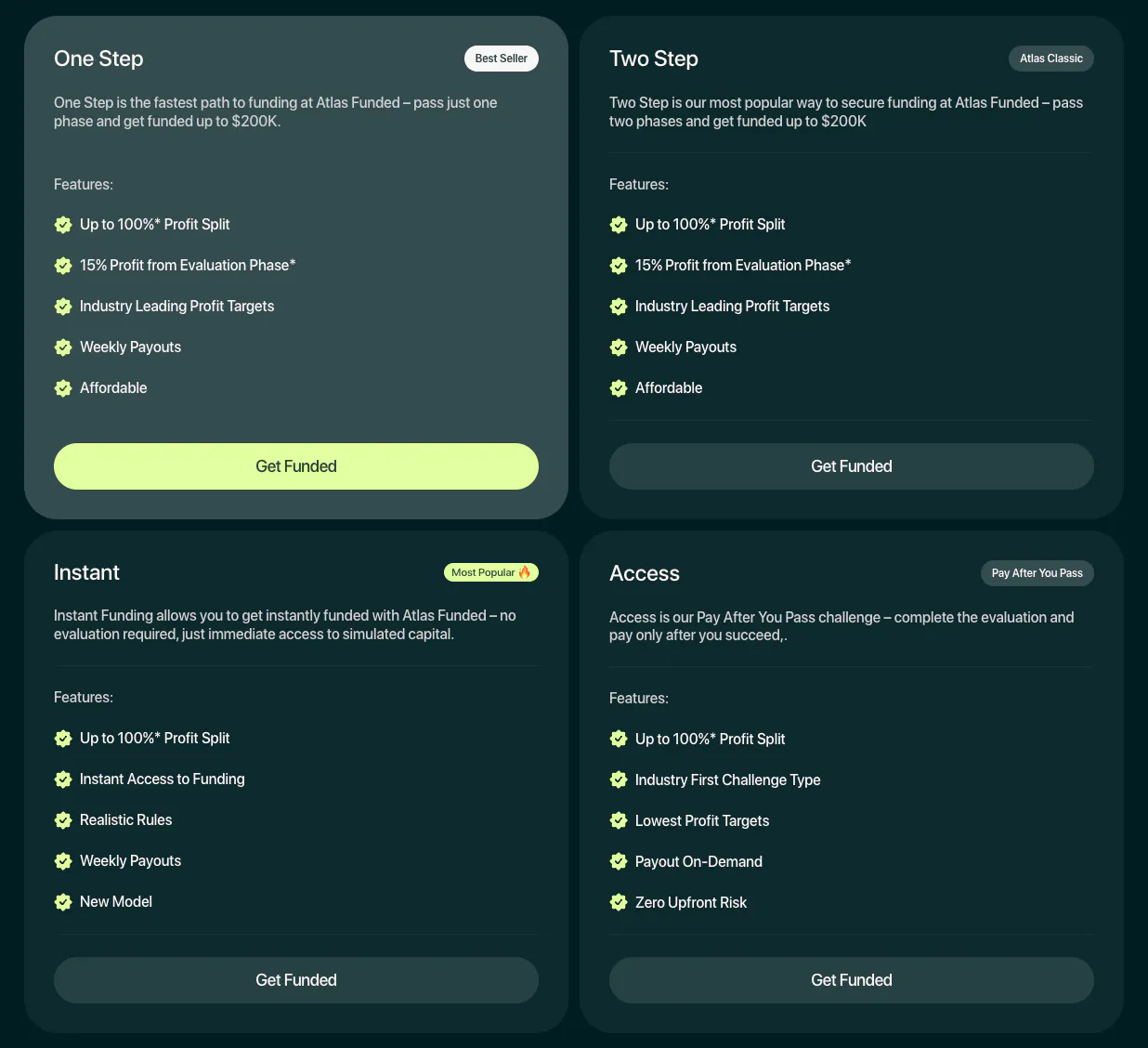
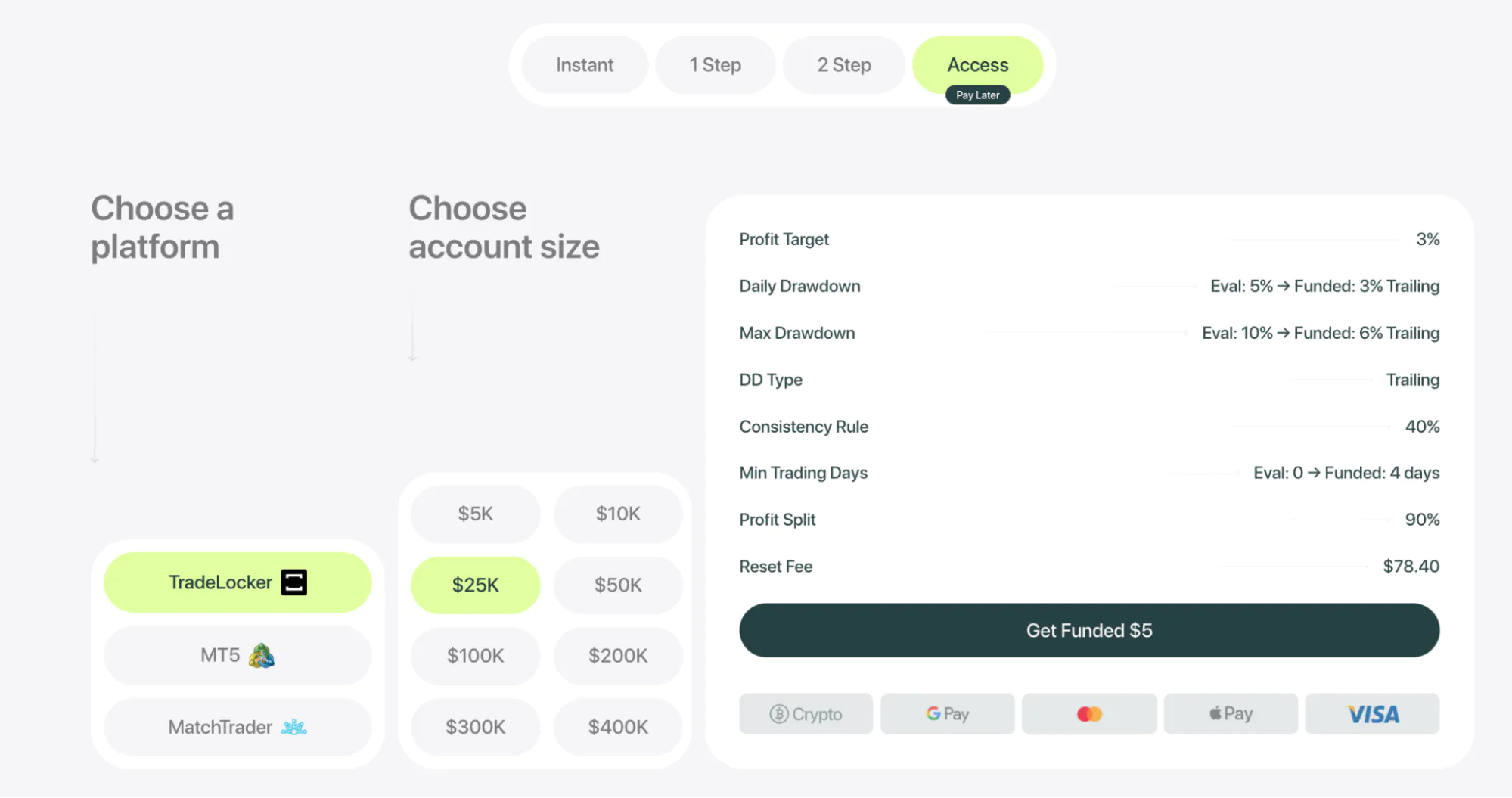
The model to look at here is Free Access, our $0-upfront pay-after-you-pass challenge. Step 1 has a minimum trading days requirement of zero and an unlimited trading period. Hit the 3% profit target inside a 7% trailing overall loss and a 5% trailing daily loss, and you're through. One session is enough if the session goes your way.
Costing nothing to start changes the calculation on a fast pass. Most firms charge you upfront, so a one-day attempt that goes wrong costs you the fee. With Free Access there's no fee until you've already passed, and the funding fee is refunded on your fourth payout.
Where we do apply a day count: the funded stage requires 4 trading days with at least 1% profit on each before you can request a payout, alongside a 30% consistency rule. We think that's worth stating plainly rather than burying, because most firms have an equivalent rule and most guides don't mention it. If you want it gone, the No Minimum Trading Days add-on removes the funded requirement for +20% at checkout. As far as we can tell we're one of the few firms that lets you buy the rule away rather than simply live with it.
Just two caveats: Our 1-Step Standard model, which is a different product, does carry a 5-day requirement at 0.5% profit per day on both the evaluation and funded stages, again removable with the add-on. And we can't accept US residents because of restrictions on the assets we support. If that's you, our guide to prop firms that accept US clients is a better starting point than this list.
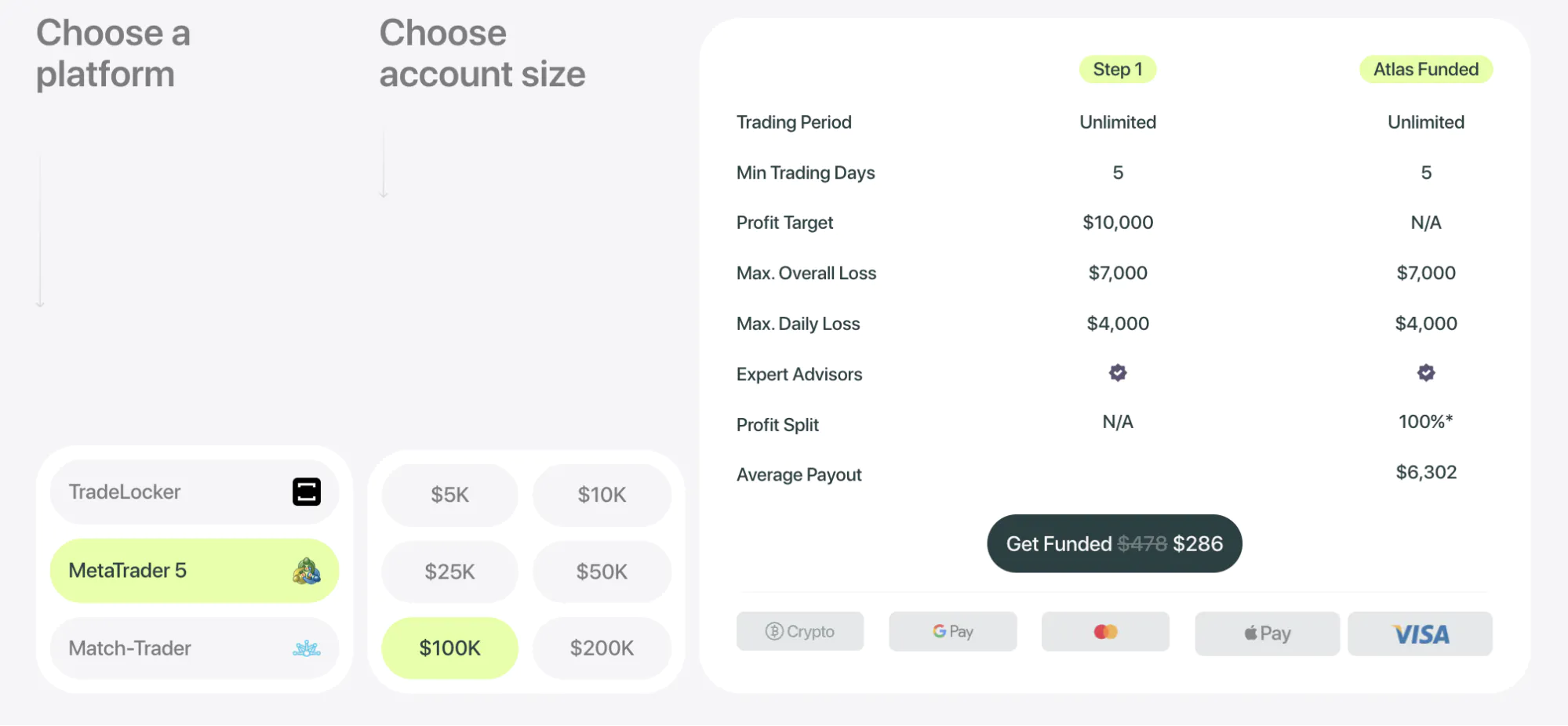
Beyond the day rules: accounts up to $400,000, MT5 and TradeLocker, EAs allowed at every stage, and payouts processed in 24 hours or we add $1,000.
Pros
- Zero minimum trading days and no time limit on the Free Access evaluation
- $0 upfront, so a fast attempt costs nothing if it fails
- Funded-stage day requirement can be removed with a paid add-on
- Up to 100% profit split, EAs allowed throughout
Cons
- Not available to US residents
- 4-day requirement on the funded account unless you buy the add-on
- The 1-Step Standard model is not a no-min-days product
2. Apex Trader Funding
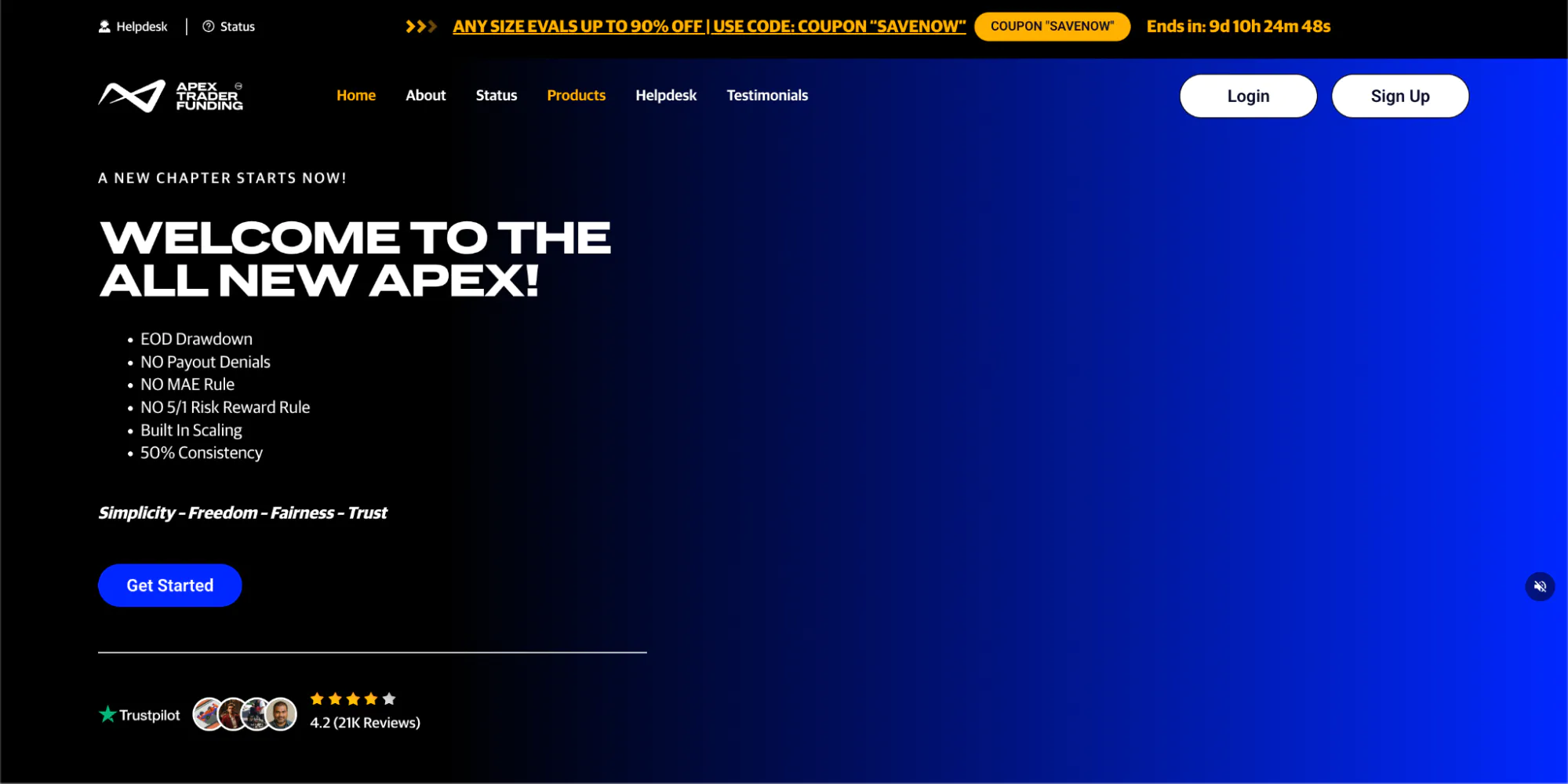
One of the stronger options on this list for futures traders, and evaluation rules have been reviewed by many to be clean, as well. Apex rebuilt its product line in March 2026 around two account types, End-of-Day Trailing and Intraday Trailing. Neither applies a minimum trading day rule or a consistency rule during the evaluation, and Apex says outright that an EOD evaluation can be passed in a single trading day.
The profit target is 6% of starting balance. You choose your drawdown structure, which is the real decision. EOD recalculates the trailing threshold once at session close, so intraday paper profit doesn't move your floor. Intraday follows your highest unrealised equity in real time, which is far harder to manage if you let winners run.
The catch is the calendar. You get 30 days of access to the evaluation, so while there's no day count there is a deadline. And once you're on a Performance Account, each payout needs 5 qualifying days, a $500 minimum and 50% consistency, meaning no single day can be more than half your total profit for that request.
Pricing runs on a monthly subscription rather than a one-off fee, which is worth modelling if you expect to take a while.
Pros
- No minimum trading days and no consistency rule on the evaluation
- Choice of EOD or intraday trailing drawdown
- 100% of the first $25,000, then 90%
- Up to 20 accounts, US-friendly
Cons
- 30-day limit on the evaluation
- Monthly billing gets expensive if you're slow
- Payouts need 5 qualifying days and 50% consistency
3. Bulenox
.webp)
A useful example of how differently the two stages can be treated. Bulenox runs Qualification, then Fast Track, then Momentum. The Qualification account, which is the evaluation, has no minimum trading days and no consistency rule. Pass it however quickly you like.
.webp)
Then the Master account asks for 10 trading days before your first payout, plus a 40% consistency rule, and the consistency ratio is calculated across your whole trading history on that account rather than the current cycle. A big day from three weeks ago still counts against you, and a subsequent losing session can push you out of compliance without you doing anything wrong.
Entry costs are among the lowest in futures, which is the main draw. If you want the fastest route from purchase to funded account, this works. If you want the fastest route to cash in hand, ten days is a long runway.
Pros
- Zero minimum trading days on the Qualification account
- No consistency rule during the evaluation
- Cheap entry, weekly Wednesday payouts
- 100% of the first $10,000, then 90%
Cons
- 10 trading days required before your first Master payout
- 40% consistency rule calculated over the account's full history
- Futures only
4. Goat Funded Trader (3 Step and Pay Later only)
Goat gets listed as a no-minimum-days firm constantly. Read their help centre and the picture is more specific than that: most of their models do have a day count. 1 Step is 3 days, or 4 for accounts bought from 27 July 2026.
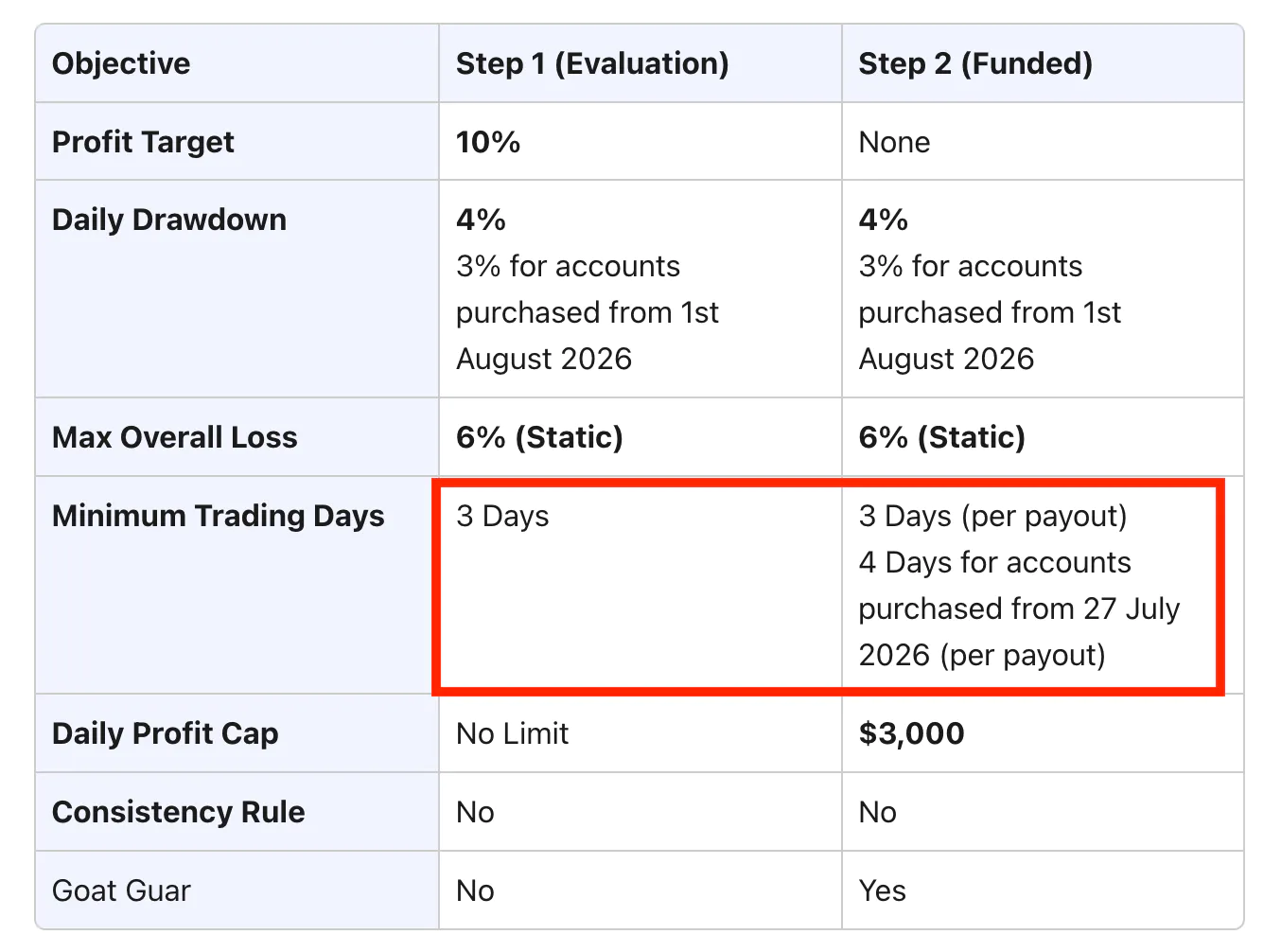
2 Step Standard and 2 Step GOAT are 3 days, or 4 from 25 July 2026.
.webp)
GOAT Blitz wants 5 in the evaluation and 5 per payout.
.webp)
What qualifies is the 3 Step, which has no requirement during any evaluation phase.
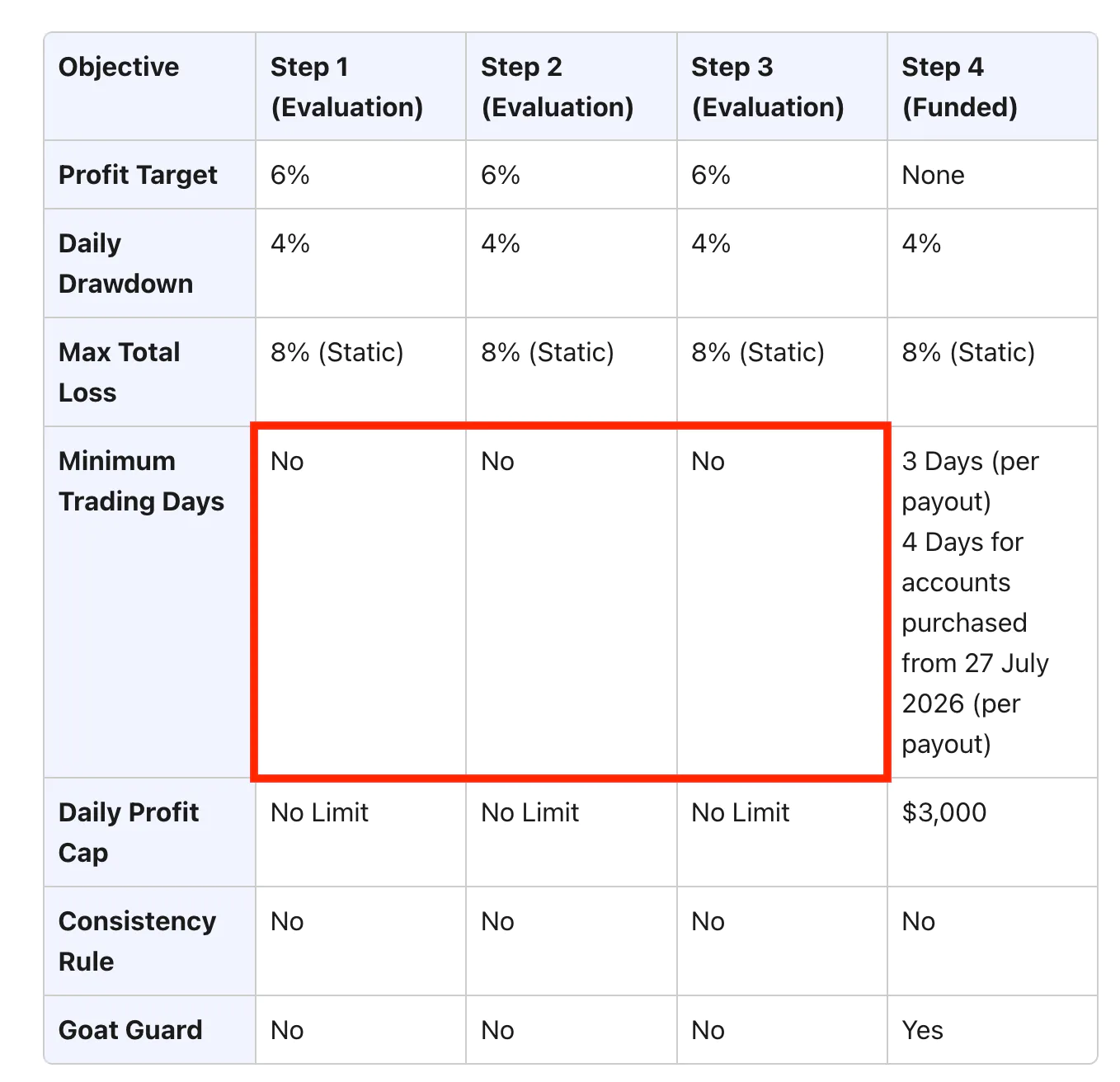
There’s also Pay Later, which has none during the evaluation and 3 once funded. If you're going to Goat for this specific reason, those are the two products to look into.
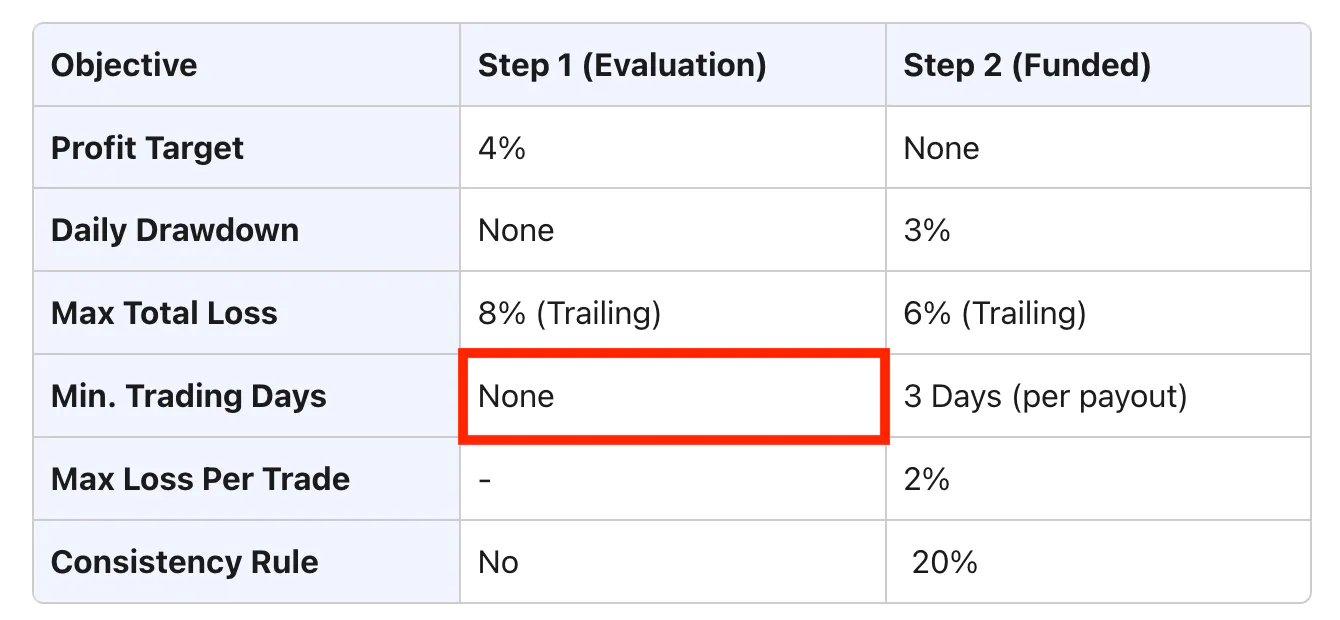
A valid trading day at Goat means at least 0.5% profit on your initial balance, and the day counter resets after every payout. Copy trading is prohibited across the board, which rules the firm out for some.
Pros
- 3 Step has no day requirement across any evaluation phase
- Pay Later removes it from the evaluation entirely
- Accounts up to $800,000, news and weekend holding permitted
Cons
- The no-min-days claim only holds for two of their models
- Day requirements increased on several models in July 2026
- Copy trading prohibited
5. FXIFY
.webp)
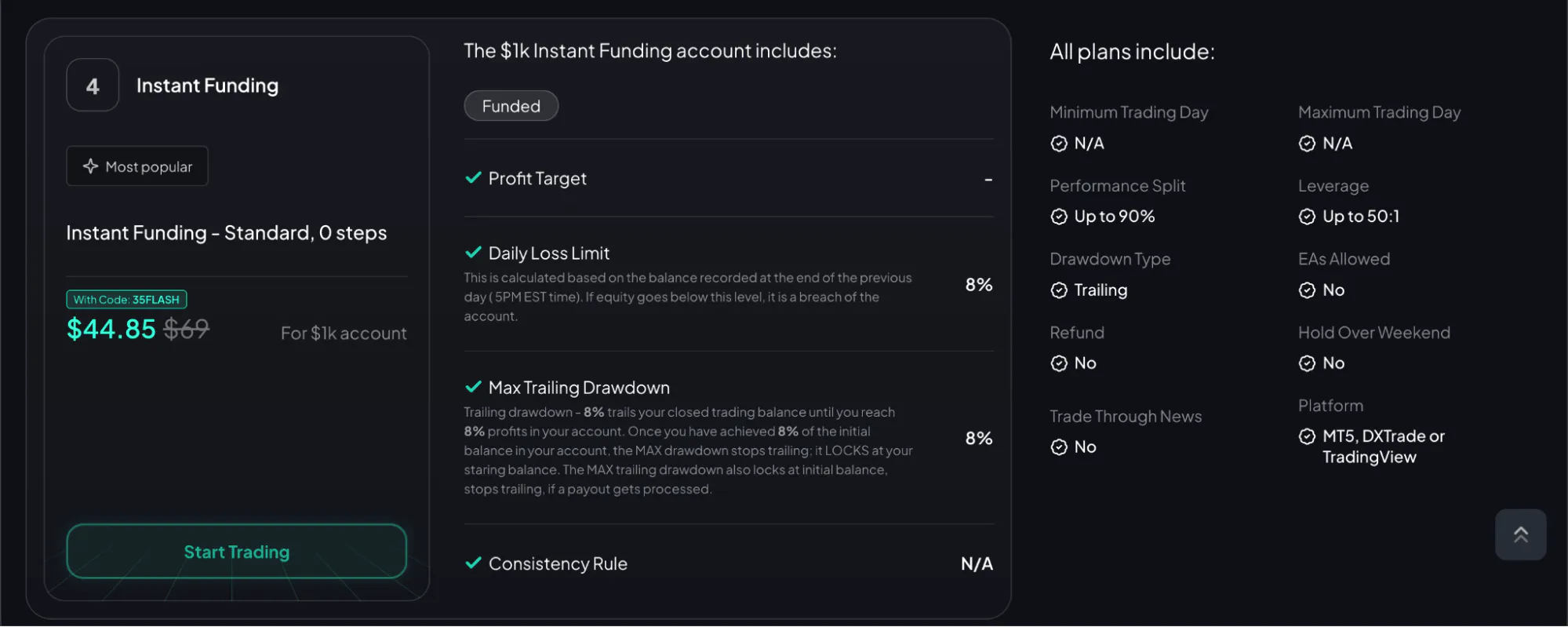
FXIFY's evaluations do apply minimum trading days, so ignore the headline if the evaluation is what you're buying. The product that qualifies is Instant Funding (Standard), which skips the evaluation altogether and carries no minimum trading days, no daily loss limit and no consistency rule. It starts at $69 for a $1,000 account and runs to $100,000, on an 8% trailing drawdown that locks at your starting balance once you're 8% up or take your first payout.
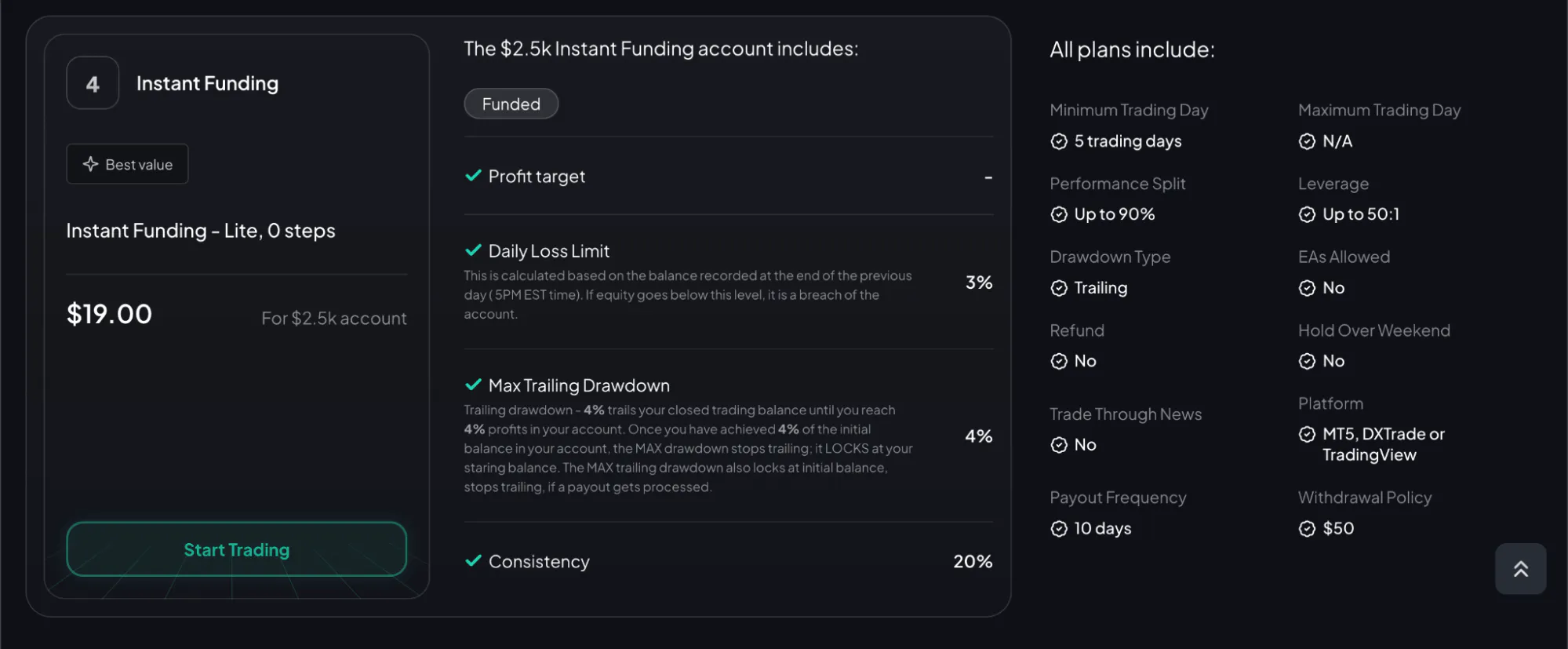
The Instant Funding Lite tier introduced in February 2026 starts at $19, which is about the cheapest entry to a funded account anywhere, but it tightens the drawdown to 3% daily and 4% trailing and adds a 20% consistency rule.
Evaluation accounts scale to $400,000, not the $100,000 figure that circulates in a lot of comparison content. Worth correcting, because it changes the value calculation considerably.
Pros
- Instant Funding Standard has no minimum days, no daily loss limit, no consistency rule
- Very low entry via the Lite tier
- Up to 90% split, MT4, MT5 and web platforms
Cons
- Standard evaluations do carry minimum trading days
- Reported 14-day requirement before the first funded payout
- Lite tier's tighter drawdown and 20% consistency rule undercut the low price
6. E8 Markets
E8's appeal has always been the account sizes relative to the fee, with E8 One starting at $500,000 for around $1,998. No minimum trading day requirement in the evaluation process, and both phases can be completed at whatever pace suits you.
The trade-off is at the back end. Reported payout terms require an eight-trading-day wait after completing the evaluation before your first withdrawal, after which requests are processed through an automated system. Splits start at 80%, which takes some of the shine off the headline capital.
Rules are laid out clearly, which counts for more than it sounds like in this industry.
Pros
- No minimum trading days in the evaluation
- Large starting capital for the fee
- Forex, indices, commodities and crypto on MT5
- EAs supported
Cons
- Eight-day wait before the first payout
- Splits start at 80%
- Conservative leverage
7. My Funded Futures
Frequently listed as a zero-day firm, though current reporting puts the minimum at around two trading days on most plans, which is low rather than absent. Worth checking against your specific plan before you buy on that basis.
What stands out is payout speed. The Rapid plan allows daily payout requests starting 24 hours after your first trade and applies no consistency rule, which is unusual and genuinely useful if you trade around high-volatility events. The Builder plan does apply a 50% consistency ratio, so the plans behave quite differently.
One-step evaluations, EOD trailing drawdown, no daily loss limits on most plans, NinjaTrader and TradingView support. Account sizes run from $25k to $150k. Traders on Reddit have flagged the Maximum Loss Limit resetting tight after a first withdrawal, which is worth reading up on before you commit.
Pros
- Very fast payouts, daily on the Rapid plan
- No consistency rule on Rapid
- No daily loss limits on most plans
Cons
- Around two minimum trading days on most plans, not zero
- Futures only
- Tight post-payout loss limit reported by traders
8. Funded Trading Plus
Both evaluation and instant funding routes, with the instant accounts carrying no minimum trading days and no profit targets. Start trading immediately, withdraw after a short waiting period.

The website is the weak point. Between the raffles and the pop-ups, working out which account you're actually buying takes longer than it should, and the number of account structures compounds that. Splits start at 80% and the largest starting size is around $200,000, both mid-table.
Support for several hundred CFD instruments on MT4 and MT5 is the reason to consider it, particularly if you want breadth of instruments over headline capital.
Pros
- Instant funding with no minimum trading days or profit target
- Hundreds of CFD instruments on MT4 and MT5
- Multiple account structures for different experience levels
Cons
- Confusing site and product range
- 80% starting split
- Maximum starting size around $200,000
Firms That Advertise It but Still Count Days
These four appear on most "no minimum trading days" lists. Their own documentation says otherwise, at least on the models people are most likely to buy.
AquaFunded
The 1 Step Standard help centre article states that to pass the evaluation you must complete a minimum of 3 trading days regardless of when you reach the profit target, each with at least 0.5% profit. Instant Funding requires 5 days at 0.5% per day. Pay After Pass requires 5 before you're eligible for a payout. The TryAqua $1 model requires 5 before withdrawal.
None of that makes AquaFunded a bad firm. The 90% standard split is strong, there's no time limit, and the rules are documented properly. It just isn't a no-minimum-days firm, and a lot of guides say it is.
Top One Trader
.webp)
Runs a "3 Profitable Days Rule" on 1 Step FLASH, which applies to both the challenge and the funded account before a payout. A profitable day means net profit of at least 0.5% of your initial balance. The 2 Step Plus model requires five profitable trading days across Phase 1, Phase 2 and funded. Their help centre gives a worked example of a trader who hit the profit target on day one and finished the required five profitable days on day six.
Payout speed is the real selling point here, with requests processed in around 24 hours, plus a 30-day inactivity rule and a $25,000 rolling monthly cap on combined profits and withdrawals.
FundingPips
The 2 Step Standard help article states you must complete a minimum of 3 trading days to pass. Worth knowing before you buy on the strength of a comparison table that says otherwise.
FTMO
.webp)
Often cited as requiring 10 days, which is wrong, and sometimes as 5, also wrong. FTMO's trading objectives page sets the Minimum Trading Days rule at 4 trading days per phase on the Challenge 2-Step, and states there is no such rule on the subsequent funded account. The 1-Step programme replaces it with a Best Day Rule capping any single day at 50% of your total positive-day profit, which in practice means you need two or three green days regardless.
There's no time limit on either phase, so FTMO is a no-deadline firm rather than a no-day-count firm.
Where the Day Count Comes Back
Four rules quietly reintroduce a day requirement after you've passed. Check all four before you buy anything on the strength of a headline.
- Minimum days before the first payout: The most common one by far, and the one comparison tables skip. Bulenox wants 10 on the Master account. Apex wants 5 qualifying days per payout request. We want 4. A firm can be completely honest about having no evaluation day count and still keep you waiting a fortnight for money.
- Consistency and best-day rules: These cap how much of your total profit can come from one session, typically 20% to 50%. Apex uses 50% on payout requests. Bulenox uses 40% across the account's whole history. AquaFunded's 2 Step models use 25%, its TryAqua model 15%. Ours is 30% on Free Access, 20% on Instant. Pass in one enormous day and a consistency rule can leave you unable to withdraw until you've traded enough additional days to dilute it, which is a minimum-days rule wearing a different hat.
- Inactivity clauses: Most firms close or suspend accounts after a period without a trade, usually 30 days. Top One Trader requires at least one trade every 30 days on challenge accounts. Apex closes a Performance Account after 30 consecutive days without two qualifying profitable days in the rolling window. If your strategy goes quiet for a month, put a small trade on.
- Trailing drawdown: Not a day rule, but it changes what a fast pass costs you. A trailing drawdown that follows your equity high, especially one that tracks unrealised profit intraday, punishes the large single-day win that a no-min-days account is supposed to let you take. Static or end-of-day drawdown is friendlier to that approach.
Best by Trading Style
If you're a swing or position trader (holds of one to seven days)
Trailing drawdown, not the profit target, is what ends most swing attempts. Prioritise static or end-of-day calculations.
If you're a scalper or news trader (holds of seconds to hours)
Watch the consistency rule more than the day count. Concentrating your profit into one volatile session is exactly what those rules are designed to catch.
If you trade futures: Apex, Bulenox, and My Funded Futures are the relevant names. Our futures prop firm guide goes into the platform and data-feed differences.
If you use EAs or algos: Atlas Funded allows them at every stage, as do Bulenox and FXIFY on select programs. Apex and Maven Trading prohibit them. More detail in our guide to prop firms that allow EAs.
How to Choose
The day count is one variable. Here's what to weigh alongside it, cross-referenced to the columns in the table above.
- Read both stages: Evaluation rules and funded rules are separate documents at most firms and they rarely match. The number you care about is usually the funded one, because that's what stands between you and a payout.
- Check the profit target against the drawdown, not in isolation: A 3% target inside a 7% trailing drawdown is a different proposition from 10% inside 10%. The ratio tells you how much room you have to be wrong.
- Work out the cost of failing, not just the cost of entering: A $478 challenge you fail twice costs more than a pay-after-you-pass model you fail four times. If you're attempting a fast pass, the downside of the attempt matters more than the headline fee.
- Compare payout timing honestly: Weekly is a reasonable floor. Some firms process on demand or within 24 hours; others run 7 to 14 day cycles and add a first-payout waiting period on top. Our daily payout guide breaks down who actually pays when.
- Confirm your platform and your market: Futures firms cluster around NinjaTrader and Rithmic, forex firms around MT4, MT5 and cTrader. Proprietary platforms can be good but carry a learning curve you may not want during an evaluation.
- Check availability from where you are: US access changes frequently and without much notice. Verify it on the day you buy.
FAQs
Get Started With Atlas Funded
If you've read this far because you're tired of day counts, our Free Access challenge is the model built for you:
- Zero minimum trading days and no time limit on the evaluation
- $0 upfront. You pay the funding fee only after you pass, and it's refunded on your fourth payout
- 3% profit target, 7% trailing overall loss, EAs allowed at every stage
- Up to 100% profit split and payouts in 24 hours, or we add $1,000
- The funded-stage 4-day requirement can be removed with the No Minimum Trading Days add-on
Prefer to skip the evaluation entirely? Our instant funding accounts put you on live capital from purchase.
Not sure which model suits you? Compare all five.
Every Atlas account also enters our monthly $200k giveaway automatically.
.webp)
.webp)
.png)



.avif)
.avif)
.avif)
.avif)