


If you’re eagerly searching how to become a proprietary trader, you’ve probably already run into the hype-heavy videos regaling how it’s possible to start in the industry in seven days, or gotten overawed by dense industry articles covering terms like “market microstructure” or “derivatives pricing”.
There’s a lot of content out there, and it can be difficult to make sense of it all if you just want a practical guide for 2026.
That’s why we’re going to strip things back and explain proprietary trading in plain English. We’ll define what it actually is and how people really get into it, plus detail prop trading salaries and what the day-to-day looks like. There’s also a list of YouTube channels to follow and other resources to help you become a prop trader.
Let’s get straight into it.
What is proprietary trading?
First, it is useful to understand what a prop firm is and how it works. A proprietary trader (regularly shortened to “prop trader”) is someone who trades a prop firm’s capital to generate profit. You aren’t using your own money like an independent day trader typically does, or dabbling with client money. The firm takes the financial risk, and you’re rewarded based on how well you perform.
As a trader, you’ll speculate on specific markets, aiming for consistent returns over time. Depending on the firm, that might mean trading stocks, forex (FX), commodities, crypto, or indices.
With Atlas Funded, for example, traders can access all of these markets across multiple platforms, and any profits generated are shared between them and the firm via a profit split. Both parties benefit.
The main difference with prop trading is that you’re trading firm capital. This means you’re expected to follow defined rules around:
- Risk
- Drawdowns
- Execution
Do that well, and you keep trading and earning. It’s all about showing you can manage risk and make good decisions consistently. Break any rules and your access to capital is very likely to be cut.
Types of proprietary trading firms
There are two main types of prop firms: institutional or professional prop trading and funded account prop firms. They each offer a very different career path, but there’s no definitive ‘best’ route; it all depends on how you want to become a prop trader.
1. Institutional prop trading
This is the trail where you get a “real” job as an employee of a trading firm. You’re hired, trained, supervised, and paid a mix of a base salary, plus a nice performance-based bonus when things go well.
Examples of firms that hire traders in this way include Jane Street, Optiver, IMC, and Susquehanna International Group (SIG). These firms run structured internships and graduate programs to funnel talented traders through the right channels so they can learn and thrive.
This path looks and feels like a conventional career, but it is very demanding. It’s a performance driven-environment.
2. Funded account prop firms
This is a newer model and far more accessible for traders looking to get into the industry. Instead of being hired, you trade a funded account — some firms have ‘instant’ options where you can get started almost immediately. There are also no challenge prop firms that can give you immediate access. You then play by the firm’s rules and earn a share of the profits if you do you well.
Atlas Funded sits in this category. We offer multiple program types depending on what sort of aspiring prop trader you are, allowing you to use platforms like MT5 and Trader Locker. There are also clear rules around things like risk limits and trade duration.
You don’t earn a salary with this route, but you do get to operate in a structured environment where you showcase your skills and build a track record without risking your own money.
One of the most trader-friendly innovations in this space is the pay after you pass model. With Atlas Funded’s Access challenge, you don’t pay the full fee until you’ve actually passed the evaluation.
What kind of prop trader do you want to be?
Before you dive into the logistics of becoming a prop trader, it’s good to step back and think about what sort of trading actually suits you. Prop trading roles and proprietary trading strategies can look wildly different.
- Short term trading - you’re taking quick opportunities during the day (but not usually “seconds-fast” as firms often have 3-minute rules)
- Swing trading - you hold your position for days to weeks.
- Market trading - you’re providing buy and sell prices and trying to profit from many small edges.
- Quant trading - you lean heavily on math and coding to make system-based decisions.
In prop trading, trades are usually made on longer time frames — there’s a focus on the slow burn and being consistent and judicious in entries and exits. It’s not a place for “hype” and ultra-aggressive strategies (though you’ll still have room to be creative and think outside the box).
Most graduate roles and internships focus on decision-making and risk management, so get used to this mindset if you’re just starting out.
The two main routes: ‘job path’ vs ‘funded path’
The main job routes are closely linked to the type of proprietary trading firm you want to work with or for. First, there’s the hard yards of landing a role in the industry, then the more democratic, accessible path with prop firm accounts.
Route A. Get hired as a trader
Getting hired as a trader is the traditional route into institutional prop trading — the job path. Most traders start with an internship or graduate program, and then get funneled through the system from there, progressing from junior trading to bigger roles.
This path is very competitive, and there are no ‘shortcuts’. You’ll need to put lots of work in over many years in a demanding industry, but the long-term upside is high if you perform well.
You can see what these roles look like at:
- Jane Street’s internships and trading internship overview
- IMC Graduate trader role
- Optiver early careers (graduate roles + trading)
- SIG EU internships page for a London/Dublin pipeline

Most traders at these firms have degrees in things like math, computer science, engineering, and statistics.
Route B. Use a prop firm to build proof
The first route has lots of barriers to entry, especially if you’re planning to switch careers or aren’t able to go to university. The second route is ‘easier’ per se, as you don’t need a degree or an internship to get going. What you do require is the ability to follow rules and produce consistent results. Obviously, you’ll still need knowledge (lots of it), so you can’t expect to rock up and start trading on a whim.
This route works best when traders treat it as a way to learn on the job and build proof, and not as an avenue to make easy money. The rules from prop firms are in place to test your discipline and risk control, not for ‘go wild or go broke’ strategies.
Funded accounts are a great stepping stone. They let you demonstrate consistency and lay the groundwork for you to pursue larger opportunities (or whatever your objectives are for your prop trading career).
Take a look at how it works at Atlas Funded to see how you can make money trading a prop firm’s capital.
What hard skills do I need for prop trading?
For the technical side of prop trading, you’re going to have to learn quite a diverse set of skills. Here are some examples of the hard skills experienced traders use every day in their job roles.
- Technical analysis - reading charts, identifying trends, support/resistance, key indicators.
- Fundamental analysis - understanding economic data, earnings reports, market-moving news.
- Risk calculation - position sizing, stop-loss placement, drawdown management.
- Trading platforms - MT4/MT5, Trading View, cTrader, and other software.
- Order types and execution - market orders, limit orders, stop orders, conditional orders.
- Quantitative skills - basic statistics and probability, understanding trading algorithms.
- Portfolio management - diversifying trades, hedging positions, managing correlated assets.
Step-by-step: how to become a proprietary trader
There’s a lot to digest there, and it’s easy to get lost in the weeds when trying to map out a journey into prop trading. A good jumping-off point is learning the fundamentals, so you’ll have a familiarity with all the concepts and what they mean. Then you can progress from there, depending on the route you want to take.
Step 1. Get the basics down without drowning in theory
It’s best to keep it as simple as possible early on. Knowing a few trading concepts in detail will help you to progress faster than trying to memorize 50 different strategies. Make sure you understand:
- What moves a market - news, rates, risk appetite, liquidity, etc.
- How orders work - market vs limit — simple stuff
- Why risk management matters - so one bad session doesn’t torpedo your best laid plans.
You don’t need a degree at this stage. Just do some courses online and read as much as you can.
Step 2. Select one market and one timeframe for 30 days
A big mistake beginners make in 2026 is switching back and forth between markets and timeframes without giving the initial strategy to take root and develop over time. If you spot any strategies telling you to trade FX today and then crypto tomorrow — give them the side eye. You need to concentrate on one thing only. It takes practice!
Start by picking one:
- Market - EUR/USD or NAS100, for example.
- Timeframe - 15 minutes or 1 hour
- Setup - one repeatable pattern you can explain in one simple sentence.
The aim is to stick to it for at least a month, as consistency beats variety at the start. It’s good for
Step 3. Open a demo account and start practicing
Before committing to a job path, it’s time to get some trades under your belt using the “pick one” mindset. This is purely a practice phase, a chance to test out things you’ve been learning so you can see that you’re capable of trade consistently.
- Open a demo account or very small personal account on platforms like MT5 and Trading View.
- Trade as it’s real money using small position sizes and 1 to 2% of capital per trade
- Stick to a chosen market and timeframe.
- Journal everything. Note down your entry and exit reasoning, the outcomes, and what you’d like to improve.
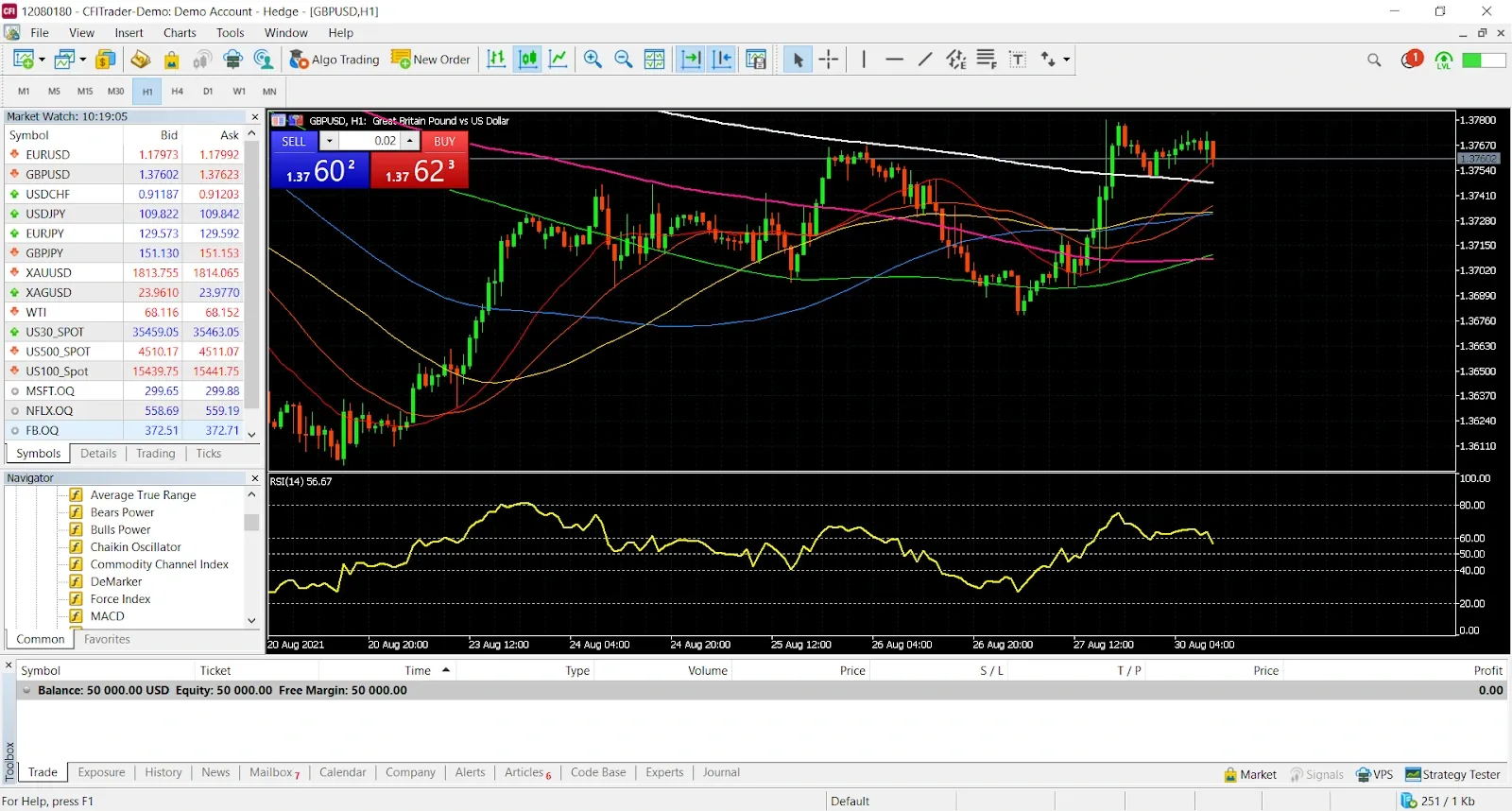
After 30 to 60 days of consistent practice, you should start getting a feel for what works, and more importantly, a solid record of risk control and repeatable results.
For more insights into building consistent results, check out our guide on the best prop trading strategies for 2026.
Step 4. Practice job skills, not just entries
Discipline is the name of the game. Real trading roles emphasize soft skills and developing positive personal traits over winning every trade. You should be able to demonstrate:
- Calm decision-making when under pressure
- Quick mental math - sizing, probabilities, “what happens if…”
- Pattern recognition and fast learning speed
- Being coachable
That’s why many top firms use problem-solving interviews and structured grad programs to nurture and test these traits, as they as so important in prop trading.
Step 5. Choose your entry point
Now, the big decision: deciding which entry to point to become a proprietary trader.
Going for the job path
The traditional job path is similar to other careers, which you might be familiar with. You’ll have to apply for internships and graduate schemes, or go straight for junior trading roles. There will be more on this later, with links to job postings and the salaries you can expect.
To get an idea now, you can look at:
- Indeed
- SimplyHired
- eFinancial careers
- Firm websites
Many of these platforms have dedicated “proprietary trader” searches and other functions that let you drill down to very specific job roles.
Going for the funded path
The funded path is easier as you don’t need an academic background, and there isn’t a formal hiring process. Instead, you trade a funded account provided by a prop firm. The main stipulation is that you follow strict rules set by the firm, and they earn a share of the profits from your successful trades.
This route suits traders who have some market experience but want to prove their consistency and build a track record without risking their own capital. The main decision is selecting your prop trading firm. Take a look at our guide on no evaluation prop firms to get a better idea of the options available.
For many people, these funded accounts are the first step towards large capital allocations and generating a sustainable, long-term income.
Prop trading salary 101
Now we’ve covered how to get into prop trading in detail, let’s look at what you can expect to earn. This is something most people want to know right off the bat — ‘prop trading salary’ is a very popular Google search term for a reason!
Unfortunately, it’s quite difficult to put prop trading salaries neatly in a box, as the min to max pay rate can range from pretty normal to completely absurd depending on the type of firm, and your role and performance within it.
But let’s try to break it down.
How much does a prop trader earn?
Entry-level roles listed as “proprietary trader” on job sites often come with quite modest salaries, especially in the UK. Glassdoor’s UK estimate shows an average of £31k, which isn’t too shabby for a fresh grad, with some roles rising to £65k+. However, these figures are typically a baseline and don’t tell the full story.
For the broader category of “prop firm trader”, things get more interesting in the UK, with a much higher average estimate of £54k rising to £84k.
In the US, salaries are higher in general, so at a legitimate prop trading firm, you’re probably looking at upwards of $100k with enticing bonuses upping annual pay by 50% or more.
When looking at salaries, you’ll usually see a common pathway with matching salaries:
- Assistant trader
- Junior trader (fresh grad)
- Senior trader
- Parter
The real big leagues are for talented quant traders and partner roles at market-making firms. Salaries are huge here, with Jane Street paying a staggering £14m per year for partner roles. The company’s latest accounts shine more light on expected salaries.
- Jane Street spent £555.6m on salaries and allowances over 12 months across its 688 employees.
- That’s an average of £808m ($1.1m) per head.
Good work if you can get it, but it must be stressed that this isn’t what new grads make. Try not to get carried away with what you could earn before you’ve even put in the work to learn the fundamentals. It’s a long journey, don’t rush it!
How prop traders are usually paid
Most of the job roles in the traditional path offer a base salary with a bonus tied to the performance of the firm and the trader. In contrast, most funded account traders get a profit split (a percentage of profits) if they manage to trade within the rules of payout conditions set by the firm.
At Atlas Funded, for example, we use a default 80/20 split for many program types, with upgrade options available depending on the program.
Where to find real prop trading job postings
As we’ve already mentioned, job sites and company pages are your best bet for finding real prop trading job posts. Be wary of vague listings that promise “instant profits” or that ask for large upfront fees. It’s important to check are prop firms legit when contacting companies outside official channels, too.
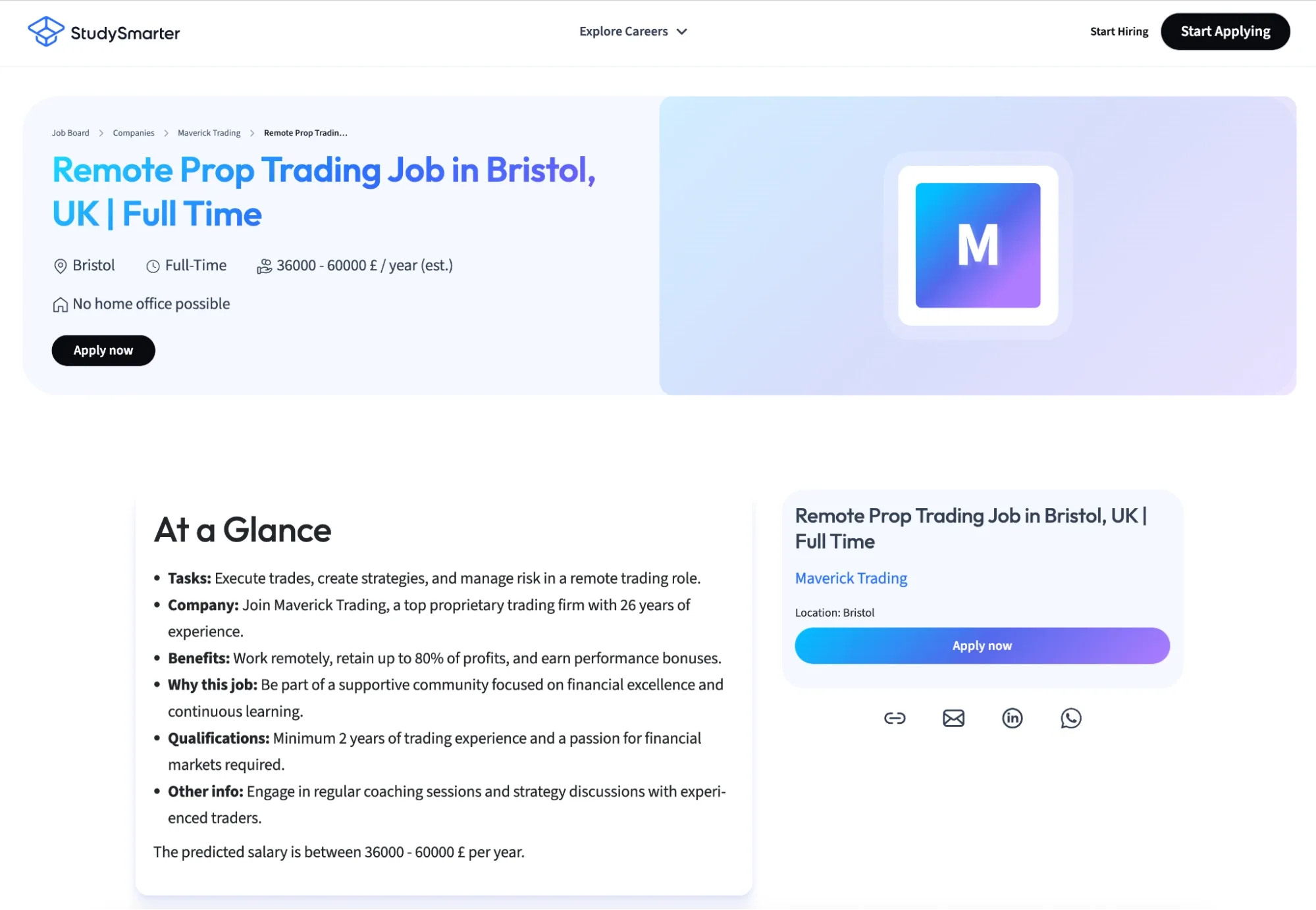
Here’s an example of a job posting on StudySmarter. This is for a remote prop trading job with an expected prop trading salary of between £36k and £60 per year. The main tasks are making trades and coming up with new strategies while managing risk — things we’ve covered in detail in this blog.
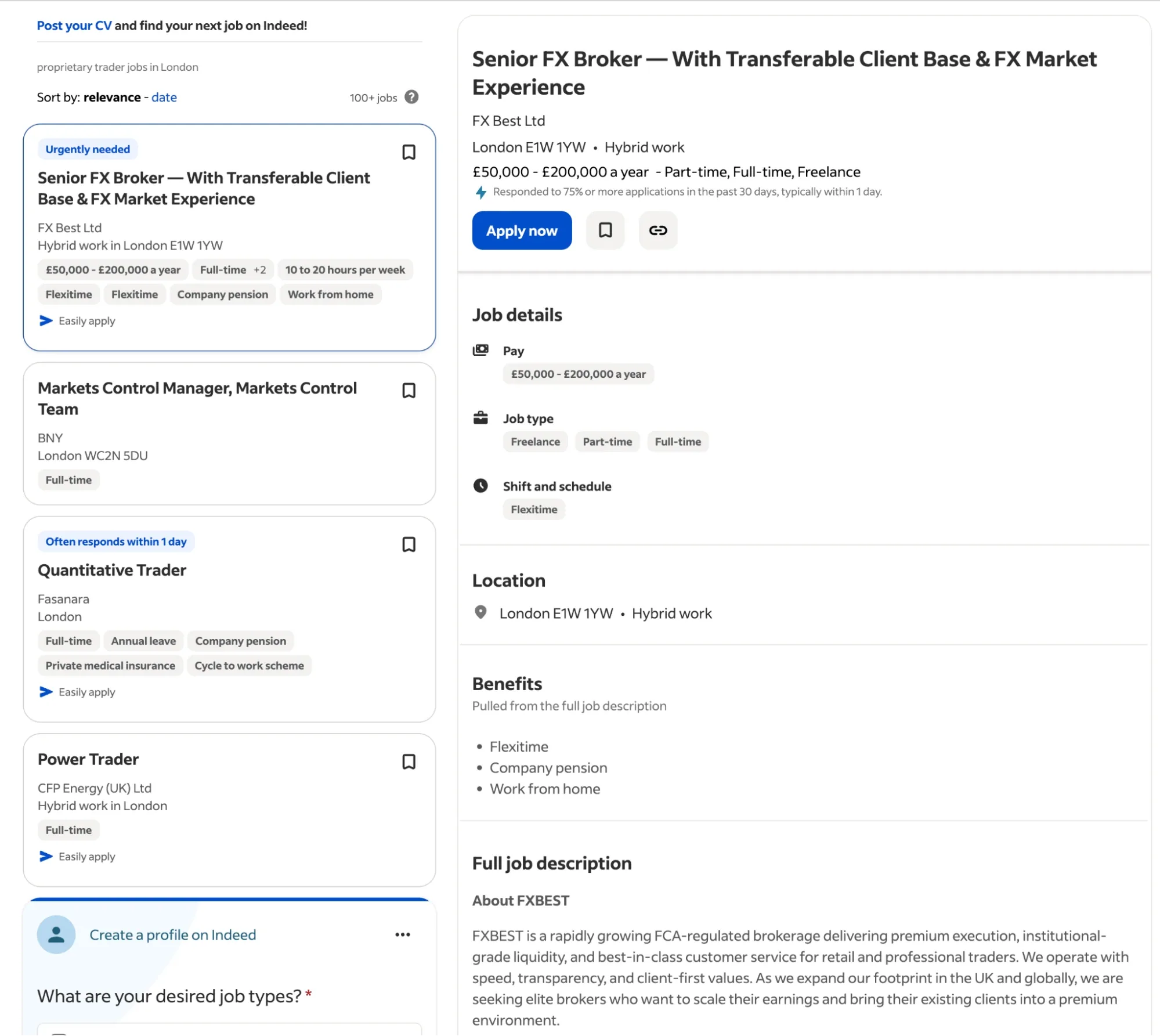
Another, more advanced job listing for a Senior FX Broker available through Indeed after searching using the keywords ‘proprietary trader’. This role, based in London on a hybrid basis, has the typical vast prop trading pay range: £50k to 200k per year.
Tips for finding prop firm trader roles
Tip 1. Use precise job titles - Inputting the term “prop firm trader” can yield results on job sites, but more specific phrases like “execution trader”, “quantitative trader”, and “fx trader” should also be in your repertoire. Lots of sites let you set up alerts for specific terms and email round-ups so you don’t miss out on newly published roles.
Tip 2. Go straight to firm websites - For graduate and internship pathways, navigate to the ‘early careers’, ‘student opportunities’, and ‘internships’ sections on firm websites to see what’s on offer.
Tip 3. Read full description for trading responsibility - Legitimate roles will usually provide some details of risk limits, P&L responsibility, training, and live market exposure. Look for postings that go deep on actual trading duties.
How to interview for prop trading roles
Prop trading interviews are very different from typical finance interviews. You’re being tested on your ability to think and adapt in real scenarios, not recall information about accounting rules or company valuations. It requires a different approach to interview prep.
What interviewers actually test
You should expect a laser focus on:
- Mental math - quick arithmetic, percentages, odds, ratios
- Probability questions - expected value, simple distributions, game-style problems
- Brain teasers - logic puzzles designed to see how you reason out loud
You don’t have to get everything right; that’s not the aim. Interviewers want to see how you logically approach many of the situations you’ll face day to day when prop trading.
Useful prep sources
To swat up for these interviews, there are a few resources you can use:
- Jane Street - Probability and Markets, which is excellent for trading-style thinking
- Mental math trainers like Arithmetic Games
- Speed arithmetic courses like Short-Cut Math
Useful coding prep platforms
If you’re shooting for a more advanced role in quant trading, there’ll be more to cover. Things like programming questions and logic-heavy case studies regularly crop up in interviews for these jobs. As coding plays a part, you can build your skill set using:
- LeetCode
- HackerRank
- Codewars
- InterviewBit
- Coderbyte
Behavioral questions
Finally, behavioral questions are a big part of prop trading interviews, whichever job you’re going for. Expect questions about:
- Handling stress
- Making decisions under pressure
- What you do when something goes wrong
- How you recover from mistakes
Because discipline is a big part of success in this industry, prop firms will be looking at your potential judgment and composure when trading, and are unlikely to be won over by polished ‘management speak’ that’s vague or misleading.
Top prop trading firms
If your goal is to work at a traditional prop trading firm, there are plenty of established names where you can grow a career. We covered a few of these briefly earlier, but the most recognized firms that regularly hire include:
- Optiver - global market-making and prop trading firm
- Jane Street - quantitative trading with a big focus on tech and problem-solving
- IMC Trading - a large proprietary trading firm with a global reach (you’ll likely fund job opportunities in most markets and regions).
- SIG - wide range of trading roles, often with structured training
- Tower Research Capital - quantitative trading, prioritizing high-performance markets
These firms will be on the lookout for talented prop traders who possess strong analytical capabilities and an ability to adapt and learn under pressure.
Instant funding prop firms
You’re also spoilt for choice with instant funding prop firms in 2026. If you don’t fancy having to pass a full evaluation to get the capital you need, there are firms that offer more accessible account types with flexible funding options. These include:
- Atlas Funding
- OFP Funding
- FundYourFX
- City Traders Imperium (CTI)
- FTUK (Funding Traders UK)
For a full breakdown of these prop funding firms, with pros and cons for each, read our blog on the ten best instant funding prop firms.
What the day-to-day feels like (the part most articles skip)
The reality of prop trading might be very different from the image you’ve built up in your head. It’s not a constant barrage of “click buy, click sell” during sessions. Most of the work happens away from live markets and is actually far less dramatic than people expect.
A typical day often starts with reviewing what happened yesterday. Not just the brass tacks of winning traders or losing money, but why decisions were made, and if they followed the framework and plan that was set out.
- Priority #1 - morning meeting to review everything
Over time, patterns start to emerge and certain mistakes repeat. Remember, with prop trading, there is an emphasis on being patient and following through on a strategy over longer time frames. That means refinement is the order of the day.
- Priority #2 - read the news and prepare for the markets to open
The nature of your full day will depend on the role. A quant trader will liaise with developers to craft strategies, while someone in a discretionary role will talk through ideas and press-test the decision with teammates.
- Priority #3 - explain your thinking (you are ultimately responsible for your own profit and loss).
You’ll find the busiest stretches of work occur around the opening and closing of sessions in whichever market you’re trading in. You might find that ‘deep’ work ebbs and flows in between, which is where your soft skills come in as you manage the day.
If you want to find out more about a more realistic sense of day-to-day life as a trader, listening to podcasts and watching YouTube vlogs will uncover some of the mysteries. For example, Chat With Traders is a great resource for making sense of the trader journeys and the processes involved. SIG also publishes content about internships and what they’re like on Instagram and other social platforms.
YouTube channels to follow if you want to become a prop trader
Social media and the rise of influencers and content creators have made it much easier to understand the life of a prop trader and stay up to date with the latest strategies and current ‘meta’.
Here are a few channels we recommend keeping tabs on as you get started in proprietary trading:
- Rayner Teo - independent trader covering the basics with beginner-friendly explanations (great if you’re just starting out).
- SMB Capital - a prop firm based in New York with ‘day in the life’ of prop trader content, plus educational and strategy-based videos.
- Trades by Matt - day trading and market analysis specifically for the crypto and futures market.
- TTrades - an excellent intro guide for futures trading and prop firms, plus other content about funded accounts, position sizing, and general trading theory.
- Mindfully Trading - insights from a full-time forex trader with a focus on being dedicated and disciplined.
Final thoughts - becoming a prop trader
So now we’ve covered pretty much everything you need to know to become a prop trader. But is it a good career choice? If you get your foot in the door and start generating profits for your firm, you’re likely to go far and be handsomely rewarded for doing so. Anyone with top-notch math or coding skills is well-placed to pivot into trading, too — it’s quite accessible in terms of recruitment. The work and lifestyle can also be enjoyable (though demanding).
That said, prop trading isn’t for everyone. Progress can be slow at first, and everything is very results driven, so you’ll need to prove yourself each day. For some, that mindset is appealing and what makes prop trading challenging but rewarding. The option of instant funding firms can also give you a ‘leg up’ if you’re struggling with traditional career paths.
If you want to explore that route, firms like Atlas Funded offer a structured way to trade firm capital and build a track record. We offer multiple trading accounts designed for different prop traders. Sign up today to start your prop trading journey.
How to become a prop trader FAQs
Practical experience and discipline are just as important as formal academic qualifications for modern prop traders. Some prop firms like Atlas Funded also offer instant funding programs for a higher upfront fee if you want to start trading capital immediately. It’s good to build a track record and evidence of your trades, though.
Beginner salaries vary wildly depending on the route you take. Entry-level institutional roles in the UK typically start around £30k to £40k, with bonuses increasing total pay if you perform well. With funded accounts, there’s no fixed salary. Instead, you earn a percentage of the profits you generate.
The fastest route into prop trading is through a funded account prop firm. You can usually start trading within just a few days, as long as you can understand the rules and risk limits. This path skips traditional hiring processes, but is no less professional — you’ll still need to demonstrate patience and discipline.
Ready to take the next step? Explore AtlasFunded's prop trading programs today and put your trading skills to work with the capital to match.

 Senior Writer at Atlas Funded





 Your move
 Only pay the full fee after you pass
 UK
UK ES
ES DE
DE FR
FR IN
IN IT
IT