


9 Cheapest Prop Firms in 2026 (& What You Actually Get)
Challenge fees add up fast when you do not pass on the first try. A $200 evaluation that takes three attempts is a $600 lesson. The real cost of a prop firm challenge is the fee multiplied by how many attempts it takes to pass. That is why finding the cheapest prop firm matters, but only if the rules behind the fee give you a realistic shot at passing.
The problem is that low cost and good value are not the same thing. A $25 challenge with a 3% trailing drawdown can burn through your account faster than a $100 one with a static drawdown and more room to trade.
The cheapest prop firm challenge is the one where the fee, the rules, and the profit split all work in your favor.
We compared nine firms that keep entry costs low without stacking the odds against you. Here is what they charge, what you get, and where the hidden costs are.
Cheap vs. Good Value: What is More Important?
The cheapest prop firm on paper is not always the cheapest in practice. A trader who pays $30 three times for a challenge with tight rules has spent $90 and is still not funded.
Another trader who pays $80 once for a challenge with more forgiving rules is funded and earning. The real cost of a prop firm challenge is the fee multiplied by how many attempts it takes to pass.
That is why the rules behind the fee matter more than the fee itself.
- Drawdown type is the biggest one.
- Static drawdown sets a fixed floor that never moves, giving you consistent room to trade.
- Trailing drawdown follows your equity upward, meaning the higher your balance goes, the less space you have before a breach.
Same price, but very different experience.
Profit split also changes how much you keep after you are funded. A firm charging $40 with a 70% split pays you less per dollar earned than one charging $80 with a 90% split.
Fee refund policies also vary. Some firms give the challenge fee back with your first payout. Others make you wait until the fourth. Some do not refund at all.
Then there are add-on costs. A handful of firms advertise low base prices but charge extra for things like higher profit splits, faster payouts, or the ability to hold trades over the weekend aka swing trading prop firms. By the time you add what you actually need, the final price is no longer cheap.
When comparing the cheapest prop firm challenges, you should look at the whole picture: fee, drawdown type, profit target, split, and what is included without paying extra.
Comparison Table: Initial Fee at a Glance
| Firm | Cheapest Entry | Model |
|---|---|---|
| Atlas Funded | $1–$5 | Pay After You Pass |
| Blue Guardian | $10 | Instant Starter ($5K account) |
| Aqua Funded | $15 | 2-Step Pro |
| Maven Trading | ~$17 ($5K) | 3-Step Challenge |
| Goat Funded Trader | $22 ($5K) | 2-Step GOAT |
| FundedNext | ~$32 ($6K) | Stellar Lite |
| FXIFY | $39 ($5K) | Two Phase Evaluation |
| The 5%ers | $39 ($5K) | Bootcamp |
| Funded Trading Plus | $89 ($10K) | 2-Step Classic |
9 Cheapest Prop Firm in 2026
Here are nine firms that keep entry costs low while still offering conditions you can realistically trade under.
Each one takes a different approach to affordability, so the best pick depends on what matters most to you beyond the price.
1. Atlas Funded (Best Overall Value)
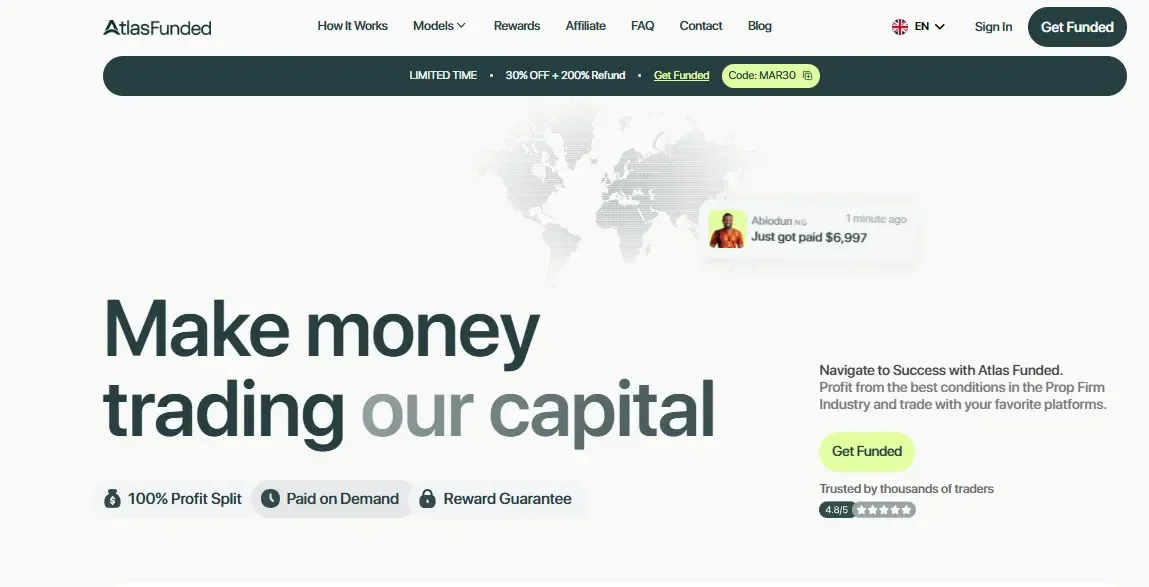
Atlas Funded's Access model is not like the typical prop firm fee structure.
You pay $1 to start the evaluation. The full account fee is only charged after you pass. If you do not pass, you lose a dollar. That is not a discount or a promotion. It is a fundamentally different approach where you prove yourself first and pay second.
The Access challenge is a one-step evaluation with a 4% profit target and no time limit. There are no minimum trading days during the evaluation phase. The max overall loss is 7% trailing, and the daily loss limit is 5%, both trailing.
Once funded, the drawdown tightens to 6% overall and 3% daily, with a 30% consistency rule and a minimum of 4 profitable trading days requiring at least 1% gain each.
Pricing after you pass ranges from $58 for a $5K account to $1,080 for $200K and up to $2,040 for $400K. The fee is refunded on your 4th payout.
The funded profit split is 100% by default on Access accounts. Add-ons are available for weekly payouts, removing the minimum trading day requirement, and bundling everything together at a discount.
Moreover, the account scaling goes up to $2M. Also, it supports platforms including MT5, TradeLocker, and Match Trader. EAs are allowed during both the evaluation and funded stages. You can hold one active Access account at a time with a maximum total allocation of $400K.
If you pass on your first attempt, the total cost of getting funded is $1 plus the activation fee. No other firm on this list offers that kind of risk-to-reward on the entry.
2. Blue Guardian (Cheapest Instant Funding with No Evaluation)
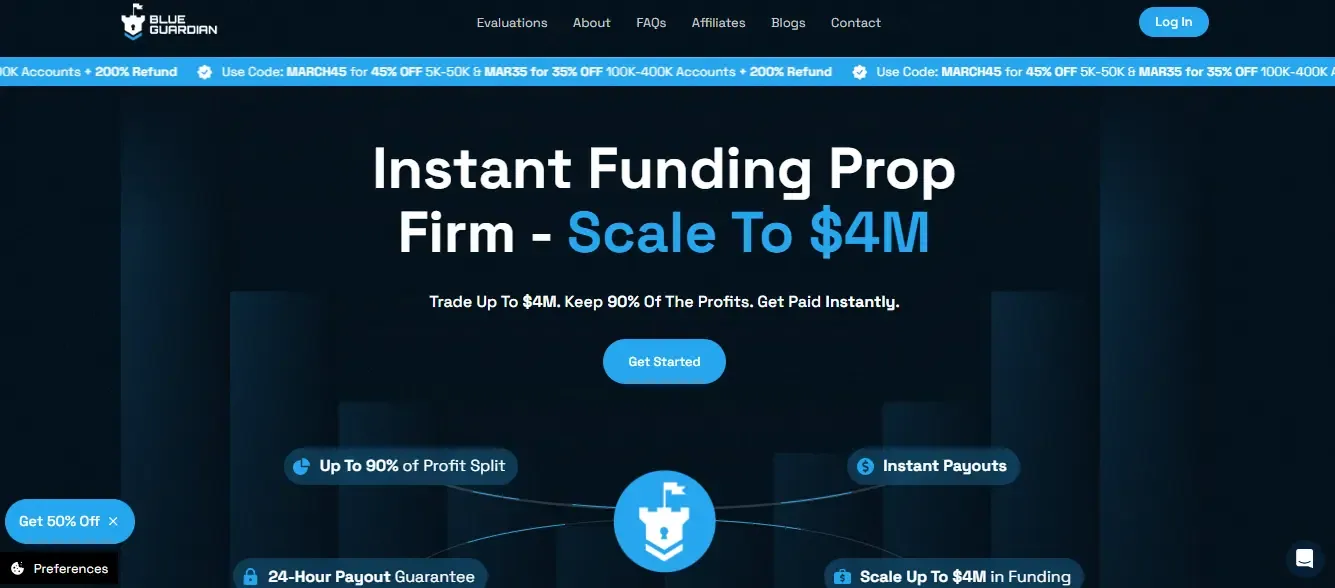
Blue Guardian takes a different approach to affordability. Instead of a cheap challenge, they skip the challenge entirely. For $10, you get a $5K funded account right away. You don’t have to hit any profit target, no phases to pass, and there’s no evaluation period as well.
You just pay, receive your login, and start trading.
The account has a 3% daily loss limit ($150) and a 5% max loss ($250) with leverage capped at 1:30. The profit split is 90%, and payouts are instant. The trading period is indefinite, so the account stays active as long as you trade within the rules.
This makes Blue Guardian the cheapest prop firm for traders who want to skip evaluations and go straight to earning.
The firm also offers 1-Step, 2-Step, and 3-Step evaluation challenges for traders who want larger accounts. The 1-Step Standard requires a 10% profit target with a 4% daily loss and 8% static max drawdown.
Account sizes go up to $200K with scaling to $4M. Challenge payouts are bi-weekly, backed by a 24-hour payout guarantee. If they miss that window, they pay 100% of your profits on that withdrawal. Challenge fees are refunded at the 4th payout.
Platforms include MT5, Match-Trader, and TradeLocker. The firm is UAE-based, founded in 2019.
3. Funded Trading Plus (Cheapest Access to Larger Accounts)
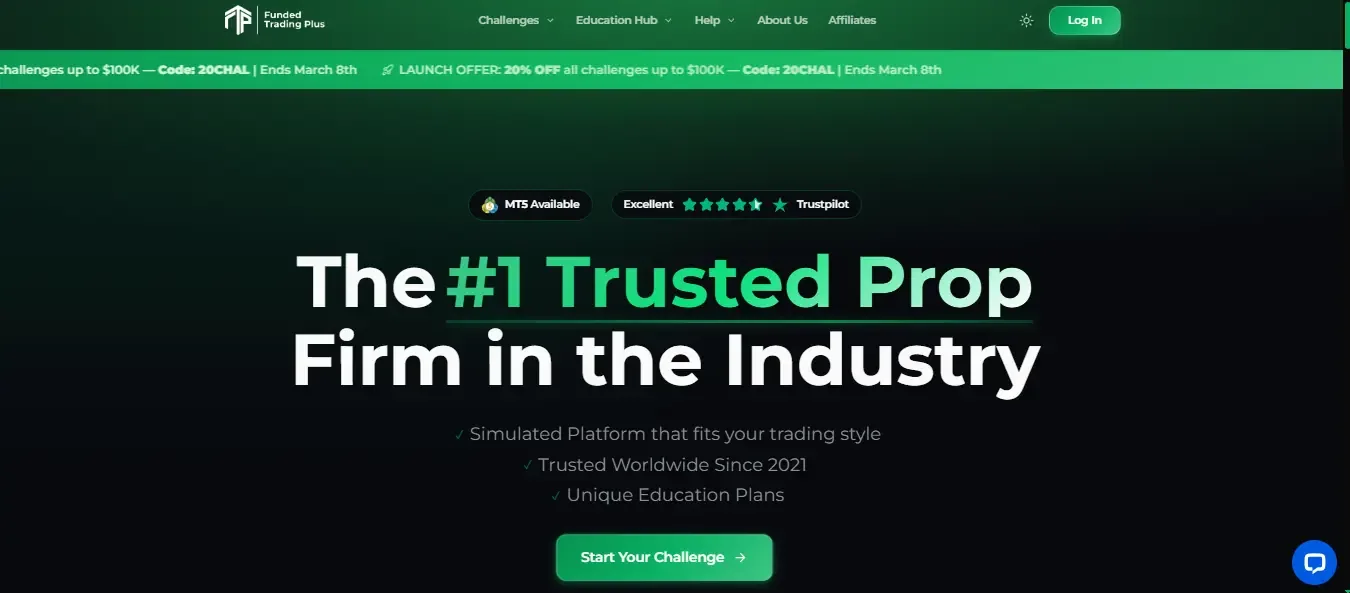
Where Funded Trading Plus stands out is in pricing at scale. Their Express 2-Step challenge fees are among the lowest per dollar of funded capital, especially for mid- to large-account sizes.
A $10K account starts at around $79 to $99. A $50K runs roughly $319 to $399. A $200K account costs around $799 to $999.
The evaluation requires a 7% profit target in both steps with a 4% balance-based daily loss limit and 8% static max drawdown. There is no time limit.
Leverage goes up to 1:50. The firm also enforces a 35% consistency score during the challenge, tightening to 50% once funded, plus a 3% symbol loss limit to prevent overexposure to a single instrument.
The default profit split is 80% with payouts every 10 days. News trading is allowed, subject to their policy. If you breach, resets are available at a 20% discount on the original fee.
The platform selection is the widest on this list: MT4, MT5, cTrader, DXtrade, and Match-Trader. The firm is UK-based, founded in 2021, with a 4.7 Trustpilot rating.
The trade-off is that the consistency score and symbol loss limit add layers of rules that cheaper competitors do not have. The 80% base split is also the lowest default on this list.
4. Aqua Funded (Cheapest Entry with 100% Profit Split)
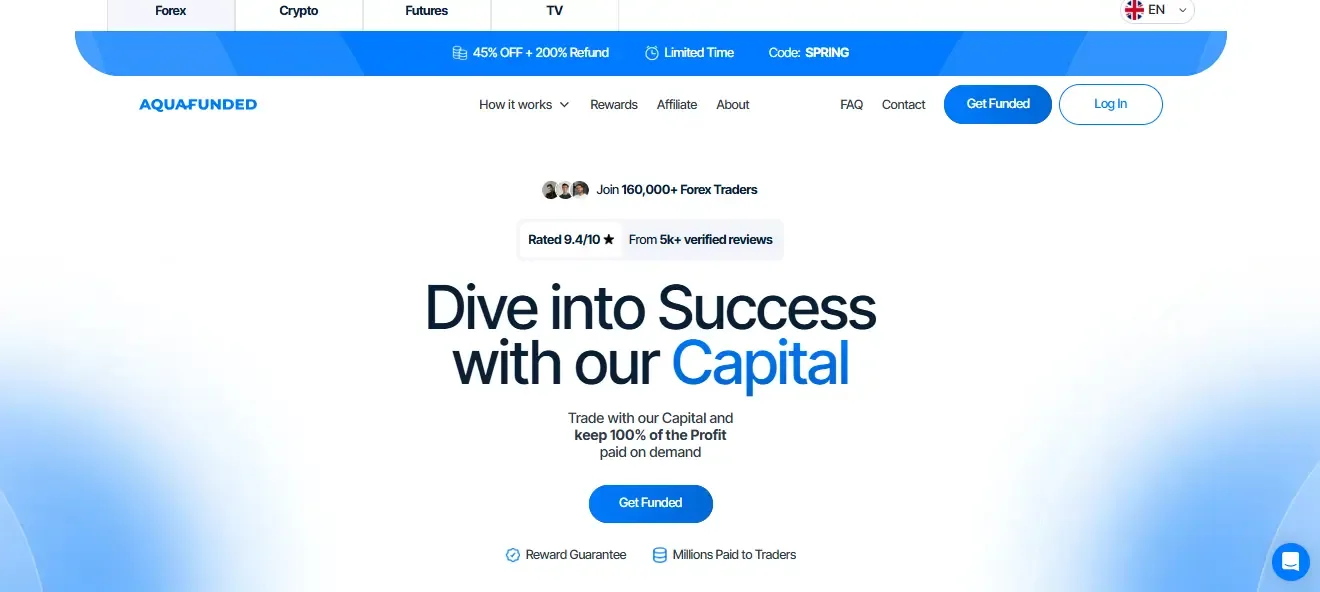
Aqua Funded pairs budget pricing with one of the most generous profit splits in the industry. Challenge fees start from $15 for entry-level accounts, and the funded profit split is 100%. At this price point, no other firm on this list matches that.
The evaluation is a 2-Step challenge. Step 1 requires a 10% profit target, and Step 2 requires 5%. The daily loss limit is 5% across both phases and the funded stage, with a 10% max loss throughout. Leverage goes up to 1:100 across all stages. There is no time limit on either phase.
Once funded, payouts are bi-weekly. Account sizes range from $2,500 to $400K with scaling potential up to $2M. Platforms include MT5, cTrader, Match Trader, and TradeLocker. Overnight and weekend holding is allowed.
5. Goat Funded Trader (Cheapest Budget Challenge with Huge Market Access)

Goat Funded Trader consistently offers some of the lowest challenge fees in the industry, with 2-Step evaluations starting around $22 for a $5K account. For traders who want to keep per-attempt costs as low as possible, this is one of the most affordable ways in.
The 2-Step evaluation has an 8% profit target in Phase 1 and 6% in Phase 2. The daily loss limit is 4% with a 10% max loss. Leverage goes up to 1:100. There is no time limit, and the minimum trading days requirement is just 3. The fee is refunded when you pass.
The profit split starts at 80% and can reach 100% through an add-on. Payouts are bi-weekly. What sets Goat apart from every other firm on this list is the instrument selection: 1,300+ forex pairs, 14,000+ stocks, 21,000+ ETFs, and 1,500+ crypto pairs. Swap-free accounts are also available. Platforms include MT5, cTrader, DXtrade, and Match Trader.
News trading is allowed, though profits within 2 minutes of high-impact events may be clawed back. Hedging, grid, and martingale strategies are prohibited.
6. FundedNext (Best Profit Split on a Budget)
FundedNext is one of the few cheap prop firms where you can earn money during the evaluation itself. They pay out 15% of whatever profit you make during the challenge phase, which no other firm on this list does.
Their cheapest way in is the Stellar Lite challenge at around $32 for a $6K account. One thing to note is that FundedNext does not offer a $5K account for CFDs, so $6K is the minimum. If you specifically need a $5K starting point, other firms on this list are better suited.
The profit split once funded goes up to 95%, which is the highest on this list outside of firms offering 100%. All challenges use static drawdown, meaning your loss floor stays fixed no matter how much profit you build. There are no time limits on any phase.
Payouts average around 5 hours after you request them, backed by a 24-hour guarantee. If they miss that window, they pay you an extra $1,000. The firm runs its own brokerage, FNmarkets, and supports MT4, MT5, cTrader, and Match Trader.
The trade-off is tight risk limits. The daily drawdown is 3% and the overall max is 6%, which leaves less room for error than most other budget options here. News trading is allowed, but only 40% of profits from news trades are credited on funded accounts.
7. FXIFY (Best for On-Demand Payouts from Day One)
FXIFY lets you request your first payout on the very first day of your funded account. No minimum trading days, no waiting period, no minimum amount. You close a profitable trade, you can withdraw. That alone makes it worth considering if cash flow matters to you.
The Two Phase evaluation starts at $39 for a $5K account. There is also a Lightning challenge (single step) from $59 and an instant funding option for traders who want to skip evaluations entirely, though that costs more.
The default profit split is 80%, but you can push it to 90% with an add-on at checkout. That is the catch with FXIFY. The base price is competitive, but the best features like higher splits, bi-weekly payouts, and performance protection are all paid add-ons. So always price out the full package before comparing.
The firm is backed by FXPIG, a broker with over 20 years of regulatory history, which gives it more operational credibility than most budget prop firms. Platforms include MT5, DXTrade, and TradingView.
8. The 5%ers (Best for Long-Term Scaling on a Budget)

The 5%ers has been around since 2016, making it one of the oldest prop firms in the industry. Their Bootcamp program starts at just $39 for a $5K account with a 3-step evaluation, which puts it right in the budget tier.
What sets The 5%ers apart is scaling. Funded traders can grow their accounts up to $4 million through performance milestones, and the profit split scales from 50% all the way to 100% as you progress. Consistently profitable traders may even get offered a monthly salary on top of the profit share, which is something almost no other prop firm does.
The Bootcamp has a 6% profit target split across three phases with a 5% max drawdown. There are no time limits, and you can hold positions overnight and over weekends. Leverage is capped at 1:30, which is lower than most firms here, but that is standard for a firm focused on disciplined, long-term swing trading.
The firm trades real capital on funded accounts rather than simulated funds, which is rare in the prop firm space. Platforms include MT5 and cTrader.
9. Maven Trading (Lowest Traditional Challenge Fee)

Maven Trading offers the absolute lowest traditional prop firm challenge fees in the industry. A 3-Step challenge for a $5K account costs around $17. For a $2K account, you can get started for as little as $13. These are standard prices, not limited-time promos.
The 2-Step and 3-Step models use static drawdown, so your loss floor stays fixed. No time limits on any phase. The 3-Step splits the profit target into three smaller phases of 3% each, which makes each individual hurdle easier to clear even though the total target adds up.
The profit split starts at 80% and can reach up to 100% through their scaling plan. Payouts happen every 10 business days on standard accounts. The firm also offers a Mini model that pays out within 24 hours, though it works as a one-shot instant account rather than a traditional funded setup.
The main limitation is a $10,000 withdrawal cap per two payout cycles on standard accounts, which can slow things down if you are generating large profits quickly. Platforms include MT5 and Match Trader.
Rules Comparison Table: What You Get Behind the Fee
| Rule | Atlas Funded (Access) | Blue Guardian (Instant Starter) | Aqua Funded (2-Step) | Goat Funded Trader (2-Step) | FundedNext (Stellar Lite) | FXIFY (Two Phase) | The 5%ers (Bootcamp) | Maven Trading (3-Step) | Funded Trading Plus (Express) |
|---|---|---|---|---|---|---|---|---|---|
| Evaluation Steps | 1-Step | None (Instant) | 2-Step | 2-Step | 2-Step | 2-Step | 3-Step | 3-Step | 2-Step |
| Profit Target | 4% | N/A | 10% + 5% | 8% + 6% | 10% + 5% | 8% + 5% | 6% (across 3 phases) | 3% + 3% + 3% | 7% + 7% |
| Daily Loss Limit | 5% (trailing) | 3% | 5% | 4% | 3% | 4% | 3% | 2% | 4% (balance-based) |
| Max Loss | 7% (trailing) | 5% | 10% | 10% | 6% (static) | 8% (static) | 6% | 3% (static) | 8% (static, balance-based) |
| Time Limit | None | Indefinite | None | None | None | None | None | None | None |
| Profit Split (default) | 100% (funded) | 90% | 100% | 80% | 90% | 80% | 50–80% | 80% | 80% |
| Profit Split (max) | 100% | 90% | 100% | 100% (add-on) | 95% | 90% (add-on) | 100% | 100% | 80% |
| Payout Frequency | On Demand | Instant | Bi-weekly | Bi-weekly | Every 5 days | On-demand (day 1) | Bi-weekly | Every 10 business days | Every 10 days |
| Fee Refund | 4th payout | 4th payout | 4th payout | On passing | 1st payout | Varies by model | Varies by program | 3rd withdrawal | 20% discount reset |
| Consistency Rule | 30% (funded) | None | None | None | Yes (funded) | None | None | None | 35% (challenge) / 50% (funded) |
How to Pick the Right Cheap Prop Firm for Your Situation
The cheapest prop firm for you depends on more than the number on the checkout page. It depends on where you are as a trader, what kind of account you need, and which rules you can realistically trade under.
If you have never traded a prop firm challenge before, start with the lowest possible risk. Atlas Funded's Access model charges $1 to $5 to begin, and you only pay the full fee after passing. That means your first experience with prop firm rules costs almost nothing if it does not work out.
The trailing drawdown on funded accounts tightens to 6% overall and 3% daily, so make sure you are comfortable managing a moving floor before committing.
If you already know your strategy works and just want funded capital without sitting through an evaluation, Blue Guardian's $10 instant starter removes the challenge entirely. It's the same model as other instant funding prop firms provide. You get a $5K account, a 90% split, and instant payouts. It is the fastest path from payment to trading.
For traders who want to manage a larger account, the fee per dollar of funded capital matters more than the absolute price. Funded Trading Plus keeps costs competitive at the $50K to $200K range, which is where most serious traders want to operate. The trade-off is a lower base profit split and additional rules like their consistency score, so make sure those work with your strategy before buying.
If profit split is your priority and you do not want to pay extra for it, Aqua Funded gives you 100% by default across all funded accounts. At entry prices starting from $15, that is hard to match anywhere else.
And if you trade more than just forex, Goat Funded Trader opens up 14,000+ stocks, 21,000+ ETFs, and 1,500+ crypto pairs from one account. For traders who want market variety on a budget, no other firm on this list comes close to that selection.
The bottom line is that match the firm to what you actually need. A cheap fee only saves you money if you can pass the challenge, stay funded, and get paid.
Quick Decision Guide
| Your Priority | Best Pick | Why |
|---|---|---|
| Zero upfront risk | Atlas Funded (Access) | $1–$5 to start. Full fee only charged after you pass. |
| Skip evaluation, trade today | Blue Guardian (Instant Starter) | $10 for a live $5K funded account with no challenge. |
| Lowest traditional challenge fee | Maven Trading | $13 for a $2K account, $17 for $5K. No promos, just standard pricing. |
| Cheapest large account ($50K+) | Funded Trading Plus (Express) | Lowest per-dollar fees at higher account sizes. |
| Highest default profit split | Aqua Funded | 100% profit split from day one, starting at $15. |
| Best profit split under $50 | FundedNext (Stellar Lite) | Up to 95% split for ~$32 entry. Earns during evaluation too. |
| Widest instrument access on a budget | Goat Funded Trader | 14,000+ stocks, 1,500+ crypto, from ~$22. |
| Fastest payouts at low cost | Blue Guardian (Instant Starter) | Instant payouts with 90% split on a $10 account. |
| On-demand payouts from day one | FXIFY (Two Phase) | No minimum trading days. Withdraw as soon as first profitable trade. |
| Long-term career scaling | The 5%ers (Bootcamp) | Scale to $4M, profit split up to 100%, potential monthly salary. |
| First time trying a prop firm | Atlas Funded (Access) | Near-zero cost to learn how challenges work. |
| Running multiple cheap accounts | Goat Funded or Maven Trading | Low per-account cost makes multi-account strategies viable. |
Verdict: Atlas Funded is hard to beat. You risk $1 to $5 to take the challenge. No other firm on this list lets you test the waters for a dollar and only pay when you have already proven you can trade.
FAQs
Atlas Funded's Access model starts at $1 to $5, with no full fee charged until you pass the evaluation, making it the lowest-cost challenge option. For traditional one-time challenge fees, Goat Funded Trader and Aqua Funded offer some of the lowest entries, starting around $25 to $42. Blue Guardian's $10 instant starter is the cheapest option that skips the evaluation entirely.
Not necessarily. The fee and the difficulty are separate things. A $25 challenge with a 4% daily loss limit and 10% max drawdown can be easier to pass than a $300 challenge with 3% daily loss and 6% trailing drawdown.
Always compare the drawdown type, profit target, and consistency rules before assuming a higher price means better conditions.
The firms on this list have documented payout histories and active trader communities. That said, reputation can shift over time. Always check recent Trustpilot reviews, Discord feedback, and community forums before purchasing any challenge, regardless of price.
Conclusion
The cheapest prop firm challenge is only worth it if the rules behind it give you a fair shot at passing and staying funded. A low fee means nothing if tight drawdowns and strict consistency rules burn through your account before you reach a payout.
- Atlas Funded removes the fee risk entirely with its Pay After You Pass model.
- Blue Guardian gets you live funded access for $10 with no evaluation.
- Funded Trading Plus keeps fees competitive at larger account sizes.
- Aqua Funded delivers a 100% profit split at budget pricing.
- Goat Funded Trader offers the lowest traditional fees with the widest market access.
- FundedNext gives you the highest profit split in the budget tier and pays you during the evaluation.
- FXIFY lets you withdraw profits from your very first funded trading day.
- The 5%ers offers the longest scaling runway of any cheap prop firm, up to $4 million.
- Maven Trading has the lowest standard challenge fees in the industry, starting at $13.
Pick the firm that matches how you trade, not just the one with the smallest checkout total.
Ready to take the next step? Explore AtlasFunded's prop trading programs today and put your trading skills to work with the capital to match.

 Senior Writer at Atlas Funded



 Your move
 Only pay the full fee after you pass
 UK
UK ES
ES DE
DE FR
FR IN
IN IT
IT