


An LULD halt is a trading pause in an individual stock that lasts at least five minutes. It most often occurs when the national best bid or offer reaches the stock's price band and remains in a Limit State for 15 seconds. Traders often encounter these halts when dealing with small-cap stocks, low-float companies, and heavily shorted securities. Understanding how the price bands work, what triggers a pause, and how trading resumes can help you avoid unexpected order executions.
What Is an LULD Halt?
An LULD halt, officially a trading pause or volatility trading pause, is a temporary suspension in trading in an individual stock, usually after it remains in a Limit State for 15 seconds. The Limit Up-Limit Down Plan is designed to prevent trades from taking place outside specified price bands.
If the stock's best bid or offer reaches the edge of the band and the market can't trade back inside within 15 seconds, the primary listing exchange (Nasdaq or NYSE, for example) pauses the stock for five minutes.
The system operates automatically under rules established by U.S. securities exchanges and FINRA. A company does not have to request a halt, and its management has no control over when one occurs.
Why the LULD Rule Exists
The rule followed the May 6, 2010 flash crash when U.S. stock markets experienced an exceptionally sharp decline and recovery within minutes. The Dow fell about 1,000 points within minutes before recovering most of its losses.
The joint SEC and CFTC report found that more than 20,000 trades across over 300 securities were executed at prices more than 60% away from where they'd been moments earlier, and exchanges later cancelled them.
Regulators responded by developing safeguards against similar disruptions. The SEC approved the LULD Plan on May 31, 2012. It was phased in during 2013 and became permanent in April 2019.
How LULD Price Bands Work
LULD price bands establish the highest and lowest prices at which a stock can trade. The Securities Information Processors (SIPs) calculate these limits using a reference price and a percentage determined by the stock's classification.
The Reference Price
The reference price is the average price of eligible trades over the previous 5 minutes. The SIPs calculate it every 30 seconds and update it only when the new figure is at least 1% different from the current one.
The first reference price of the day is the opening price on the primary exchange. If the stock opens with a quote instead of an opening transaction, its previous closing price or last sale may be used.
Tier 1 vs Tier 2 Stocks
The LULD Plan divides covered securities into two categories.
- Tier 1 covers S&P 500 and Russell 1000 stocks plus selected exchange-traded products (ETPs).
- Tier 2 covers everything else, including leveraged ETPs.
The main difference between the tiers is the percentage used to calculate price bands.
| Previous close | Tier 1 band | Tier 2 band |
|---|---|---|
| Above $3.00 | 5% | 10% |
| $0.75 to $3.00 | 20% | 20% |
| Below $0.75 | Lesser of $0.15 or 75% | Lesser of $0.15 or 75% |
The previous closing price determines the applicable percentage, but the current reference price determines the actual dollar value of the bands.
Wider Bands at the Close
During the last 25 minutes of trading (3:35 to 4:00 p.m. ET), the percentages double for all Tier 1 stocks and for Tier 2 stocks priced at $3 or less. That means 10% for Tier 1 stocks above $3, 40% for stocks between $0.75 and $3, and the lesser of $0.30 or 150% for stocks below $0.75. Tier 2 stocks above $3 stay at 10%.
This gives eligible stocks more room to absorb price movements as traders adjust their positions before the closing bell.
Bands used to double during the first 15 minutes of trading as well, but that ended in February 2020. Older guides that mention wider opening bands are out of date.
What Triggers an LULD Halt
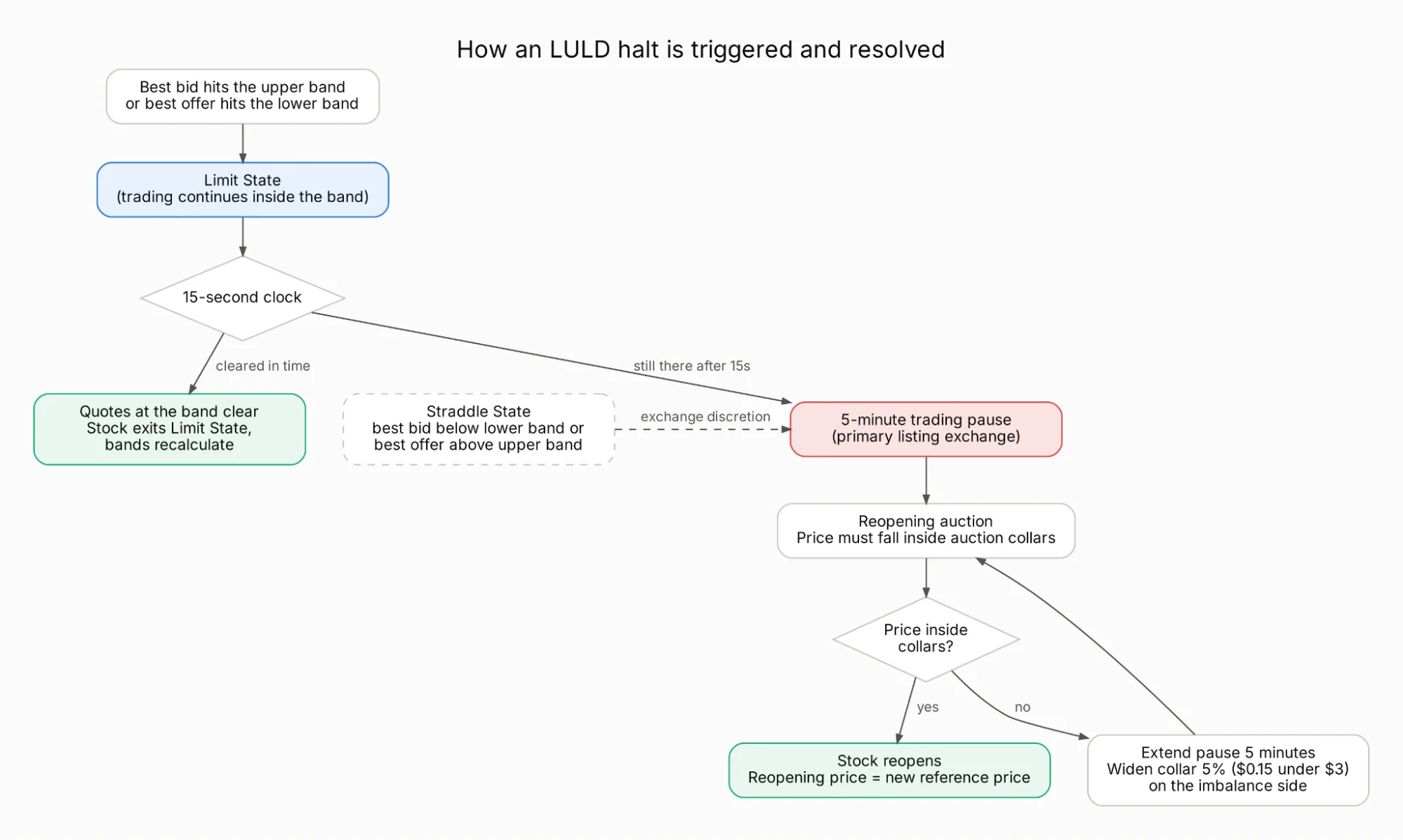
A stock does not automatically halt as soon as it touches its upper or lower price band. It must first enter a condition called a Limit State.
A stock enters a limit state when the national best offer (NBO) reaches the lower band or the national best bid (NBB) rises to the upper band. Trading continues inside the band, but the stock can't trade through it.
Then there’s the 15-second rule. Once the limit state begins, a 15-second clock starts. If the quotations at the band get executed or cancelled in that window, the stock exits the limit state, and the bands are recalculated. If the quote is still there when the 15 seconds end, the primary listing exchange declares a trading pause.
There is also a second, less common path. A stock enters a Straddle State when the national best bid falls below the lower band or the national best offer rises above the upper band, without the stock being in a Limit State. The primary listing exchange can declare a trading pause during a Straddle State if trading has broken from normal patterns. Straddle States happen mostly around the open, when liquidity is thin.
What Happens During and After the Pause
Once an LULD pause begins, trading in the affected stock stops across participating U.S. trading venues. No stock trades can execute until the exchange reopens the market.
How existing orders are handled
Orders submitted before a halt don’t necessarily disappear. Some exchanges retain eligible resting orders on their books, while others apply different procedures depending on the order type and its instructions.
Market orders cannot execute during the pause. If one remains active for the reopening, it may fill at a price far from the last traded price. Stop orders also cannot execute while trading is suspended. If a stop-market order is triggered, it may become a market order that executes at a different price when trading resumes.
What happens to stock options?
Options on the stock pause too. Options exchanges generally stop trading in these contracts while the underlying stock is halted because its market price is an important input in valuing options.
The reopening auction
After the initial five-minute pause, the primary listing exchange attempts to reopen the stock through an auction. It collects eligible buy and sell orders to find the price at which the largest number of shares can trade. That price must fall within auction collars. If the stock paused at its upper band, the upper collar starts 5% above that band and the lower band stays as the lower collar. A pause at the lower band works the same way in reverse. For bands under $3, the collar moves $0.15 instead of 5%.
If the auction price would land outside the collars, often because of a large order imbalance, the exchange extends the pause by five minutes and widens the collar by another 5% (or $0.15) on the side of the imbalance. This repeats until the stock reopens.
If a stock is still in a Trading Pause during the last 10 minutes of the session, the exchange generally does not reopen it. Instead, it attempts to complete the day's trading through its closing procedures.
Gaps, Wide Spreads, and Repeat Halts
When trading resumes, the stock’s reopening price can be considerably higher or lower than its pre-halt price. Bid-ask spreads can also widen within the first few moments as traders adjust their orders. Another LULD pause is possible if the stock reaches a price band and meets the triggering conditions again.
LULD Halt Example
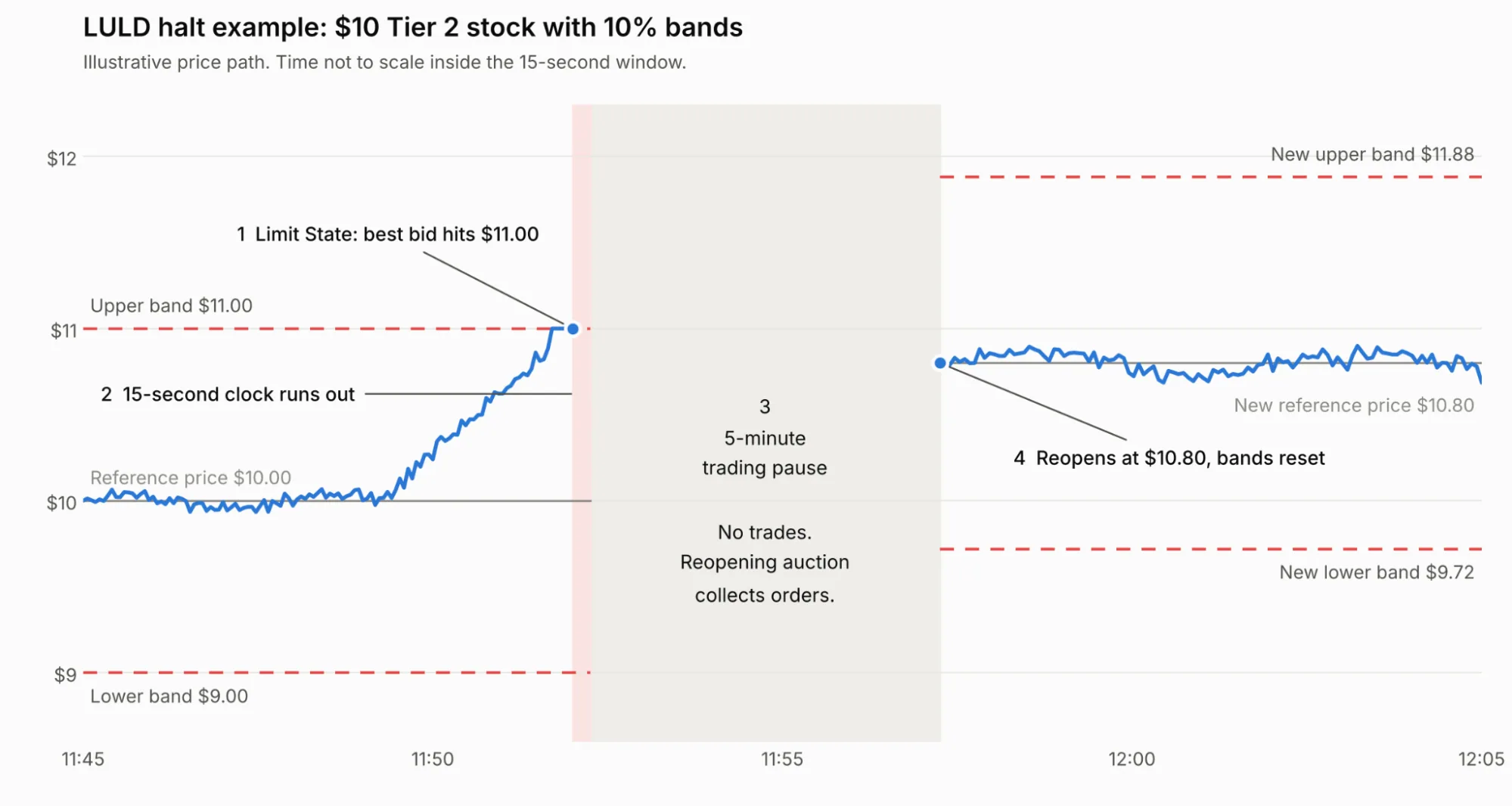
Say a small-cap stock closed yesterday at $10. That makes it a Tier 2 stock above $3, with a 10% band. At 11:50 a.m., it's trading around $10.00, and the five-minute average, which is the reference price, is also $10.00.
| Calculation | Price |
|---|---|
| Reference price | $10.00 |
| Upper band (+10%) | $11.00 |
| Lower band (-10%) | $9.00 |
Suppose positive news attracts buyers and pushes the stock towards $11.
- Limit Up: A bid at $11.00 becomes the national best bid, which equals the upper band, so the stock enters a limit state.
- 15-second period: The market has 15 seconds to clear the limit-state quotations through executions or cancellations.
- Trading pause: Let’s say some of those shares are still unexecuted after 15 seconds. The stock stays in the Limit State, so the primary listing exchange declares a five-minute pause.
- Reopening auction: The exchange runs its reopening auction. The upper collar starts at $11.55 (5% above the $11.00 band), and the $9.00 lower band serves as the lower collar.
- Trading resumes: Suppose the stock reopens at $10.80. The reopening price becomes the new reference price, so the bands reset to $9.72 to $11.88.
LULD Halts vs Other Trading Halts
An LULD pause is only one of several kinds of market halts. Exchanges and regulators can also suspend trading while a company prepares an announcement, investigates a compliance issue or addresses a broader market disruption.
| Halt type | Trigger | Who initiates it? | Typical duration | Scope |
|---|---|---|---|---|
| LULD | Stock remains in a Limit State for 15 seconds, or exchange discretion during a Straddle State. | Automatically, based on SIP price bands | 5 minutes initially, with possible extensions in 5-minute steps if the stock can't reopen | Individual stock |
| T1 News Pending | Material company news about to be released. | Listing exchange | Open-ended; the exchange announces a resumption time. | Individual stock |
| Regulatory halts (T12, H10, H11) | Requests for additional information from the listing market, SEC trading suspensions, or other regulatory or compliance concerns. | Exchange or regulator | Can last days or longer, depending on the issue | Individual security or affected securities |
| Market-wide circuit breaker | S&P 500 falls 7% (Level 1), 13% (Level 2), or 20% (Level 3) from the prior close. | Exchanges, automatically, based on the index level | 15 minutes for Levels 1 and 2 when triggered before 3:25 p.m. ET. Level 3 ends trading for the day. | Broad U.S. equity market |
How to Trade Around LULD Halts
LULD halts are a common concern for traders dealing with volatile stocks. Here are some ways you can trade around them.
Know which stocks halt most: Large Tier 1 names rarely pause. According to the LULD Plan’s 2025 annual report, about 65% of all trading pauses that year came from Tier 2 stocks (excluding ETPs) priced at $3 or more, even though that group made up only 41% of covered symbols. Low-float stocks, securities with high short interest, small caps, and meme stocks can experience sharp price movements that bring them close to their price bands.
Use limit orders: A limit order lets you specify the maximum price you will pay or minimum price you will accept at the reopen. Market and stop orders can fill at unexpected prices when trading resumes.
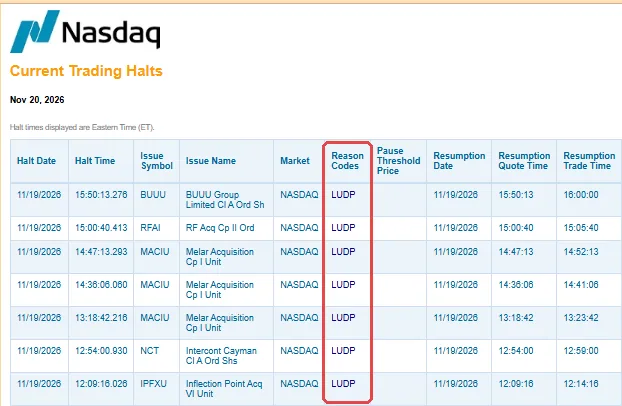
Set up alerts and halt feeds: Nasdaq Trader's halt page lists current halts, and many platforms push them to you. Learn the codes: LUDP is a volatility trading pause in a Nasdaq-listed stock, and M marks a volatility pause in a stock listed on NYSE or another exchange. LUDS marks a pause triggered by a straddle condition.
Watch the auction imbalance before the reopen: During the pause, the primary exchange publishes imbalance data. Indicative prices and buy-sell imbalances can show whether buying or selling pressure is building. A heavy buy imbalance may point to upward pressure on the indicative reopening price. But these figures can change as traders add, modify, or cancel orders before the auction, so use this only as a guide.
LULD Halt FAQs
How Long Does an LULD Halt Last?
An LULD pause lasts 5 minutes at a minimum. If the primary exchange can't reopen the stock in an orderly way, it extends the pause in five-minute steps, so some halts run 10 minutes or longer.
Can a Stock Halt More Than Once a Day?
Yes. A stock can experience multiple LULD halts during one trading session. Each reopening resets the bands around a new reference price. The stock can halt again if it subsequently enters another Limit State that meets the conditions for a pause.
Will My Stop-Loss Trigger During a Halt?
Not necessarily. A stop order needs a qualifying price movement to trigger. If triggered, a stop-market order cannot execute until trading resumes. If the reopening price is at or beyond your stop price, the stop triggers and a stop-market order fills at whatever is available.
Does LULD Apply Outside Regular Hours?
No. The LULD Plan applies during regular U.S. trading hours, from 9:30 a.m. to 4:00 p.m. ET. It does not cover conventional premarket or after-hours trading.
Do Futures Markets Have Limit Up-Limit Down?
Futures markets have separate price limits and volatility controls. CME Group uses price limits on certain futures contracts to restrict how far prices can move during a session. The London Metal Exchange (LME) also uses price limits and volatility controls.
Ready to take the next step? Explore AtlasFunded's prop trading programs today and put your trading skills to work with the capital to match.
Explore funding programs
 Senior Writer at Atlas Funded



 Your move
 Only pay the full fee after you pass

 UK
 ES
 DE
 FR
 IN
 IT